The Model Y is the Tesla on the Eastside loop: I-405, SR 520, then a wet climb into Issaquah or Newcastle. When that Y stops, Tesla roadside and a local mobile charger are different tools. Pick based on whether the pack is empty, the 12-volt system is dead, or you are sitting in a lane that needs 911 first.
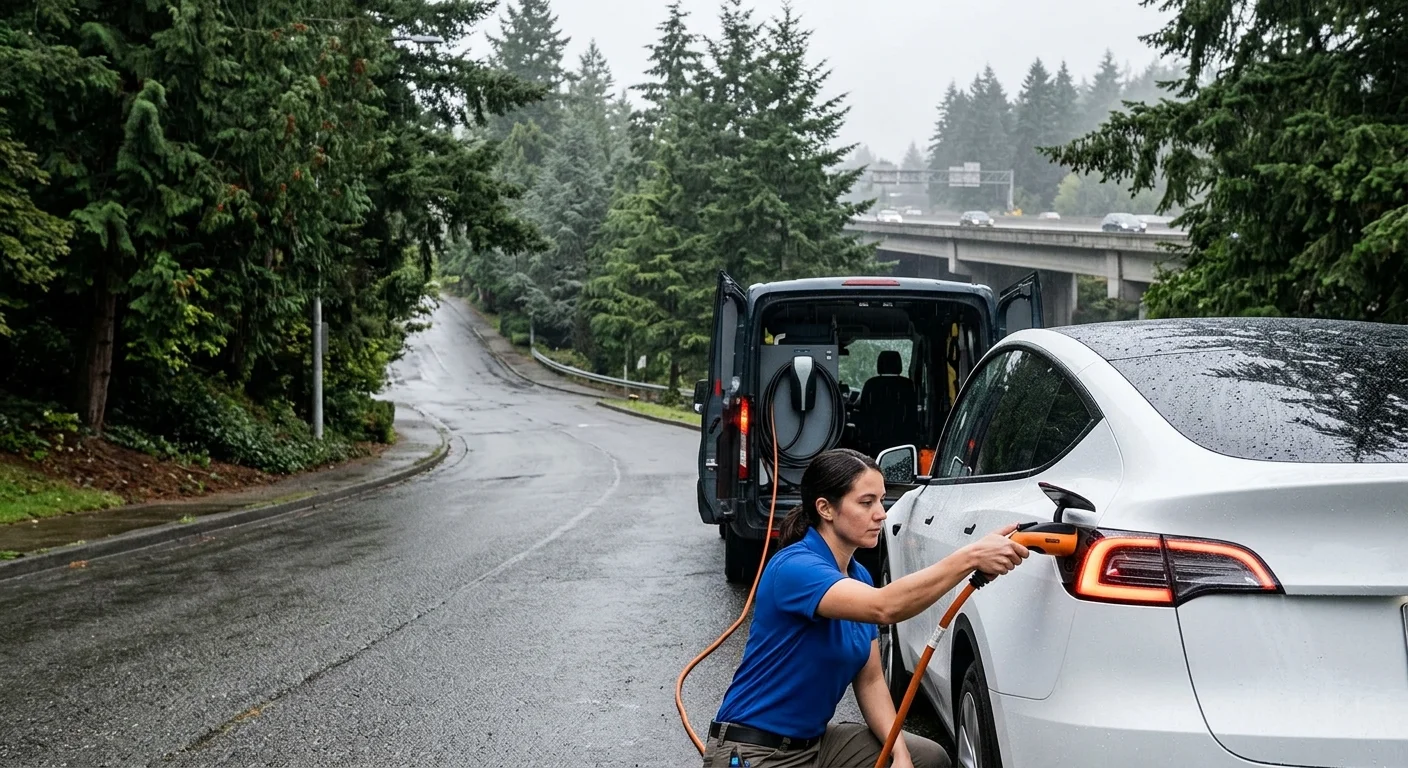
What Tesla roadside covers on a Model Y
Tesla’s Roadside Assistance for a Model Y lives in the Tesla app and on Tesla’s official support pages. Those two places are the source of record. Tesla writes the rules for your VIN. This page will not invent a term of years, a mileage cap, or a fee.
Open the Tesla app and find Roadside. Tesla’s published program has grouped lockouts, towing, and tire events. Whether a used Y still carries an included period, whether a given tow is a courtesy, and whether Tesla bills a long haul, depends on that VIN. Confirm it in the app before a contractor hooks the car.
The broader program shape is in what Tesla roadside assistance covers. Use that article for orientation. Use Tesla for the live terms on this car, this week.
Tesla advertises an included roadside program for many new cars. A used Model Y, a car past Tesla’s stated term, or a tow Tesla treats as extra, can be billed. Tesla does not publish a simple public price list we can reprint. The cost of Tesla roadside assist on your event is a Tesla quote.
Tesla’s contractors are set up for Tesla Service and Tesla’s tow vendors. A tow toward a Supercharger or a Service Center may be what Tesla offers. Energy at a Newcastle driveway, a Bellevue garage, or a Kirkland cul-de-sac is a different product. That is the local mobile-rescue job.
If you are in a live lane on I-405, SR 520, or I-5, safety comes first. Dial 911. WSDOT’s Incident Response Team responds to incidents on state highways, from flat tires and running out of gas to major collisions. Teams are on call 24/7 and patrol major corridors during peak hours, covering roughly 1,300 centerline miles. WSDOT’s published materials do not mention electric vehicles, out-of-charge stops, or on-site EV charging. IRT clears the lane.
Flat tires on a Model Y
Tesla’s tire help depends on how the car is equipped. Many Model Y cars ship with a tire-repair kit rather than a spare. Tesla’s current Model Y documents were not available to lock a run-flat claim or an on-site change rule for this page. If the tire is flat, stay out of traffic. If you are in a live lane, 911 first. Then open Tesla Roadside and take the option Tesla shows for your VIN.
Empty pack vs a dead 12V on the Y
Two failures look the same from the sidewalk and need different calls.
An empty traction pack is a range problem. The screens still wake. The Tesla app still talks to the car. You cannot drive far enough to reach a charger. Rain, cabin heat, and a climb off I-90 into Issaquah burn range faster than the estimate at the bottom of the hill.
A dead 12-volt system is a wake problem. The car may not unlock. The app may not connect. The charge port may not open. That is a low-voltage failure. Feeding the main pack will not fix it.
Tesla’s current Model Y owner’s documents were not available to lock a 12-volt chemistry claim for this page. The jump procedure on some Tesla 12-volt packs is not a gas-car jump on the strut tower. Do not improvise at the frunk. Read Tesla Model 3 and Y lithium 12V if the car will not wake. For a matched local operator on that job, see Tesla 12V battery jump.
Who to call if a Tesla battery dies depends on which battery failed. Empty pack, car still awake, safe pin: Tesla Roadside for a possible tow, or a local mobile charger who can add range at the curb. 12-volt dead: Tesla Roadside or a Tesla-capable 12-volt rescue. A random jump pack used the wrong way can make the morning worse.
If you are on a state highway in a live lane, WSDOT Incident Response is reached by dialing 911. A typical mobile rescue charge, when an operator can reach the car, is 10 to 20 miles of range in 15 to 30 minutes of Level 2 charging. That figure is charging time at the car. It is not travel time to you.
Eastside hills, 405, and 520 range traps
The Model Y is the volume Tesla in this metro. Washington DOL EV population data shows Tesla at 122,981 registered vehicles, about 41 percent of EVs statewide. King County holds 63,017 Teslas of 144,257 EVs, about 44 percent. Seattle, Bellevue, Redmond, Bothell, Kirkland, Sammamish, and Renton sit at the top of the three-county city list. Combined, King, Snohomish, and Pierce hold more than 207,000 registered EVs. That is why a Y-specific roadside page belongs here.
The commute that empties a Y is a wet, hilly loop.
I-405 through Renton, Bellevue, and Kirkland stacks traffic, then dumps you onto grades. A dead Supercharger is a different failure than an empty pack in the right lane. If the stall is the charger, read Tesla Supercharger down on I-405. If the car is the problem on that corridor, out of charge on I-405 walks the shoulder case.
SR 520 is a wind and rain corridor. Cabin heat, a slow crawl across the Evergreen Point Floating Bridge, and a climb into Redmond or Houghton take more from the pack than the same miles on a dry July evening. Recurrent Auto’s winter testing across 30-plus EV models found EVs retain on average 78 percent of range at 32F, about a 22 percent loss. AAA testing at 20F found temperature alone cut range 10-12 percent, and cabin climate control pushed the loss toward 40 percent. A Model Y on a January 405 or 520 crawl sits in that band. Cold rain on these roads is covered in Tesla daily range in Puget Sound cold and rain.
Issaquah and Newcastle are the grade traps. You leave I-90 or Coal Creek Parkway with a number that looked fine on the flats. The climb into a cul-de-sac burns it. Issaquah EV roadside and Newcastle EV roadside are the local versions of that call. Private streets and steep driveways are hard for a conventional tow and workable for a mobile charger if the operator can park legally.
RCW 46.61.560 generally prohibits stopping on the roadway outside incorporated cities and towns, with an exception for a vehicle so disabled that stopping is unavoidable. RCW 46.61.590 then requires the driver to arrange prompt removal. A Y on an Issaquah shoulder is on a legal clock. On a state highway, WSDOT Incident Response is there to clear the lane.
When a local operator is the right call
Call Tesla first when the car is under Tesla’s live roadside terms and the fix Tesla offers matches the failure: a covered tow, a lockout Tesla will handle, a tire event Tesla will dispatch.
Call a local operator when the Y needs energy at the pin. Empty pack, car still awake, somewhere a charger van can stand. Drivers hunting roadside assistance for Tesla from a Puget Sound pin are usually choosing between Tesla’s app and that local charge.
Charge Pro SEA is a referral service. We match stranded Model Y drivers with licensed, independent local operators. The operator quotes you, does the work, and bills you directly. We set no price. We publish no arrival window.
Tesla roadside rescue is the match for that job. A typical rescue charge is 10 to 20 miles of range in 15 to 30 minutes of Level 2 charging. That is charging time at the car, not a promise about when someone shows up.
A local operator is also the right call when Tesla’s contractor cannot reach the pin: a gated Eastside community, a stacked Bellevue garage, a stall at SEA-Tac when you are already dead in the wrong row. The SEA garage has 94 EV stalls with free Level 2 charging (regular parking rates still apply), 64 on Floor 7 in General Parking and 30 on Floor 4 in Reserved Parking, plus two DC fast chargers in the Cell Phone Lot. Paine Field has four EV charging stations in Premium Lot P1, first-come first-served. Those stalls help only if the Y can still drive to them.
Do not wait in a live I-405 or 520 lane for a mobile charger. If you are in traffic, 911 first. Move the car only when it is safe. Then sort Tesla versus a local charge. Tesla roadside assistance near me, from a Bellevue shoulder or a Newcastle driveway, is that choice: Tesla’s dispatch, or energy at the curb.
When to call us
If the Model Y is empty, the screens still wake, and a charger van can park at the pin, a mobile EV rescue operator can add range at the curb. If the car will not unlock or the port will not open, ask for a Tesla-capable 12-volt rescue. Call us at (206) 202-7018 and we’ll connect you with a local EV rescue operator.