The climb toward Snoqualmie Pass starts eating range as soon as you leave Issaquah. Eastbound I-90 from the Highlands or the Front Street exits begins a sustained grade that does not let up for miles, and that is exactly why getting help before the climb matters. Issaquah sits at the edge of the metro, where EV density is high and the next city over the pass is a long way from a charger.
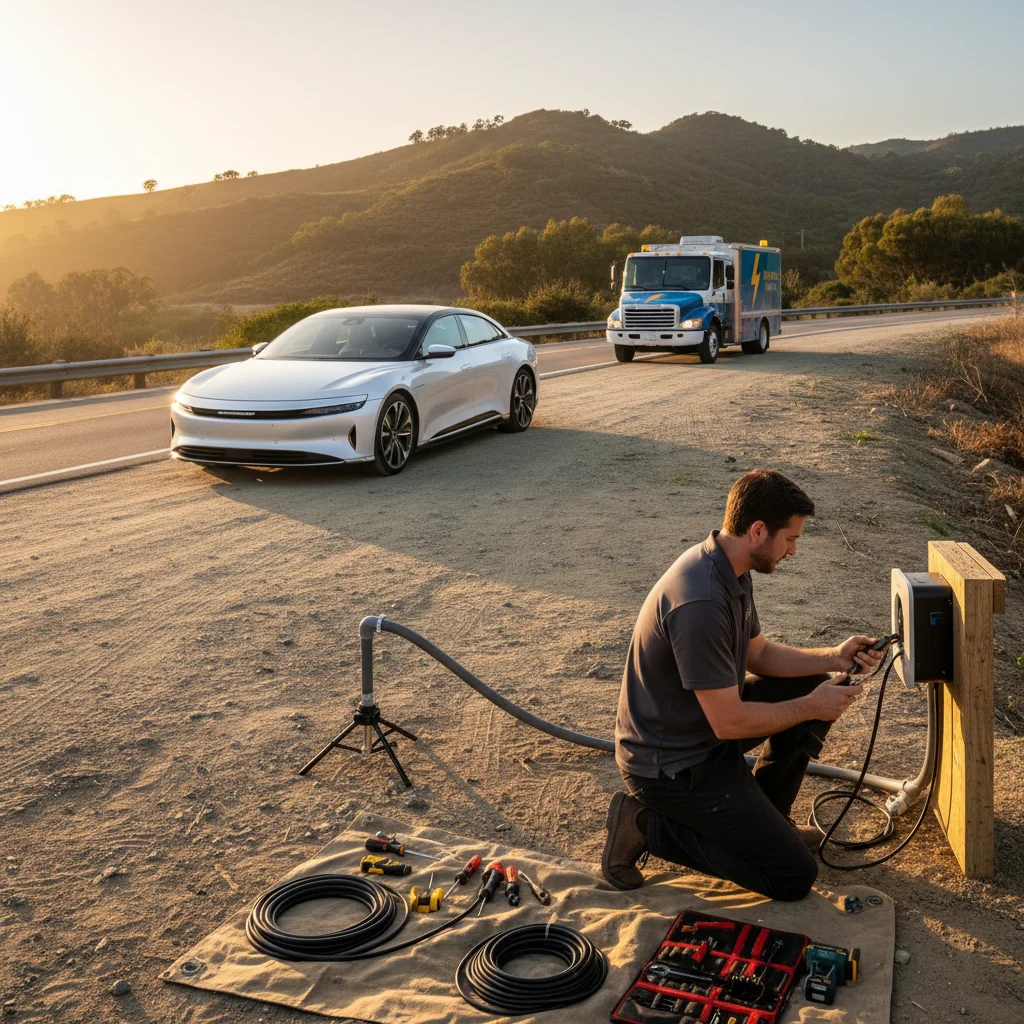
Why Issaquah EV drivers strand more than they expect
Issaquah is one of the metro’s highest-EV-density communities, with a registered EV count above 4,300. The mix of newer Highlands subdivisions with home Level 2 chargers and the older Front Street area with apartment dwellers who depend on public charging creates two very different range profiles, and both end up calling for help when plans go sideways.
The I-90 climb is the obvious reason. Eastbound from the Front Street on-ramp, the grade climbs steadily toward the pass summit. Drivers who calibrated their range on flat Bellevue commutes underestimate how much the sustained climb costs. A Tesla Model Y showing 50 miles at the Highlands interchange can arrive near North Bend with the battery warning on and the math not working.
The reverse direction matters too. Drivers returning from Eastern Washington across the pass often arrive at the summit with more apparent range than they actually have, because the car’s range prediction optimizes for terrain it has not yet crossed. The descent to Issaquah usually recovers some energy through regenerative braking, but the math depends on speed, traffic, and how long the descent takes.
Cold and rain make the climb worse. The metro’s 35 to 45F rain band pushes cabin heat and defrost load up, and the heater is the biggest single drain on the pack during cold months. AAA has measured cabin heat pushing loss to roughly 40% at 20F. Even shoulder-season cold snaps along I-90 east of Issaquah change the energy budget for the climb.
Where we get called around Issaquah
Requests for EV roadside assistance in Issaquah concentrate on a few consistent spots.
The I-90 corridor between the Front Street exits and the start of the climb produces a steady share. Drivers who realize too late that they do not have the range for the pass pull over at the first safe spot, often the shoulder just past the on-ramp. That is actually the right move. Better to stop near Issaquah than to commit to the grade with a marginal pack.
The Sammamish Plateau west of Issaquah generates its own calls. Drivers commuting between Sammamish and Issaquah or Bellevue run their pack down across the plateau’s rolling terrain and arrive at the Plateau Center or the Highlands with a low-battery warning.
The Highlands and Talus subdivisions are home to a lot of newer Teslas and Rivians, and most have home Level 2 charging. When the home charger fails, or the driver forgot to plug in, the morning commute on a dead pack becomes a roadside call.
The Front Street and old town area sees apartment dwellers who depend on public charging. The nearest public stations can be in use during evening hours, and a failed session can leave a driver short for the next morning.
What EV roadside assistance in Issaquah includes
When you call for EV roadside assistance in Issaquah, an operator rolls out in a mobile rig carrying a 240V Level 2 outlet, not a tow truck and not a jump pack from a gas-station kit. That unit typically puts 10 to 20 miles of usable range back into a passenger EV in 15 to 30 minutes, enough to clear the local range problem or to reach the nearest real station.
Our out-of-charge recovery service covers all major EV makes, Tesla, Rivian, Ford F-150 Lightning, Hyundai Ioniq 5 and 6, Kia EV6 and EV9, Chevy Bolt and Equinox EV, Polestar, and most other North American EVs. Operators carry a NACS connector plus a CCS adapter, so tell dispatch your model and we will confirm the right connector before anyone rolls out.
If your car is not waking up at all, screen dark, doors acting strange, that is almost always the 12V battery rather than the main pack. Our Tesla 12V battery jump service handles that on the spot, and if the battery will not hold a charge after a jump, the operator can quote a replacement right there instead of sending you to a shop.
Mobile charge vs tow for Issaquah drivers
This comparison comes up on nearly every first Issaquah call we take. If your only problem is a battery at zero, mobile charging beats a tow almost every time on speed, cost, and hassle. A tow from Issaquah to the nearest fast charger runs well past what a mobile charge costs, and you lose your car for an hour or longer while you arrange a ride. A mobile charge gets you moving again in the same spot, usually inside 30 minutes.
The exception is a mechanical issue beyond the battery: a flat tire, a charge port that will not release, or a fault code pointing to the drivetrain. Those need a shop, not a charge. But if the car simply ran out of range on I-90 or on the Plateau, you do not need a tow truck. You need power.
What to expect on arrival
Issaquah is close-in Eastside coverage, well inside the shorter response windows that apply out past North Bend or the pass. The operator who takes your call factors in traffic on I-90 and the local streets before quoting a window, and during evening commute hours that window can run a little longer than midday.
Census ACS figures put a meaningful share of Issaquah homes as built in the 1990s and 2000s, with newer Highlands construction extending through the 2010s. That is generally good news for home charging, since most panels in those homes have headroom for a Level 2 circuit if you decide to install one. That is separate from roadside work, but it is a question we get often enough to mention.
You can see our full local coverage details on the Issaquah EV charging guide. For neighboring Eastside communities, our Bellevue roadside guide covers the same ground with the same level of detail. You can also see how our response coverage works across the wider metro in our out-of-charge freeway guide.
When to call us
If your EV battery hit zero on the I-90 climb, in the Highlands, or in a lot off Front Street, that is the call. Same if your Tesla’s 12V died in the driveway and the car will not wake up. We do not need the full story, just your location and what the car is doing.
Call (206) 202-7018 to reach a local operator who will roll a rig to you and quote you before starting.
Frequently asked questions
How fast can EV roadside assistance reach me in Issaquah?
Issaquah sits inside our core Eastside coverage area, so response times here are shorter than for communities further out like North Bend or the pass. The operator who takes your call confirms a realistic window based on current traffic on I-90 and the Plateau before heading your way.
My Tesla will not start at Talus, is that the main battery or the 12V?
Almost always the 12V. If the touchscreen is dark or the doors are behaving strangely but the car otherwise looks fine, the small 12V battery that powers the low-voltage systems has failed, not the main traction pack. A jump gets most cars moving again in minutes, and if the battery will not hold a charge afterward, the operator can quote an on-site replacement.
Do you cover non-Tesla EVs in Issaquah?
Yes. Operators carry a native NACS connector plus a CCS adapter, which covers Rivian, Ford Lightning, Mustang Mach-E, Hyundai Ioniq and Kia EV models, Chevy Bolt and Equinox EV, Polestar, Nissan Leaf, and most other EVs sold in the US. Tell dispatch your make and model when you call.
Is mobile charging cheaper than towing in Issaquah?
For a simple out-of-charge situation, yes, almost always. A tow to the nearest fast charger typically runs well past what a mobile charge costs and takes an hour or longer once you factor in dispatch and loading. A mobile charge happens where your car already is and usually wraps up in 30 minutes or less.
What if I run out of charge on I-90 heading east toward the pass?
Call us as soon as you notice range getting tight, before you are past the point where turning back is an option. The climb past North Bend gets steeper and public charging thins out the further east you go, so a call placed early is easier and faster for an operator to handle than one placed after you have already stopped moving. Our out-of-charge I-90 guide covers the broader protocol if you want the full picture.