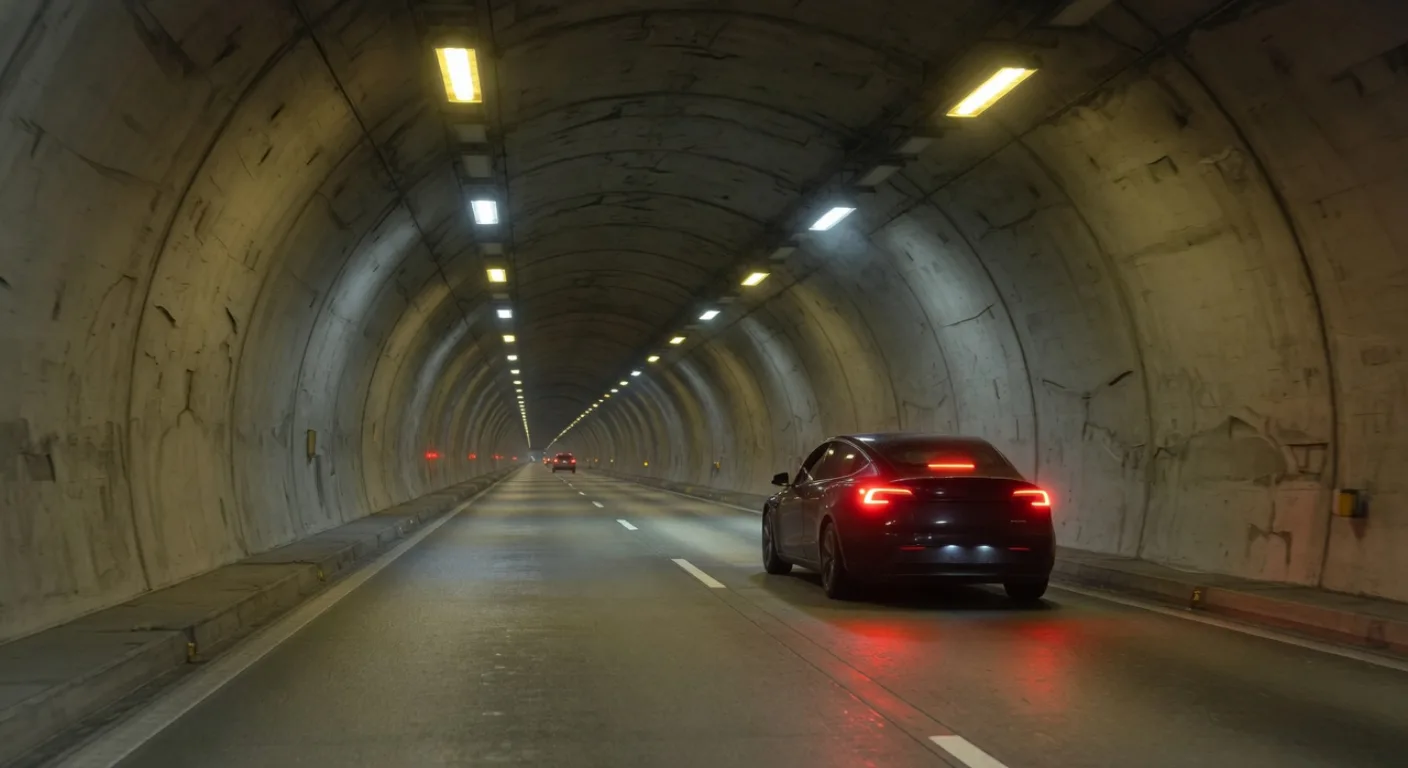
The traction pack hits zero in the SR 99 tunnel under downtown Seattle and the car stops rolling. You are in a bored state highway, not a city block with a charger around the corner. Stay in the car, hazards on, dial 911, and wait for WSP or WSDOT before you think about a mobile charge.
Why the tunnel is a different empty-pack job
SR 99 through downtown Seattle runs in a bored tunnel. Surface SR 99, the old Pacific Highway, is a different road with a different post: EV roadside assistance on SR-99. This page is the tunnel.
Seattle has 45,469 registered EVs. King County has 144,257. Those counts feed this bore every weekday. Tesla makes up about 44% of King County’s EV fleet. That still does not put a plug in the tunnel.
Shoulder and stopping-lane rules for this bore were not confirmed on WSDOT’s public pages for this article, so follow posted signs and the trooper in front of you. If you are in a live lane, stay in the car. Do not walk the tunnel looking for a charger. Do not open the charge port in moving traffic.
WSDOT’s Incident Response Team responds to incidents on state highways, from flat tires and running out of gas to major collisions. Teams are on call 24/7 and patrol major corridors during peak hours. Published IRT materials mention motorists who’ve run out of gas. They don’t mention electric vehicles, out-of-charge packs, or mobile charging. Dial 911 to reach help on the roadway.
RCW 46.61.560 lets a disabled vehicle stop when stopping is unavoidable. RCW 46.61.590 still requires the driver to arrange prompt removal. Chapter 46.55 RCW governs towing and impound.
I-5, SR-520, I-405, and I-90 have their own empty-pack posts. The SR 99 tunnel is the downtown bore. Don’t mix it with the I-90 floating bridge or the 520 crossing.
North portal, the bore, and the south portal
Say where you are in plain words. A matched operator, and WSP, need a portal and a direction, not “I’m in the tunnel.”
North of the bore
The north end feeds South Lake Union, the waterfront, and the approach to the city. If you went empty before you entered the tunnel, stay out of the bore. A surface stall or a legal curb is a charging job. The tunnel is not.
Inside the bore
If you are already inside, you are on a WSDOT facility with freeway speeds and limited places to get out of the way. Stay in the car with the hazards on. Give a direction, northbound or southbound, and any milepost or portal sign you can actually read. Don’t guess.
South of the bore
The south end feeds SoDo, the stadium district, and the run toward West Seattle and the industrial edge. If you can roll out of the tunnel under your own power, do that before you request a charge. A SoDo lot or a legal curb is where a charging van can work.
Winter range loss is real on the approaches. Recurrent Auto’s testing across 30-plus models found EVs keep about 78% of range at 32F. AAA testing at 20F found temperature alone cut range 10-12%, and cabin heat pushed the loss toward 40 percent. A downtown loop that looked fine in August can fail in the bore in January.
Charge, jump, or wait for a tow
Inside the tunnel, the first job is getting the car out of the travel path. That is almost always a WSDOT/WSP move or a tow. A mobile Level 2 van is not a tunnel-lane tool.
Once you are on a portal approach, a SoDo lot, or a legal curb, a pack charge is on the table. A 15 to 30 minute Level 2 connection adds roughly 10 to 20 miles. Local operators run 240V AC at 9.6 kW. NACS for Tesla. J1772 or a CCS adapter for many others. That is out-of-charge recovery.
A dead 12V is a no-wake. Stadium-district garages and SoDo lots produce that after a long sit. If the car is dark with range still showing in the app, that is a 12V, covered in a dead 12V in a Seattle stadium garage.
Tesla Roadside states that when the battery charge is depleted, Tesla can assist, but “this is not a financially covered service.” Do not wait in the bore for a pack charge Tesla has not promised.
Charge Pro SEA is a referral service. It matches you with a licensed, independent local operator. It performs no work and owns no trucks. The operator quotes and bills you. Ask whether they can meet you at a portal or a SoDo pin, not in a live tunnel lane.
Call (206) 202-7018 after you are out of the bore, or from a portal pin the operator can actually reach.