The Tesla is dark in a Seattle stadium garage. Doors don’t wake. The app still shows range. That is almost always the 12V, not an empty traction pack. Charge Pro SEA connects you with a licensed local operator who can jump it, load-test it, and quote a replacement at the stall.
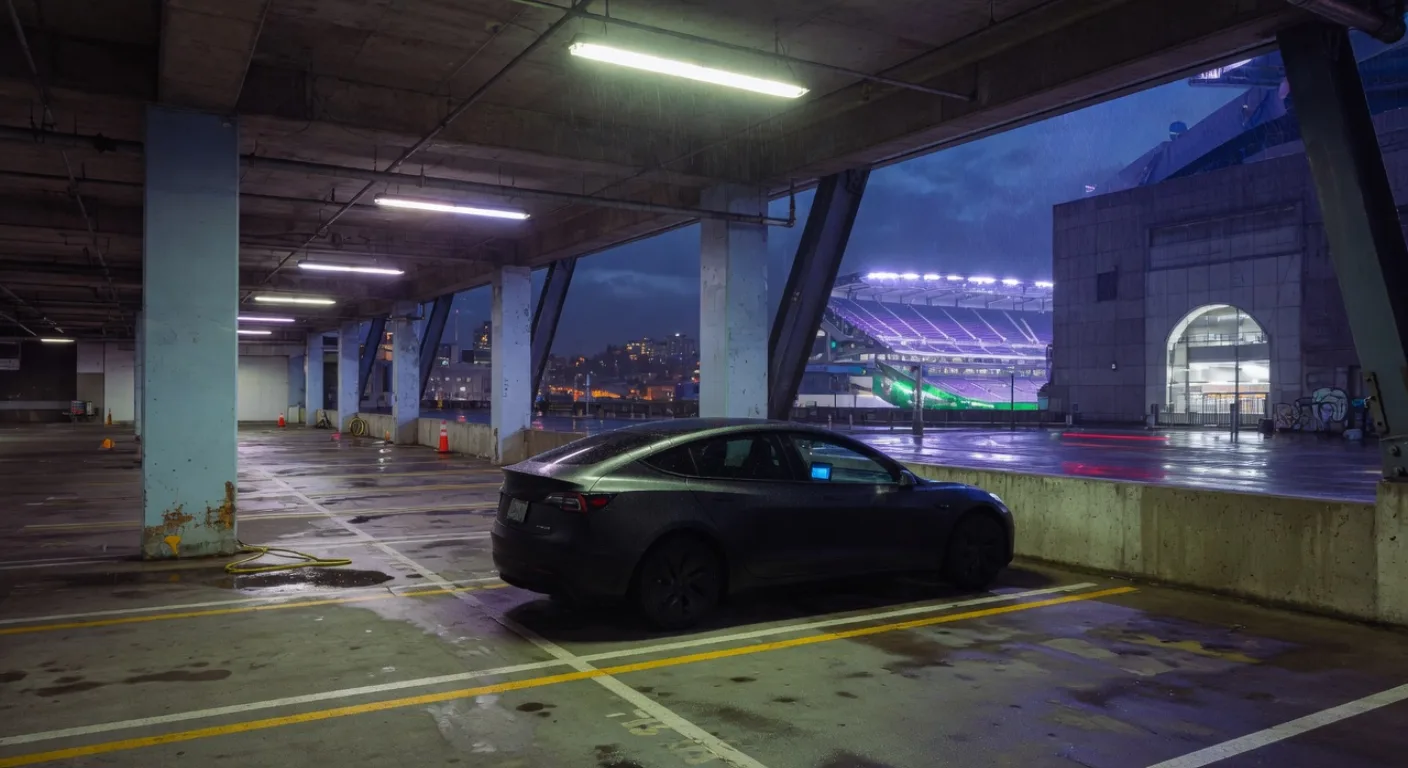
Why stadium garages kill the 12V
Seattle has 45,469 registered EVs. King County has 144,257. Tesla is 63,017 of those King County EVs, about 44 percent. Game days, concerts, and shift parking put those cars in concrete garages for hours.
The 12V wakes the car: screens, locks, contactors. When it is too low, the car looks dead even if the pack still holds miles. Sea-Tac’s long-term floors are the famous version of this sit. A stadium garage is the same physics closer to downtown: hours parked, wet cold, no trickle from a wall connector.
Tesla’s service docs split the chemistry by factory date. Vehicles built in Gigafactory Shanghai before about October 2021, and in Fremont before about December 2021, have a lead-acid low voltage battery. Vehicles built after those dates have a lithium-ion low voltage battery. Both fail the same way from the driver’s seat.
Tesla’s own manuals say a Model 3 cannot be used to jump start another vehicle. The same sentence appears for Model S, Model X, Model Y, and Cybertruck. Do not make the car in the next stall the donor.
This is not Sea-Tac. Sea-Tac’s garage has 94 EV stalls with free Level 2 charging, regular parking rates still applying, 64 stalls in Rows E/F on Floor 7 and 30 in Rows E/F on Floor 4. Stadium-district garages were not confirmed with those stall counts. Don’t hunt a green-striped stall that isn’t posted.
For 12V lifespan, see how long a Tesla 12V battery lasts. For warranty, see Tesla 12V battery warranty coverage.
Pack empty vs 12V dead in a tight stall
Two failures look the same from a garage aisle.
A dead 12V: the car is dark. The app may still show range. Handles don’t present. That is a Tesla 12V battery jump. A matched operator jumps it, load-tests it, and can replace a failed 12V on site (AGM lead-acid or lithium, per model year). The operator quotes both options and bills you.
An empty pack: the car drove until it couldn’t. Screens may still work. Range is at zero. That is a pack charge. A 15 to 30 minute Level 2 connection adds roughly 10 to 20 miles. Garage access is the constraint. Tight ramps, low clearance, and attendants who will not let a charging vehicle in are tow cases. If a van cannot reach the port, the car has to move.
SoDo, the stadium district, and First Hill garages are private property. Access rules sit with the garage operator. We could not confirm a published public rule for EV rescue inside those facilities. Follow posted site security. Ask the attendant before an operator comes onto the property.
If you went empty in the SR 99 tunnel on the way in, that is a WSDOT incident, covered in out of charge in the SR 99 tunnel. Wake-up in the garage is this page.
What to tell the operator
Give the garage name, the level, the nearest stair or elevator, and whether the car can roll. “I’m at the stadium” is a weak pin. Lumen Field, T-Mobile Park, and the surrounding SoDo lots are different jobs. Say the one you can see.
Say whether the dash is dark or the range is at zero. Say the model. Say whether an attendant is already calling a tow. Chapter 46.55 RCW governs towing and impound, including private-property impounds.
Seattle City Light serves Seattle. That does not put a charger in this stall.
Charge Pro SEA is a referral service. It matches you with licensed, independent local operators. It performs no work, owns no trucks, and holds no trade license. The operator quotes, does the work, and bills you. The brand sets no price and promises no ETA.
Call (206) 202-7018 from the stall. Stay with the car if you can do it legally.