The Tesla that will not wake is almost always the small 12V, not the pack that stores range. How long that 12V lasts is a different question from how long Tesla traction batteries last. This page stays on the low-voltage battery.
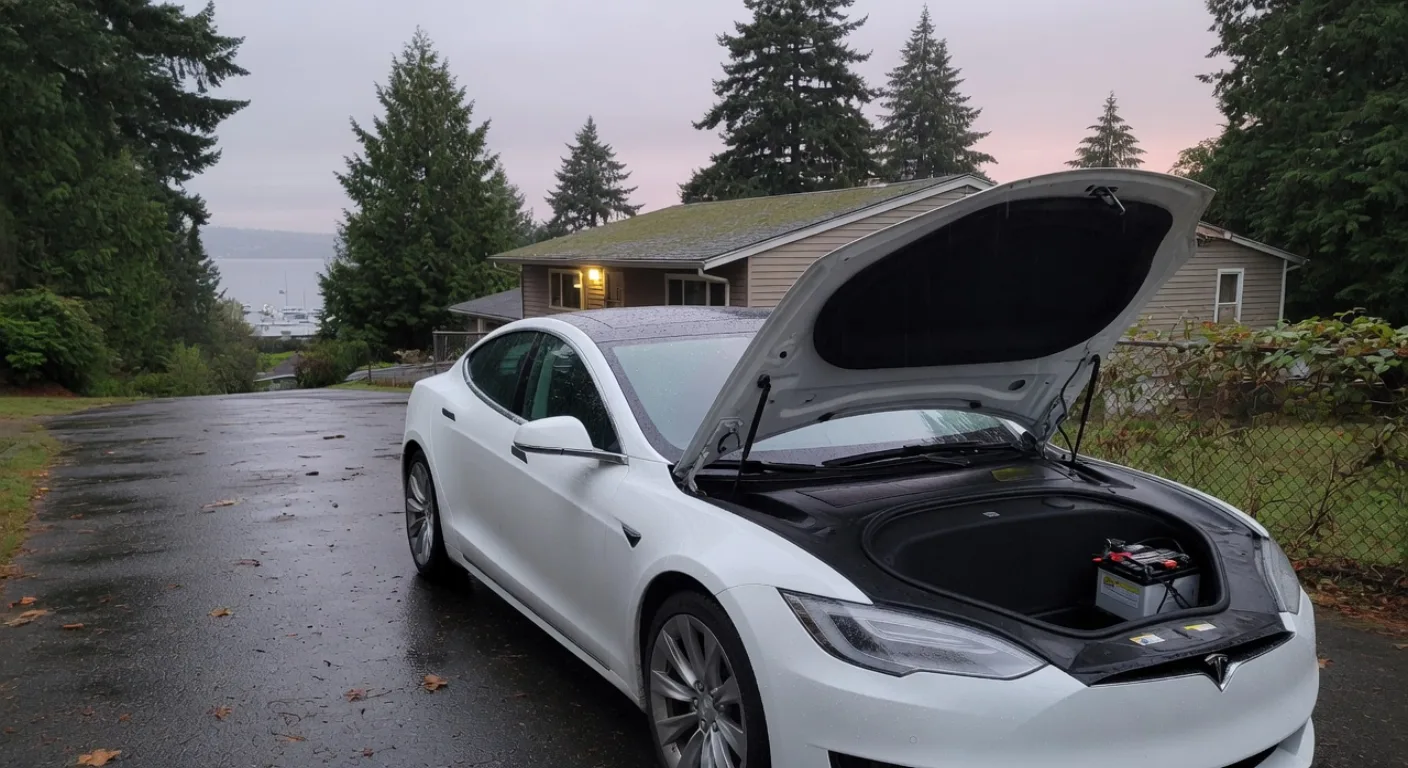
The 12V is not the pack
Every Tesla has two batteries. The traction pack under the floor stores driving range. The 12V (low-voltage) battery wakes the car: screens, locks, contactors. When the 12V is too low, the car looks dead even if the app still shows miles.
That is why Google keeps sending “how long does tesla 12v battery last” to a pack-life article. Pack health is an 8-year class of question. The 12V is the battery that dies after a wet sit in an unheated garage.
Tesla’s service docs split the chemistry by factory date. Vehicles built in Gigafactory Shanghai before about October 2021, and in Fremont before about December 2021, have a lead-acid low voltage battery. Vehicles built after those dates have a lithium-ion low voltage battery. Both still fail the same way from the driver’s seat: dark screen, dead handles, no Drive.
Tesla’s own manuals also say a Model 3 cannot be used to jump start another vehicle. The same sentence appears for Model S, Model X, Model Y, and Cybertruck. A Tesla is not a donor. A gas-era jump pack still belongs on the 12V job.
We could not find a published year range for 12V service life. Tesla does not publish a “replace every N years” figure we can cite. Treat calendar-year guesses as unconfirmed. Watch the car, not a blog number.
What shortens a 12V in this climate
Puget Sound winters sit in a cool, wet band. Cars sit. Apartment garages are unheated. Long airport sits at Sea-Tac are a common trigger. Sea-Tac’s garage holds over 12,000 stalls across eight floors. A Tesla parked on a dark long-term floor for a week often comes back with a dead 12V, not an empty pack.
A “12V battery needs service” message, a flickering screen, or phantom errors that vanish after a restart are the usual warnings. A car that went dark overnight after sitting is the usual failure.
Lead-acid and lithium both wake the same way at the roadside: jump the under-hood points, wait for the dash, then see if Drive returns. Lithium in newer Model 3 and Model Y packs is smaller. The job is still a 12V job.
If the traction pack is empty, the 12V may still be fine. Screens work. Range is at zero. That is a pack charge, not a 12V replacement. Mixing those two is how people wait for the wrong truck.
Jump, load-test, or replace
A matched local operator jumps a dead 12V on site, load-tests it, and can replace a failed 12V on site (AGM lead-acid or lithium, per model year). The operator prices and quotes both options before starting, and bills the driver directly. That is the published service, not a promise about any one operator’s stock.
A jump gets you off the driveway. A 12V that will not hold still needs a replacement. Tesla service or an independent shop can do that replacement too. This page does not publish a shop price.
Tesla Roadside is a separate program. Tesla’s North America roadside policy states coverage extends for 4 years or 50,000 miles, whichever occurs first. A 12V no-start can still be a Tesla roadside event while that window is open. After that window, roadside events not related to the battery or drive unit are the owner’s responsibility. Check Tesla’s own channels for the VIN.
Charge Pro SEA is a referral service. It matches you with licensed, independent local operators. It performs no work, owns no trucks, and holds no trade license. The operator quotes, does the work, and bills you. The brand sets no price and promises no ETA.
For the replacement process, read Tesla 12V battery replacement explained. For lithium Model 3 and Y no-starts, read Model 3 and Y lithium 12V is dead. For whether a 12V is even on the car, start with Do Teslas have a 12V battery?.
When to call for a 12V rescue
Call when the Tesla is dark, the app still shows range, and you need the car to wake where it sits. Call when a jump got you home yesterday and the car is dark again this morning. Call when you are in a Puget Sound driveway, a Sea-Tac garage, or a campus lot and you do not want a flatbed for a 12V.
Do not call this line for a traction-pack warranty question. That is Tesla’s pack warranty, covered separately. Do not ask the brand for a year-by-year lifespan number Tesla has not published.
Washington had 299,705 registered EVs in the DOL file updated 2026-09-15. Tesla is 122,981 of those, about 41 percent. King County has 63,017 Teslas of 144,257 EVs, about 44 percent. Plenty of those cars sit through wet weeks in Seattle, Bellevue, and Tacoma.
Call (206) 202-7018 and we’ll connect you with a local operator for a Tesla 12V battery jump.