Yes. Every Tesla on the road carries a low-voltage battery in addition to its main traction pack. That second battery confuses a lot of owners, because Tesla markets the car as electric without spelling out that it still runs a separate 12V-class system underneath.
The short answer for Tesla owners
A Tesla has two distinct power systems, not one. The large traction battery pack drives the motors and gets the range figure on the window sticker. A second, much smaller low-voltage battery runs everything else: the touchscreen, door handles, contactors, cameras, and the computer that wakes the car up in the first place.
That second battery is not unique to Tesla. Nearly every production EV on sale today keeps a low-voltage battery alongside the main pack. The reason is structural, not a Tesla quirk.
What trips owners up is the assumption that a battery electric vehicle only has one battery to worry about. It does not. If the low-voltage battery drops too low, the car can go completely dark, silent, and unresponsive even though the traction pack behind it still shows a healthy charge. That mismatch, a car that “won’t start” with plenty of range left, is one of the more confusing failure modes an EV owner runs into.
So the direct answer is yes, every Tesla has a 12V-class low-voltage battery. What that battery is made of, where it sits, and how a technician reaches it is a separate question, and it is not the same across the lineup. The rest of this guide keeps those two questions apart on purpose.
Why Tesla uses a low-voltage system
The main traction battery in any EV operates at several hundred volts. That is the voltage needed to push serious power to the drive motors efficiently. It is not a voltage you want running the door locks, the cabin lighting, or the airbag control unit, both for safety reasons and because most of a car’s small electronics and safety systems are built around familiar low-voltage automotive parts.
So Tesla, like other automakers, isolates the high-voltage pack behind contactors, which are essentially large relays. Those contactors need their own low-voltage power source to open and close, because they are what connects and disconnects the high-voltage system in the first place. The low-voltage battery is what wakes the car’s computers, closes the contactors, and only then lets the traction pack start doing its job.
That is the chicken-and-egg problem an EV has to solve: the high-voltage system cannot power itself on, because closing its own contactors takes low-voltage power. A gasoline car has the same layered design, just with a starter motor and alternator instead of contactors and a DC-DC converter. The concept is not new. Tesla just applies it to a car with no engine.
While the vehicle is running or plugged in, a DC-DC converter steps voltage down from the main pack to keep the low-voltage battery topped off. Once the car is parked and asleep, the low-voltage battery runs the background systems by itself, including the always-on monitoring that lets the mobile app check status or lets Sentry Mode watch the car. That constant background draw is part of why this battery can drain even when the car looks like it is doing nothing.
How the system can differ by model and year
This is the part where a lot of generic advice online gets it wrong. Tesla has changed the low-voltage battery’s chemistry, its physical location, and how a technician accesses it more than once across the Model S, Model 3, Model X, and Model Y lineup, and those changes do not line up neatly with a single cutoff year across all four models.
Some Tesla vehicles use a traditional lead-acid low-voltage battery. Others use a lithium-based low-voltage battery. The two behave differently as they age and fail, and they are not serviced the same way. Location and access also vary. On some vehicles the low-voltage battery sits somewhere a driver could reasonably picture; on others, reaching it involves removing trim or working from underneath the car, which is not a driveway job.
This guide does not hand you a table that says “this model year gets lithium, this one gets lead-acid, and here is the amp-hour rating,” because that kind of chart goes stale the moment Tesla runs a running change mid-production, and getting it wrong sends someone toward the wrong replacement part or the wrong procedure.
Signs that low-voltage power may be missing
The symptoms of a failing low-voltage battery look different from a depleted traction pack, and telling them apart matters before anyone touches the car. A dead low-voltage battery typically shows up as a car that will not wake up at all: the touchscreen stays black, door handles do not present, the mobile app cannot reach the vehicle, and nothing in the cabin responds to the key.
A depleted traction pack looks different. The car usually still wakes up, the screen still turns on, and the dashboard shows a driving-range warning rather than total silence. That distinction, dark and silent versus awake but low on range, is the fastest way to tell the two problems apart before calling anyone.
Location matters here too. A car that will not wake up in a Bellevue garage overnight is a different logistics problem than the same symptom on the shoulder of I-405 near Renton, or in a Sea-Tac parking structure. Coastal rain cycles, eastside garage sits, and the heavier tow distances out toward North Bend or Gold Bar all change what an operator needs to know before responding.
What to confirm before requesting roadside help
Before anyone works on the low-voltage system, confirm the exact model, model year, and trim, since that is the information that determines chemistry, location, and access procedure. Your owner’s manual for that specific car is the primary reference. Tesla’s current published service documentation is the other one, and it supersedes anything a general article says, including this one, because Tesla updates that documentation as designs change.
Do not let a driveway workaround or a video for a different model year talk you into a shortcut. Because the battery type and access point genuinely differ across the lineup, a procedure that is routine on one Tesla can be the wrong move on another. If you are not certain which category your car falls into, say so out loud when you request help rather than guessing.
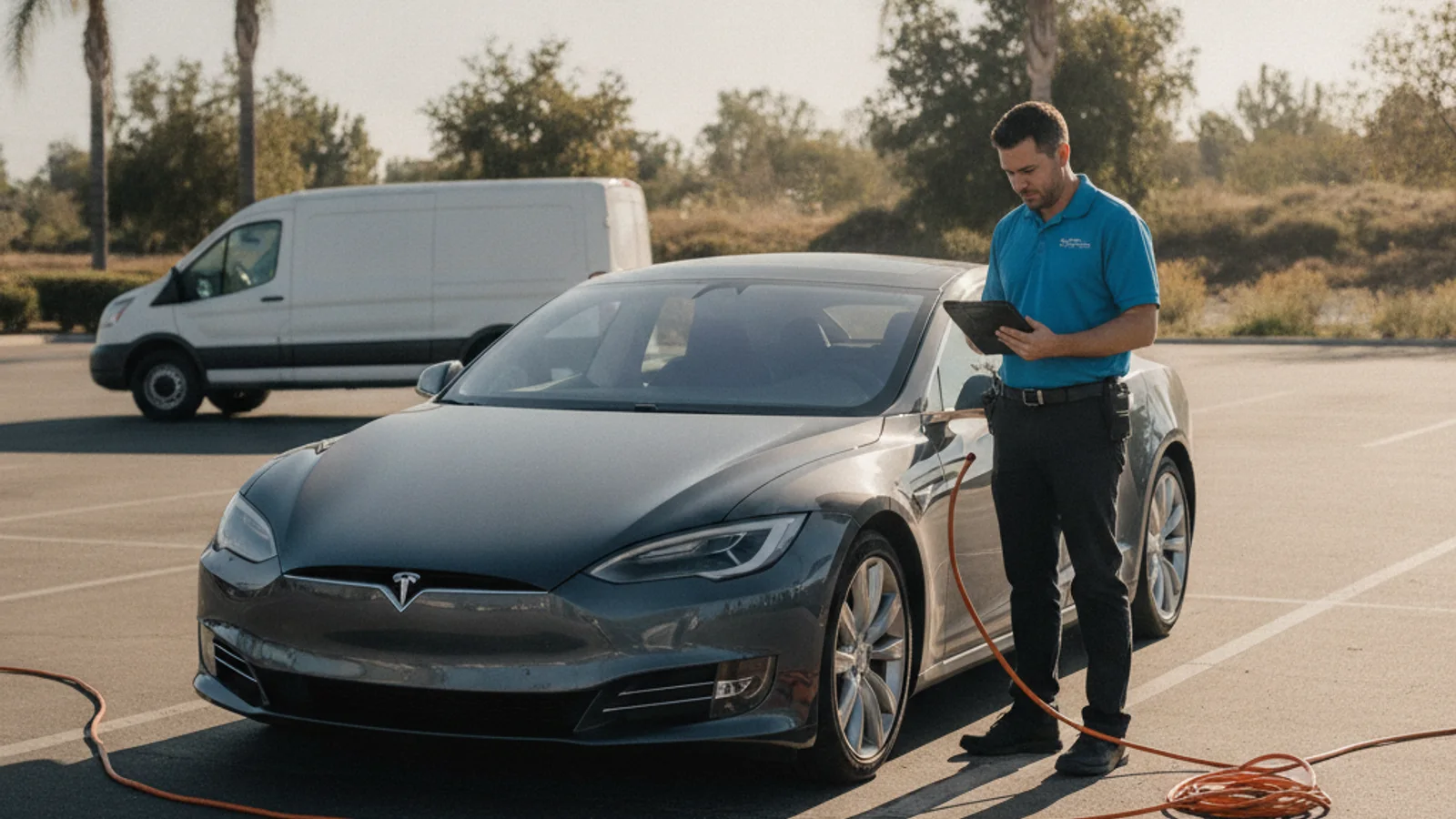
Our Tesla 12V battery jump service and broader Tesla roadside rescue connect metro drivers with independent local operators for exactly this situation. The matched operator confirms the vehicle’s specific low-voltage system before doing anything to it. We do not perform the work ourselves and do not set the operator’s price.
Call (206) 202-7018 to reach a local operator when your Tesla has gone dark and unresponsive, even if the range display showed a healthy charge the last time you saw it.