Driving an EV in Seattle means a lot of time on SR-99, the Alaskan Way Viaduct replacement, the deep-bore tunnel, and the Aurora Avenue couplet that links Shoreline to downtown. It is one of the densest corridors in the metro, with apartments stacked above the roadway and very few places to plug in overnight. When an EV goes dead on SR-99, the geometry of the corridor makes the answer different from a freeway shoulder stop. The tunnel has no usable shoulder, the Aurora stretch has narrow parking pockets that disappear at rush hour, and the apartment stack means the nearest charger may be three miles inland.
Why SR-99 is its own problem
The tunnel itself is the most obvious hazard. The SR-99 tunnel runs from the stadiums south of downtown up to South Lake Union, and it has no shoulder. None. If a car loses power inside the bore, the only options are to coast to one of the two portals or to stop in a travel lane and call 911 so WSDOT can manage traffic around the hazard. The bore has its own ventilation, lighting, and incident response, but it does not have a place for a stalled EV to sit safely.
Outside the tunnel, the corridor flips. Aurora Avenue North from Shoreline through Bitter Lake, Greenwood, Phinney Ridge, and into the south end of the tunnel has a mix of parking pockets, bus lanes, and sidewalks that disappear at rush hour. An EV that dies at 130th and Aurora has very different options than one that dies in the tunnel bore itself. Our out-of-charge freeway guide covers the freeway-shoulder version, which is the right read for I-5 but not for the SR-99 corridor.
The apartment problem north of the tunnel
North of the tunnel, SR-99 is lined with multifamily housing. Shoreline, Bitter Lake, and Greenwood together hold tens of thousands of apartment units built in the 1970s through 1990s, and a large share of those buildings were not wired for at-home Level 2 charging. Seattle City Light’s residential EV rebate and Multifamily EV Charging Program are starting to add stalls, but most buildings still rely on a few shared 120V outlets in the garage.
That is the geometry that turns into a roadside call. A driver parks in a covered garage with no charger, drives to work, comes back at 6pm with a low pack, and finds the shared outlet is in use. By the time they realize the pack is going to be tight for the morning, the apartment has no other plug and the nearest public fast charger is a 10-minute drive. SR-99 carries a lot of that pattern.
What to do if your EV stops on SR-99
If the car stops inside the tunnel, the first call is 911. The tunnel is monitored. WSDOT will dispatch the incident response team. Stay in the vehicle with hazards on. Do not exit onto the roadway. The bore has its own air system, and walking along a live travel lane is the wrong answer for any reason.
If the car stops on the Aurora couplet or one of the surface segments, pull as far right as you can. The Aurora corridor has narrow parking pockets that may or may not be legal parking. Hazards on, lights on. If you have flares or reflective triangles, set them. SR-99 is a fast road and the first 30 seconds matter most for the cars behind you.
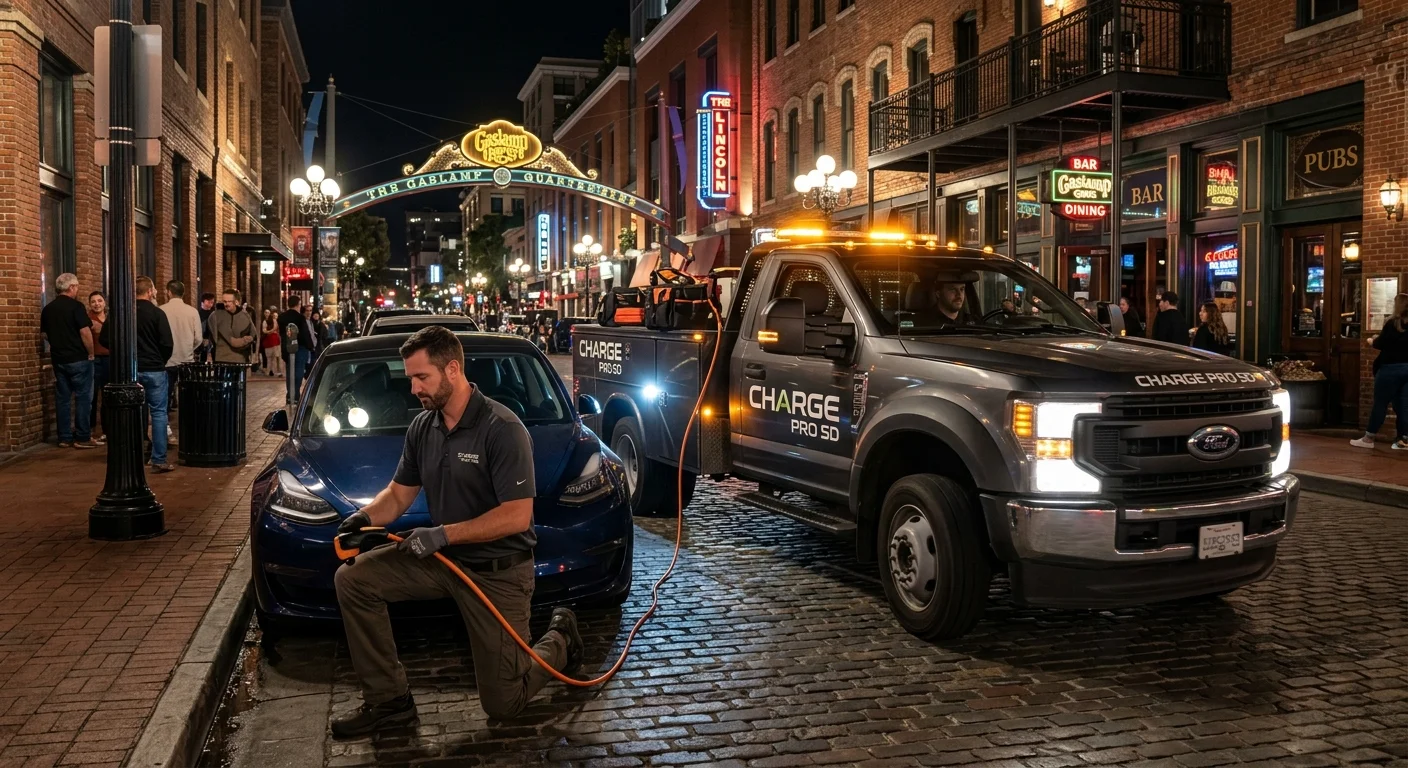
Once you are safe, the next call is to a mobile EV rescue operator. Our mobile EV charging service connects you with operators equipped for urban corridor work, including 50-foot NACS and CCS cables and a 240V bed outlet. The operator confirms the window with you and quotes before starting. For a Level 2 mobile charge, that usually means 15 to 30 minutes on-site for 15 to 20 miles of added range, enough to clear the corridor and reach a charger.
If the situation involves a 12V battery that has died alongside the main pack, the operator also carries a 12V jump pack and can wake the car before charging the pack. Our EV roadside assistance service covers the full triage: jump, charge, or tow recommendation, depending on what the dashboard shows.
How the SR-99 corridor connects to the rest of the metro
SR-99 does not stand alone. The southern end of the tunnel empties into SODO and the stadiums, where SoDo, Georgetown, and Beacon Hill all feed into it. The northern end spills into South Lake Union and the Battery Street tunnel stub, which connects east to I-5 and west to Aurora. An EV that stalls on the SR-99/Aurora corridor is rarely more than a 10-minute drive from a working fast charger, but getting there without enough range is the problem.
For drivers heading north out of the metro, SR-99 ends near Shoreline and feeds into I-5 at the 145th Street interchange. That handoff is where corridor traffic merges with the main spine, and the same stall on that merge becomes an I-5 shoulder stop instead. Our EV roadside assistance in Shoreline and EV roadside assistance in Seattle pages cover both ends of the corridor.
What to tell the dispatcher when you call
When you call, the dispatcher needs three things fast:
- Exact location. “Southbound SR-99 in the tunnel, halfway between the SODO and South Lake Union portals.” “Aurora Avenue North at North 130th Street.” “Aurora and North 85th, southbound.” The location matters more on this corridor than almost anywhere else in the metro.
- Vehicle. Year, make, model. The cable we need changes with the connector type.
- State of the car. Pack dead only, or also 12V dead? Any warning lights? Any collision damage?
That gets the right truck with the right cable. Operators carry both NACS and CCS, and the dispatch line confirms the cable you need before they roll. Most corridor calls reach an operator in well under an hour, sometimes faster if you are in the southern half of the corridor where most operators are based.
When a mobile charge is not the answer
A mobile charge handles the most common SR-99 stalls. Empty pack, 12V still alive, car accessible from a parking pocket or a curb cut. The operator pulls in, plugs in, and you drive away.
There are cases where a mobile charge is not the right answer. If the car has collision damage, a warning triangle on the dash, smoke, or a fluid leak, it is a tow, not a charge. If the 12V is dead and a jump does not bring the car back, the issue is bigger than an empty pack. If the car is stuck in the tunnel bore and traffic management has not cleared the scene, do not try to charge on the roadway. Get to a safe location first.
For those cases, our out-of-charge recovery service and Tesla roadside rescue pages walk through what an operator can and cannot do on-site. The operator will tell you on the phone whether the situation fits a mobile charge or whether a flatbed is the right answer.
After you are moving again
Once the operator has added range and you are back on the road, take 15 minutes to plan differently. SR-99 has predictable charging gaps. The corridor south of the Stadium has the SODO DCFC cluster. The Aurora stretch has fewer fast chargers than the rest of the metro, and the closest reliable stalls are on 15th Avenue NE, in Greenwood, or in Shoreline. If your pack is below 30 percent and you are north of 85th, the next stall is farther than it looks.
For daily driving on this corridor, the rule of thumb is simple. If you live in an apartment with no charger and your commute is along SR-99, plan a charging stop every two days rather than waiting for the pack to drop into single digits. The corridor has the infrastructure for that rhythm, but not for end-of-pack dashes.
When to call us
If your EV is dead on SR-99, in the tunnel, on Aurora, or anywhere along the corridor, call (206) 202-7018 to reach a local operator. Operators cover the whole metro and quote before starting.