You are driving down Aurora Avenue through Shoreline, windows fogging in the drizzle, and the nearest charger is the one you did not plug into last night because your apartment building does not have one. North-end renters run on a thinner margin than most EV drivers in the metro, and Highway 99 is where the math tends to fall apart.
Why Shoreline EV drivers run dry mid-trip
Shoreline sits north of Seattle along Highway 99, and its housing stock is dominated by older apartments, duplexes, and small condo buildings built in the 1960s through the 1980s. Most of those buildings do not have dedicated EV charging, and the few that do often have waitlists. Renters in those buildings depend on public Level 2 stations, on workplace chargers, or on whatever they can access in a friend’s garage. That thinner margin is the local EV problem.
A dead EV battery on Highway 99 is not usually about poor planning. It is about running out of cushion that a homeowner with a Level 2 in the garage would not have to think about.
- The morning commute runs longer than expected when I-5 or Highway 99 stalls, and the pack that looked fine at 6 a.m. is gone by 8.
- The apartment building’s public Level 2 stalls are full, and the closest backup charger is across the highway in a different lot.
- A surprise cold snap pushes cabin heat load up, and the range that was adequate yesterday is not adequate today.
This pattern catches drivers off guard because the planning that would have prevented it, charge at home every night, is not available to them. There is no garage to plug into. There is only the public charger they hoped would be free.
Highway 99, Aurora, and the north-end hotspots
Certain spots along Highway 99 through Shoreline are common places for EV drivers to get caught.
Aurora Avenue between N 145th and N 205th. This stretch is the spine of Shoreline’s commercial corridor, and it is where most apartment dwellers end up when they need a charger. The traffic is stop-and-go, with long lights at major intersections and constant lane changes. Idling, creeping, and running climate control all eat range faster than steady cruising.
The I-5 interchange at N 175th. Drivers heading to or from I-5 often realize here that they do not have the range they thought. The interchange sits at the edge of Shoreline’s commercial area, and the nearest public chargers may require a turn or two on surface streets.
Northgate and the boundary with Seattle. Drivers running between Shoreline and Northgate face a corridor with decent public charging but heavy traffic. A planned charger stop becomes a missed stop when traffic moves slower than expected.
The 185th and 145th Street arterials. These east-west corridors carry a lot of local traffic and connect Shoreline to the residential neighborhoods. A driver who lives in a building without EV charging often charges at a station near one of these arterials, and the station being full or out of service is what triggers the next morning’s low-battery call.
In each of these hotspots, the problem is the same: a lack of reliable, immediate home charging combined with driving patterns that drain batteries faster than a typical commute.
What CHP and WSP expect on Highway 99
Getting stranded on Highway 99 is stressful. The shoulders along parts of Aurora are narrow, and parts of the road are designated as bus lanes or have bike infrastructure that complicates where you can safely stop. WSP treats a stranded vehicle the same way it treats any disabled vehicle: priority is safety.
Here is what to do and what to expect:
- Safety first: the moment you realize you are losing power, turn on your hazard lights. This is the universal signal for distress.
- Pull over safely: do your best to coast as far to the right as possible. If you can make it to a side street, a designated parking spot, or a parking lot, do it. Avoid stopping in the middle of a traffic lane or a bike lane.
- Stay in the vehicle: on a busy road like Aurora, WSP advises that it is almost always safer to remain in your car with your seatbelt on. Standing next to your vehicle exposes you to traffic.
- Have a plan: when a WSP officer arrives, they will want to know your plan to clear the vehicle. Saying “I don’t know” or “I am waiting for a friend” might result in them calling their designated tow service to clear the road quickly.
Having a professional EV roadside service on the way shows them you have the situation under control. You can provide our ETA and explain that a mobile charging unit is en route, which is a much faster and more efficient solution than waiting for a flatbed.
How mobile rescue reaches Shoreline
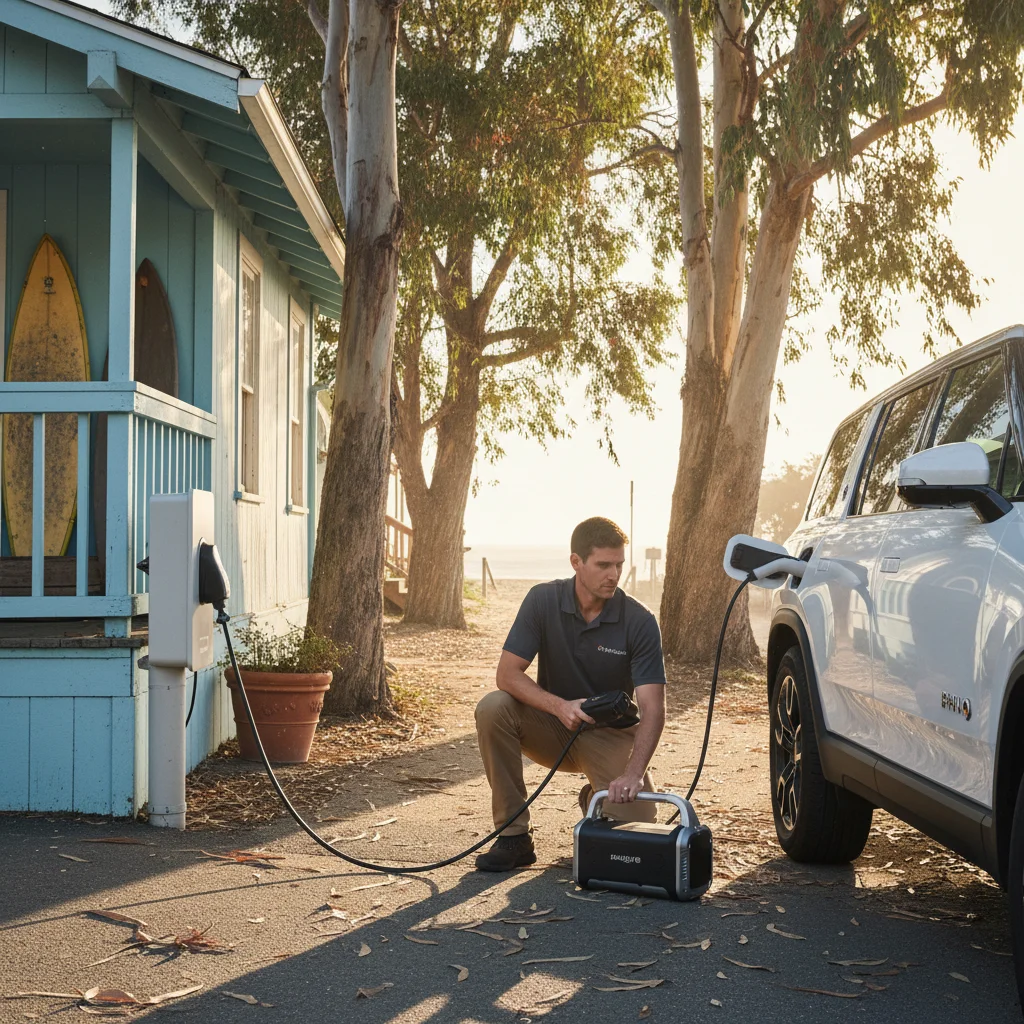
A fast response time is critical when you are stranded on a busy highway. A long wait is not just an inconvenience, it is a safety issue. That is why our dispatch is not run from a single distant depot. Operators stage across the metro, with Shoreline calls typically handled by crews already running in the north Seattle corridor.
Operators working this stretch are usually near the I-5 or Highway 99 corridor, with quick access onto N 175th, N 145th, or local arterials. We know the local traffic patterns, the back roads, and the safest places to conduct a roadside charge.
When you call us, you are not calling a national dispatch center that has to find a local contractor. You are reaching a team that connects you with the operator covering the Shoreline corridor, who confirms a precise arrival window with you on the phone.
This rapid deployment is a core part of our emergency EV roadside assistance service. We understand that an out-of-charge recovery situation requires urgency. Our goal is to get you charged and safely on your way before a traditional tow truck has even been dispatched.
Mobile charge vs tow for Shoreline drivers
When your EV runs out of battery, you have two main options: call for a tow or call for a mobile charge. For drivers in Shoreline, the choice is clear.
A traditional tow truck presents several problems for EV owners. First, there is the risk of damage. Electric vehicles must be towed on a flatbed to avoid damaging the electric motors and drivetrain. Not all tow operators are trained in the specific procedures for every EV model. An inexperienced operator can cause thousands of dollars in damage. Second, towing is a logistical headache. The truck takes you to a charging station, not your home. You are dropped off to wait an hour or more while your car charges, turning a minor inconvenience into a multi-hour ordeal.
Mobile charging is the modern solution designed specifically for this problem. Here is how it compares:
- Convenience: we bring the charger to you. There is no need to transport your vehicle anywhere.
- Speed: a 20 to 30 minute charge from the operator’s mobile unit typically adds enough range to get you home or to the nearest reliable station. That is enough to clear the immediate problem without the wait.
- Safety: our service eliminates the risk of tow-related damage. We simply plug in, charge your battery, and you drive away in your own car.
- Efficiency: for a Highway 99 stranded scenario, a mobile charge is the fastest way to resolve the situation. Instead of waiting for a flatbed to navigate traffic and then waiting again at a charger, you drive away from where you stopped.
In a place with thin home charging options, narrow roads, and traffic you would rather not be sitting in, a quick mobile charge is simply the smarter, faster, and safer choice.
When to call us
When you are stalled on the side of the road with a dead EV, a low 12V battery, or a range emergency, that is a job for us. We are a dedicated rescue service, not an installer.
Call (206) 202-7018 to reach a local operator who will roll a rig to you.