Driving an electric vehicle in Seattle offers quiet commutes and dense charging infrastructure, but the fear of running completely out of battery can cause real anxiety for apartment renters who can’t plug in at home. It’s a situation no EV owner wants to face. When your vehicle goes from “low battery” warnings to truly “zero” power, you’re not just inconvenienced; you’re in an emergency.
This guide walks through exactly what to do if your EV completely dies in Seattle. We’ll cover calm, clear steps and explain how Charge Pro SEA connects you with a local operator who can charge the car where it sits.
Why Seattle apartment renters end up stranded
Seattle has one of the highest EV adoption rates in the United States. The city accounts for 45,469 registered EVs, the most of any city in Washington state, but the housing stock tells the harder story. Seattle is 54.2% pre-1980 housing. Capitol Hill, the U District, Beacon Hill, and much of West Seattle are dense apartment neighborhoods with limited dedicated parking. Most residents can’t install a Level 2 charger at home, and many buildings don’t even offer a 120V outlet in their assigned stall.
That pushes EV owners toward public charging. The SEA garage holds 94 free Level 2 EV stalls spread across two zones, plus 2 DC fast chargers in the Cell Phone Lot for pickups. The garage itself holds 12,000+ stalls across 8 floors with Park Assist. Some commuters use those stalls as their daily routine, parking on Floor 7 in the General rows, charging during their trip, returning to a topped-up pack.
The catch: when that routine breaks, there’s no home plug to fall back on. A delayed flight, a missed connection at the airport, or a long day running errands between downtown and Capitol Hill can leave a Tesla or Ioniq 5 sitting at 4% with no margin for error.
Low charge versus zero charge: what actually happened
A low EV battery and a completely depleted one are different problems. When your EV’s main high-voltage battery is low, your car typically goes into a “limp mode” or “turtle mode.” It reduces power and speed to preserve the last few miles of range, giving you time to find a charger. You’ll see multiple warnings on your dash, often escalating in urgency.
“Zero battery” means something far more critical. The high-voltage battery is entirely drained, and often the vehicle’s separate 12V auxiliary battery may also be compromised or unable to power essential systems. When this happens, your EV isn’t just slow; it’s completely unresponsive. You can’t shift into neutral, engage hazards, or even open the doors in some cases without manual overrides. The car is effectively bricked.
This complete power loss demands a different kind of solution than simply limping to the nearest station.
First steps: get to a safe location
When your EV dies completely, your immediate priority is safety. If you’re still moving, try to coast to the nearest shoulder or safe pull-off area. Turn on your hazard lights immediately. Even if the 12V battery is dead, some vehicles retain enough residual power for a short time to activate these essential safety features.
Once stopped, if you’re on a busy freeway or in a precarious spot, stay inside your vehicle with your seatbelt on. Your car’s structure provides better protection than standing outside, especially at night or in bad weather.
Avoid trying to push the vehicle yourself. EVs are exceptionally heavy, often weighing thousands of pounds more than comparable gasoline cars due to their battery packs. If your EV is blocking traffic, or you’re on a dangerous stretch of road like I-5 or SR 99, call 911 for immediate assistance from law enforcement. Once you’re safely situated, your next call should be to a specialized EV roadside service rather than a traditional tow truck.
Why mobile charging is your first, best option
When your EV is truly out of charge, a mobile EV charging service is a straightforward solution. Traditional towing services often aren’t equipped for dead EVs. Towing an EV requires specific knowledge and equipment, especially if the 12V battery is also dead and the car can’t be put into neutral. Improper towing can cause significant damage to the EV’s drivetrain, leading to costly repairs.
Charge Pro SEA connects drivers with licensed, independent local EV rescue operators across the Puget Sound region. The matched operator brings the charge directly to you, wherever you are. The operator’s mobile charging units are specifically designed to safely and efficiently deliver enough power to get your vehicle to the nearest charging station or even home. This approach is quicker, often less expensive than a specialized tow, and significantly reduces the risk of damage to your EV.
Plus, the operators we work with are highly trained in EV systems, understanding the unique needs of different makes and models. When you’re completely out of battery, time is critical, and a mobile charging service provides immediate, specialized relief.
What to expect when the operator arrives
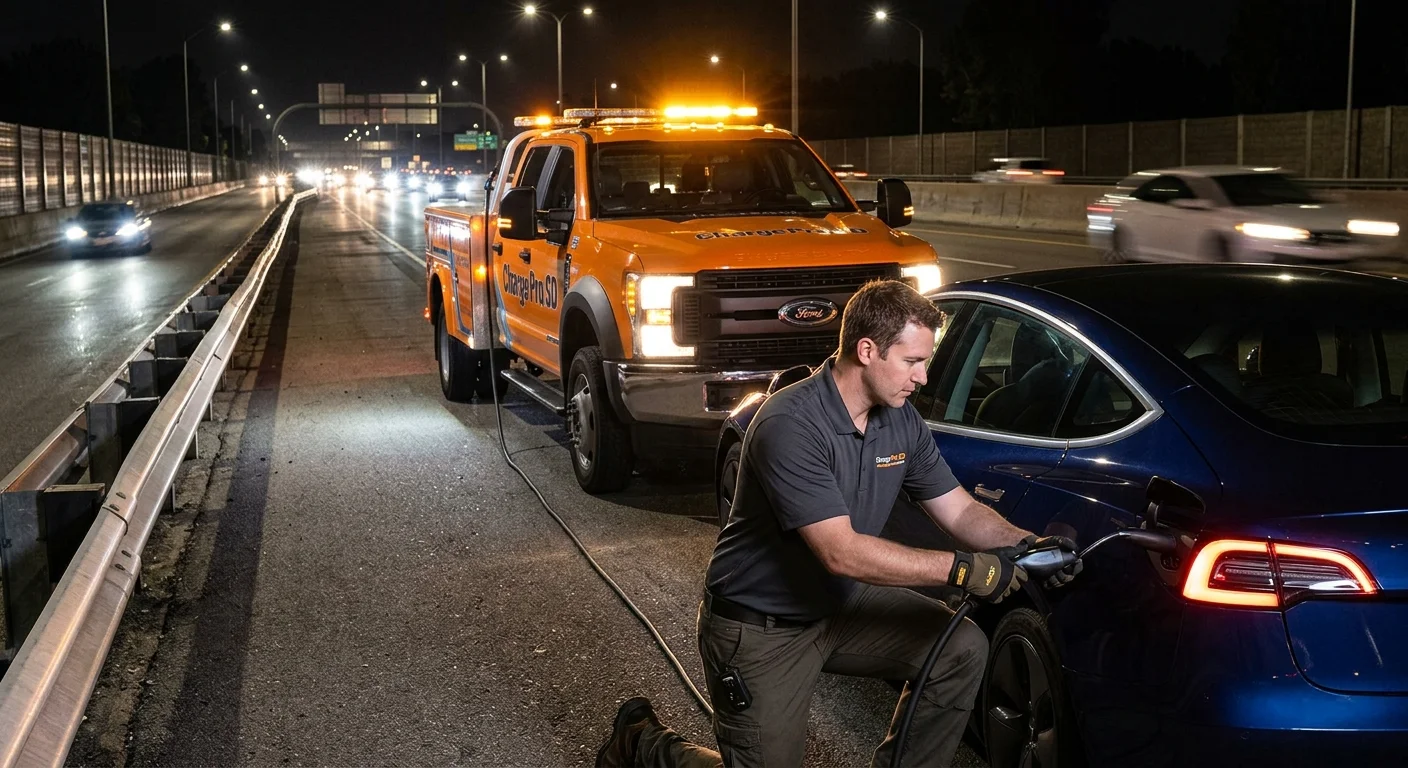
Once you’ve called our referral line, leave your location, EV make and model, and a callback number. We connect you with the closest available operator. When the operator arrives, you’ll see a professional, clearly marked truck equipped with advanced mobile EV charging technology. The trained operator will first assess your situation and ensure your vehicle is in a safe location.
They’ll then carefully connect the operator’s mobile charging unit to your EV’s charging port. The matched operator uses powerful, compatible equipment designed to deliver a sufficient charge to revive your battery. They’ll also provide a brief update on the charging process and answer any questions you might have, keeping you informed during a stressful situation.
How much charge do you need to reach the nearest station?
When your EV is completely dead, our goal isn’t to fully recharge your vehicle on the spot. The matched operator provides a strategic “boost charge” designed to give you enough range to comfortably reach the nearest functional EV charging station or even make it home if it’s nearby. Typically, that delivers 10 to 20 miles of range.
The exact amount of charge needed depends on a few factors: your EV’s efficiency, the distance to the closest reliable charging infrastructure, and whether you’re traveling uphill or downhill. The operator discusses these details with you.
When to call us
If your electric vehicle runs completely out of battery and leaves you stranded, especially in a dangerous or inconvenient location in Seattle, it’s time to call a mobile rescue. Don’t risk damage with an inexperienced tow, or your safety trying to push a heavy EV. Call (206) 202-7018 to reach a local operator who quotes you before starting.