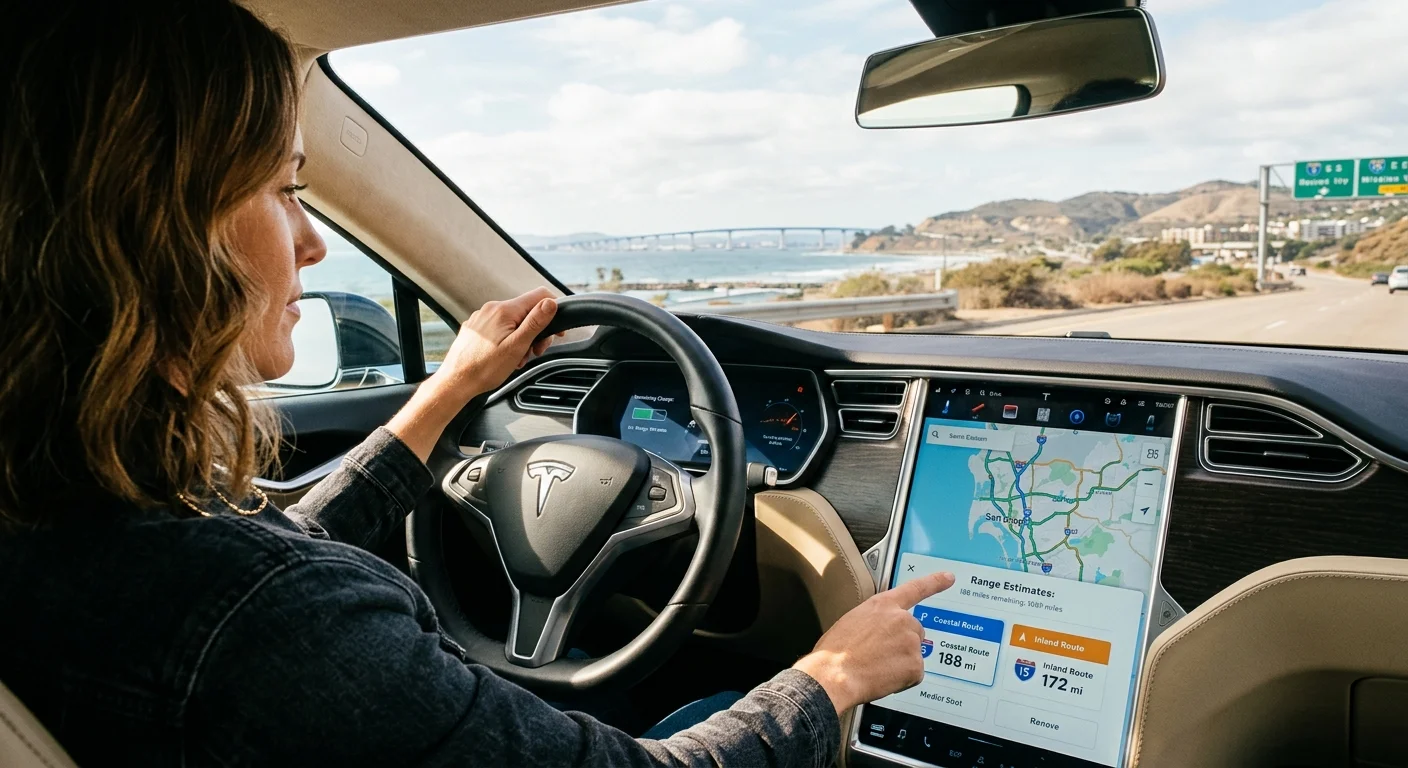
A Tesla in the Puget Sound does not lose the same range it would in a desert or southern California. The lowlands sit in the 35 to 45F band for months. Cabin heat and defrost run on nearly every trip. A driver who leaves home with 80 percent sees the buffer drop faster than the dashboard’s range estimate predicted.
What the cold band actually does
Recurrent Auto reports that across 30-plus EV models, EVs retain about 78 percent of range at 32F. AAA testing at 20F showed climate control pushing losses toward 40 percent. The Puget Sound does not hit 20F often, but it sits in the cold-soak zone for months. The drain is not a hard freeze but a slow leak from the heater and the defrost.
A driver who charges to 90 percent overnight sees the battery warm slowly to operating temperature before the morning drive. A driver who parks outside in a 35F rain soaks the battery overnight and loses more on the first miles of the morning commute.
The daily range scales with the battery size. A Model 3 Standard Range Plus has fewer kilowatt-hours than a Model S Long Range. The cold band cuts both by 20 to 30 percent in real conditions. A driver who expects 250 miles in summer should plan for 180 to 200 in winter.
What cabin heat actually costs
Cabin heat is the single biggest drain on a Tesla in the Puget Sound. A driver who runs the heater at 72F for a 45-minute commute can lose 20 percent or more of the buffer. The seats and steering wheel heaters use less power than the cabin blower.
A driver who notices the buffer dropping fast should kill the cabin heat and run the defrost only for the windshield. The buffer climbs back within a few minutes. Most Teslas also have a heat pump option that improves cold-weather efficiency. Confirm whether the specific model has the heat pump before relying on that efficiency boost.
What regen and one-pedal driving add
Highway speeds cut range fast. A driver who drops from 70 to 60 mph on I-5 buys back real miles. Coasting down grades with regen turned up recovers some of the buffer. Most modern Teslas allow one-pedal driving, which uses the motor as a generator when the accelerator lifts.
Wet roads and standing water are a concern. Regen on a wet road can trigger traction control. The driver should set regen to a lower level in heavy rain and use the friction brakes more. Safety outranks range.
What changes on the climb to Snoqualmie Pass
The I-90 climb from North Bend to Snoqualmie Pass adds 2,100 vertical feet over six miles. WSDOT confirms the summit at 3,022 feet. Cold rain and cabin heat make the climb the worst-case range scenario.
A driver who leaves North Bend with a thin buffer is asking for trouble. The right move is to charge in North Bend, Issaquah, or Bellevue before the climb. A driver who runs low on the climb should pull off at the closest chain-off area and call for help.
Mobile EV charging at the shoulder is faster than a tow. The operator quotes before starting and bills the driver directly. Charge Pro SEA connects you with a local operator who knows the corridor.
When to call
Call (206) 202-7018 when your Tesla cannot reach a charger in the Puget Sound region. Charge Pro SEA connects you with a local operator who quotes before starting and bills you directly.