I-405 is a different freeway than I-5 or I-90. The corridor runs the Eastside from Tukwila through Renton, Kirkland, and Bellevue up to Lynnwood. It carries express toll lanes, heavy commute traffic, and a series of segments with narrow or non-existent shoulders. A driver whose pack goes to zero on I-405 has fewer safe places to stop than a driver on a typical interstate, and the recovery sequence is more sensitive.
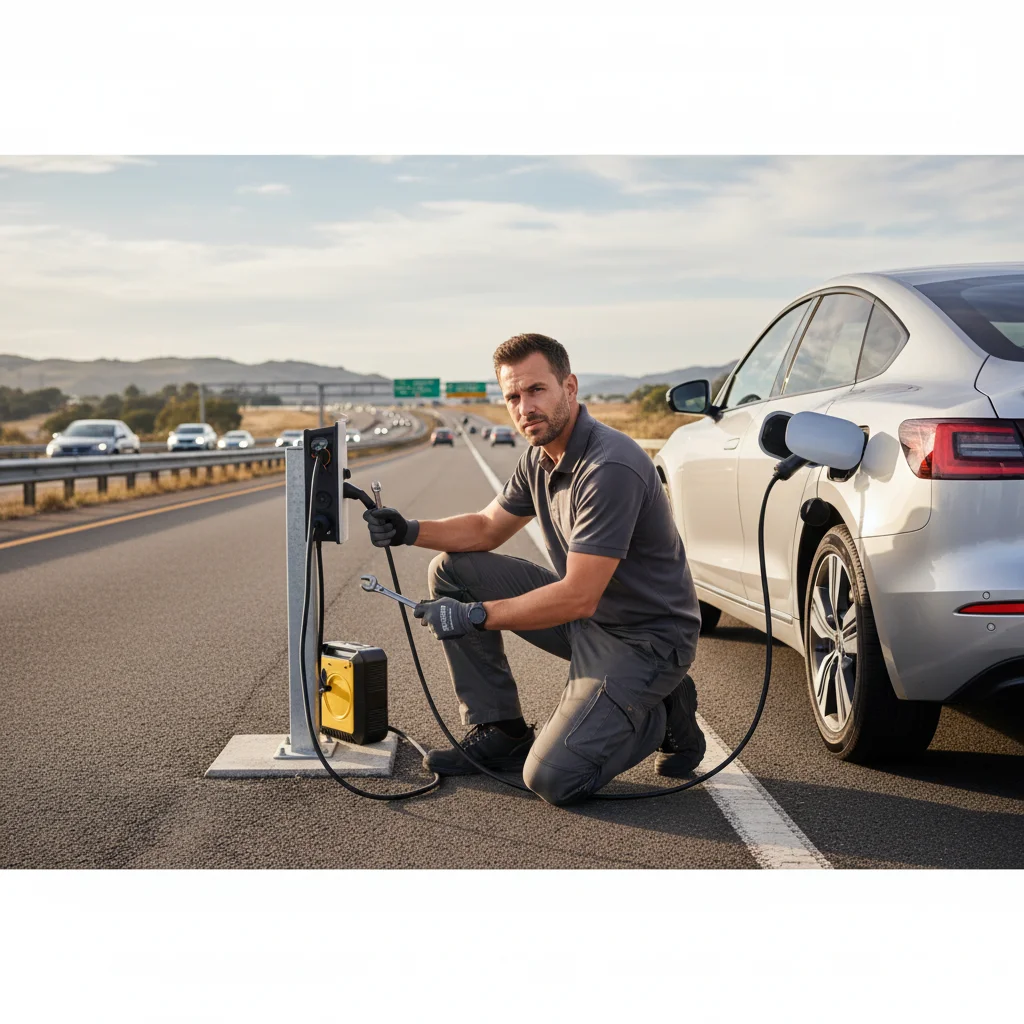
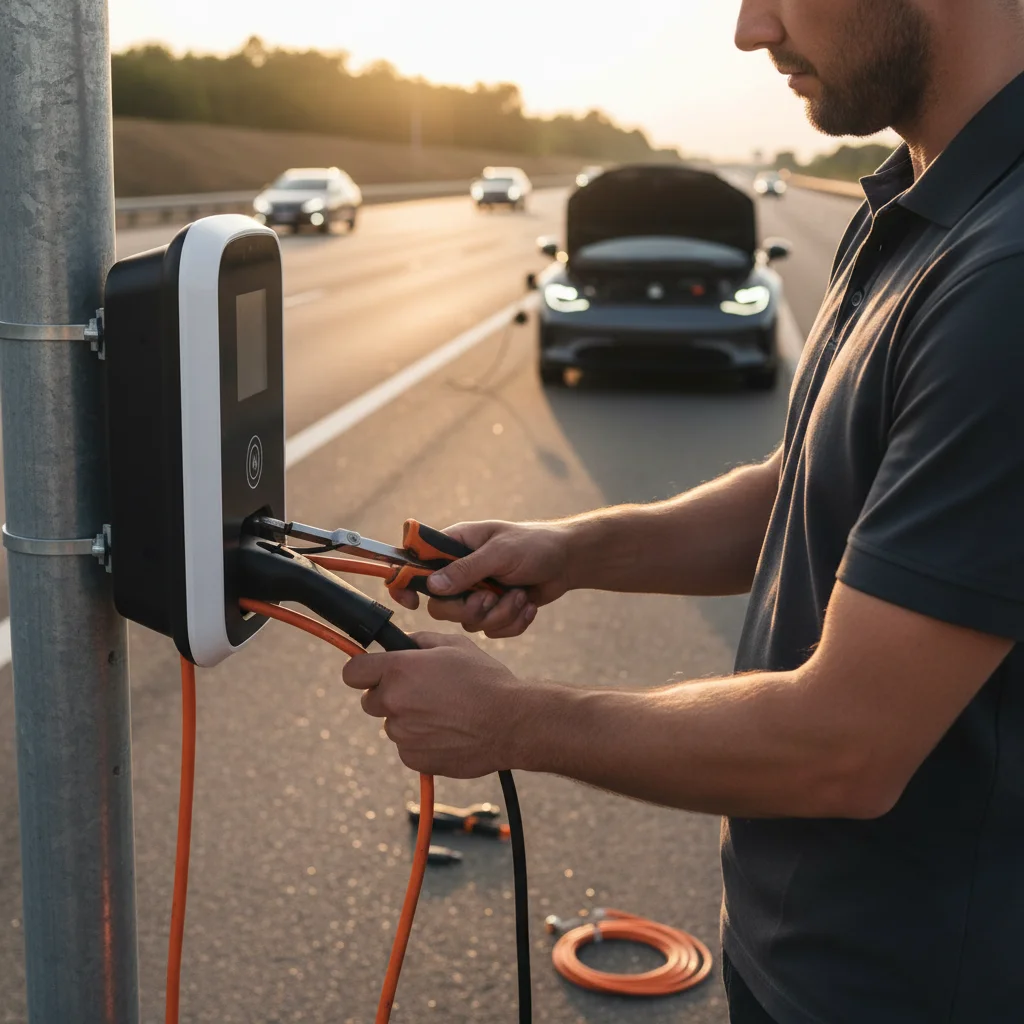
This guide covers what to do when the pack goes to zero on I-405, how to recognize the warning signs before the cutoff, and how mobile charging reaches a stopped EV on a shoulder that is not always wide enough for a normal roadside response.
Why I-405 is harder than other corridors
Three features of I-405 make a dead-pack scenario more dangerous here than on a typical freeway.
The express toll lanes (ETLs). The ETLs are buffer-separated from the general-purpose lanes. A driver who pulls into the ETL buffer because the car is slowing down has no legal place to stop and very little room to wait. The right choice is to exit the ETLs at the next gore point and find a wide shoulder on the right side of the freeway.
Limited shoulder width. Several segments of I-405 between Renton and Bellevue have shoulders that are too narrow for a normal passenger vehicle. The WSDOT active traffic management signs sometimes show “no shoulder” warnings in work zones. A driver who tries to stop in a narrow shoulder creates a hazard for passing traffic and for the operator who would respond.
Steep grades. The I-405 climb through Newcastle and the descent toward Kirkland both pull more energy than the flat sections. A driver whose pack is at 10 percent at the bottom of the Newcastle climb sees the predicted range drop faster than the miles tick by. The math is unforgiving in cold rain.
What happens when the pack hits zero
Modern EVs do not roll to a stop suddenly. The car drops into a low-power mode, reduces throttle response, and may show a “turtle” indicator or a “reduced propulsion” message. The cabin stays powered for a few minutes so the driver can pull off the road. The windows and hazard lights continue to work.
The right move in this state is to leave the freeway at the nearest exit and find a wide, legal stopping place. A parking lot, a gas station, a wide shoulder on a city street, or a designated pull-off are all safer than a freeway shoulder. The goal is to stop where the operator can reach the car safely.
If the car stops before the next exit, the driver should pull as far right as possible, set the parking brake, turn on the hazard lights, and exit the vehicle from the side away from traffic. Standing on a narrow freeway shoulder with passing traffic is the most dangerous part of the incident. A driver who can reach the upstream guardrail and stay behind it is materially safer.
The right sequence after a stop
Once the car is stopped and the driver is in a safe place, the next steps matter.
Call 911 if the car is in an active traffic lane or blocking any part of the roadway. WSDOT’s Incident Response Team and Washington State Patrol respond to freeway incidents and provide traffic control. Their first job is the safety of the scene; the dead EV is a secondary concern.
Call a mobile rescue once the scene is safe. Charge Pro SEA matches the driver with a licensed, independent local EV rescue operator. The operator dispatches based on the location, the connector type, and the access conditions.
Do not attempt to push the car to an exit. A modern EV in low-power mode is heavy, and pushing on a freeway shoulder exposes the people pushing to passing traffic.
Do not attempt a 240V charge from a building outlet. Connecting a portable EV cable to a building outlet without a proper EVSE is dangerous and may damage the outlet, the cable, or the car.
How mobile charging reaches an I-405 shoulder stop
A mobile operator working with Charge Pro SEA has a few options depending on the shoulder conditions and the city the driver has reached.
The driver exits the freeway to a nearby parking lot or street. This is the most common path. The operator meets the driver at a safe location off the freeway and charges the car there. The driver pays the operator directly; Charge Pro SEA does not set prices or perform the work.
The driver is on a wide shoulder or a designated pull-off. The operator can reach the car directly. The matched operator confirms the access, sets up cones if available, and connects the portable Level 2 charger.
The driver is on a narrow shoulder where a van cannot safely stop. The operator may not be able to dispatch and may refer the driver to a towing service that can flatbed the car to a safe charging location. A mobile operator will not put their crew in a position where passing traffic creates an unacceptable risk.
For these reasons, the operator asks detailed questions about the exact location before dispatching. “I’m on I-405” is not enough. “I’m on the right shoulder of northbound I-405, just past the Coal Creek Parkway exit, in a 200-foot pull-off” is the right level of detail.
How to avoid the I-405 dead-pack scenario
The Eastside is dense enough that a dead pack is rarely a surprise. Drivers who run daily commutes from Auburn to Bothell or from Issaquah to Redmond can build small habits that prevent the cutoff.
The pack should stay above 20 percent on days with significant rain or cold. The cabin heat load on a 38-degree rainy day can drop real-world range by 15 to 20 percent. A driver whose pack is at 25 percent at the start of a 25-mile commute may reach the destination at 3 percent instead of the predicted 15 percent. The next morning, the cold-soaked battery plus a few cold-soak miles can put the driver in turtle mode before they reach the charger.
The fastest charging station on the Eastside corridor is rarely the closest. The driver who plans for the station near their destination rather than the one near their current location avoids the I-405 dead-pack scenario. A 10-mile detour to a working stall is cheaper than a roadside incident.
Public charging near the Eastside corridors is concentrated in a few hubs. A driver whose usual hub has a broken stall can use the next public option along the route, which is usually within five miles.
The legal layer in plain English
Disabled vehicles on Washington highways are governed by RCW 46.61.560 and RCW 46.61.590. The first requires drivers to move disabled vehicles off the traveled portion of the roadway when it is possible to do so. The second requires prompt removal. A dead EV on I-405 falls under both: the driver is required to leave the freeway when possible, and required to arrange removal promptly.
Towing and impound on Washington highways fall under Chapter 46.55 RCW. A driver whose car is impounded for non-removal pays both the towing fee and the impound fee, which is more expensive than a mobile charge at the scene.
The all-party consent rule under RCW 9.73.030 applies to recorded calls. A driver on a recorded roadside line is being recorded. The recording is admissible as evidence if needed, and the driver should treat the call accordingly.
When to call us
If the pack is at zero on I-405 and you have reached a safe exit or wide shoulder, Charge Pro SEA connects Eastside drivers with licensed independent local operators who run mobile charging trucks. The matched operator confirms the location, the connector type, and the access conditions, then dispatches or refers. Call (206) 202-7018 to reach a local EV rescue operator.