The Tesla app may take a roadside request at 1 a.m. on I-5. A ticket at that hour still leaves you in the rain until the right help actually arrives. Drivers searching is tesla roadside assistance 24 7 around Seattle should treat Tesla’s live app as the clock, because a verified local hour window for King, Pierce, or Snohomish County could not be confirmed from Tesla’s current official roadside page.
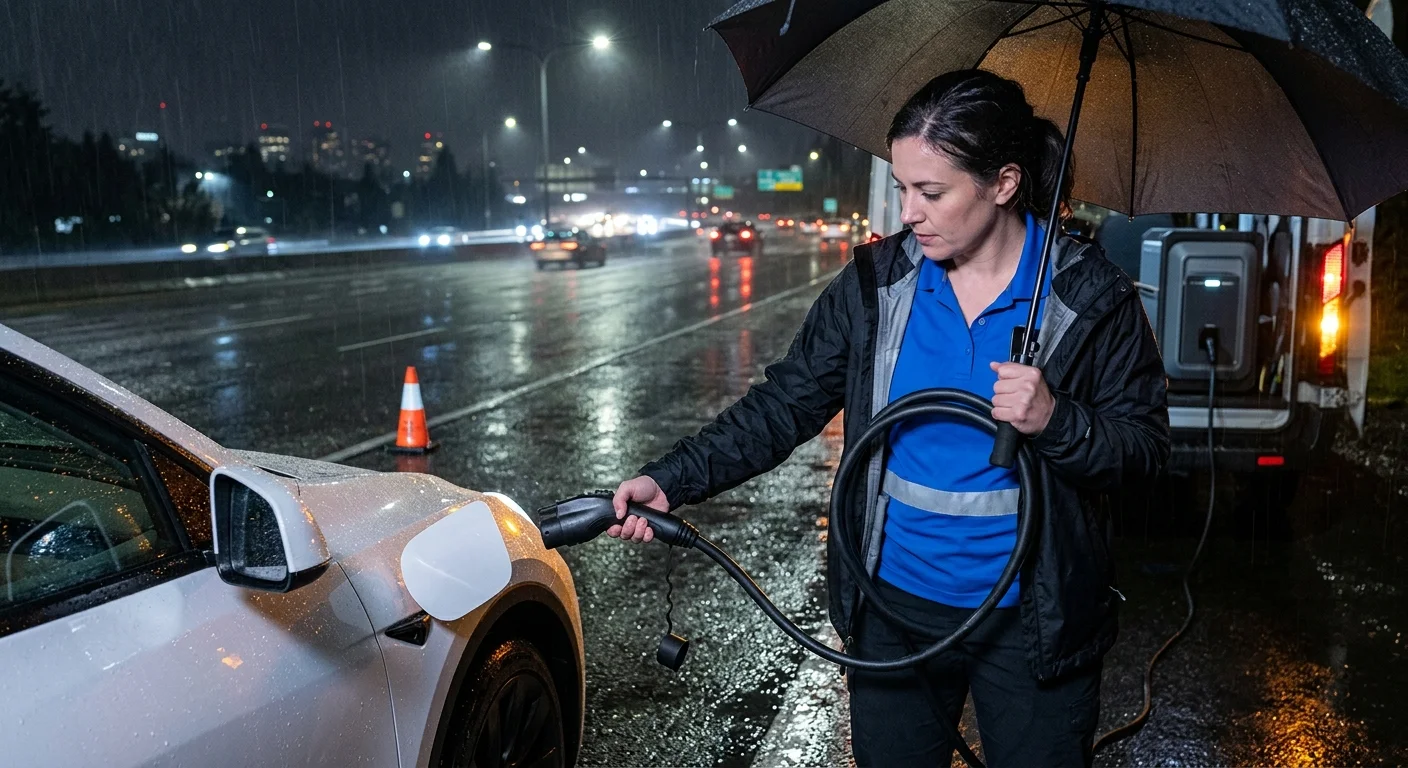
What Tesla publishes about after-hours help
Open Roadside on the Tesla touchscreen or in the Tesla app. That screen is the current offer for your VIN: whether Tesla will take the ticket, which service type it lists, and any terms you have to accept.
Tesla’s public pages often describe roadside as around the clock. Treat that as Tesla’s national language. It is not a posted Seattle dispatch window. If the in-car flow accepts a request at 2 a.m., Tesla is taking the ticket. If the request will not send, a slogan is not a local guarantee. Check the live status in the app before you commit to sitting on a shoulder.
Call tesla roadside assistance the way Tesla wants the call to happen. Start in the vehicle or the app. Phone numbers copied from old blogs go stale. Tesla’s official roadside page is the second check, next to the screen in the car. Keep the car in Park, hazards on if you are stopped in traffic, and the phone charged enough to finish the request.
What Tesla will cover is VIN-specific. People ask whether Tesla roadside is free, and what a billed Tesla roadside charge looks like. A dollar figure that circulates as a $99 Tesla charge could not be confirmed from Tesla’s current official roadside page. Tesla’s billed amounts and warranty-era terms change. Read the request screen and your Tesla Account before you confirm a dispatch.
Does tesla roadside assistance work at night in this metro? The app is the only live yes. Night tickets, weekend tickets, and holiday tickets still run through that same screen. For how those tickets play out around this metro, read Tesla roadside assistance on nights and weekends. The clock question and the wait question are different. Use how long Tesla roadside assistance takes once a ticket is already open.
A 24/7-style Tesla ticket still has a service type. Tesla roadside is built around towing, lockouts, flats, and 12V help. Confirm on screen if you need range in the pack. A tow toward a Supercharger is a different night than a Level 2 rescue, which puts about 10 to 20 miles of range back in 15 to 30 minutes of charging time. That interval is charging time, not an arrival window.
If the problem is a flat, plan for a tire service or a tow. Most Teslas do not carry a spare, so the Tesla path is a repair kit you already own, a Tesla tire dispatch, or a flatbed. Get out of the travel lane if you can. On a state highway, WSDOT’s Incident Response Team is on call 24/7. You reach that help by dialing 911. WSDOT’s published materials cover flats and running out of gas. They do not mention electric vehicles, out-of-charge stops, or charging.
Night rain, I-5, and garage access here
The Puget Sound is not one shoulder. A Model Y on the I-5 lid downtown, a Model 3 in a Bellevue office garage, and a car on US-2 near Gold Bar do not get the same night.
I-5 through Seattle is rain, spray, and short sight lines. The lids near Freeway Park and the Convention Center pinch the corridor. SODO, the ship canal bridges, and the Northgate weave add merge chaos after dark. If you are disabled on the roadway, Washington law is specific. RCW 46.61.560 generally bars stopping on the roadway outside incorporated cities and towns, with an exception for a vehicle so disabled that stopping is unavoidable. RCW 46.61.590 then requires the driver to arrange prompt removal. Hazards and a phone are the start of that, not the whole plan. If you are on a state highway, 911 is how you reach WSDOT’s incident crews.
South of downtown the corridor stays wet and fast. Federal Way, SeaTac, and the I-5 run into Tacoma stack airport traffic on top of freight. Pierce County’s housing stock is older on average than the Eastside’s, and street lighting drops off once you leave the main arterials. A Tesla that rolls to a stop on a dark Tacoma shoulder still has to come off the travel lane if it can.
Downtown garages change the job. After-hours gates in Belltown, South Lake Union, and Bellevue’s downtown core close. A Tesla contractor with a flatbed may not have a fob for the ramp. Tell Tesla your exact garage, floor, and whether the gate is locked. A white Tesla on Floor 4 of a reserved garage is invisible from the street. Security desks sometimes let a tow in and still block a smaller rescue vehicle, or the reverse. Say what the car needs and whether the operator can reach the stall.
Eastside hills add water and grade. Kirkland, Redmond, Issaquah, and the I-405 climbs around Factoria soak the pavement. Recurrent Auto’s winter testing across 30-plus EV models found cars keep about 78% of range at 32F, a 22% loss. AAA testing at 20F found temperature alone cut range 10-12%, and cabin heat pushed the loss toward 40%. That is how a “fine” commute becomes a 1 a.m. stop on an Eastside hill with no spare range.
Tesla density is high here, which is why the 24/7 question keeps coming up. Washington DOL EV population data counts 122,981 Teslas statewide, about 41% of registered EVs. King County has 63,017 Teslas out of 144,257 EVs, about 44%. Seattle alone has 45,469 registered EVs. Plenty of those cars will be on I-5, I-405, or a garage ramp after dark.
Does tesla roadside assistance work at night on those roads? Only the app can say if Tesla will take your ticket. Weather, a closed garage, and an empty pack are separate problems from Tesla’s clock.
24/7 on paper vs a contractor who can charge
A 24/7 ticket means Tesla accepted the request. It does not name the truck. Tesla contracts third-party roadside. The person who arrives may be set up to tow, jump a 12V, or change a wheel. High-voltage charging at the curb is a different skill and a different truck.
If the screen says tow, believe it. If you need the car to drive itself to the next charger, say that in the notes and confirm the service type. Tesla roadside often solves a dead 12V or a flat. An empty traction pack is out-of-charge recovery, and that is the gap that leaves people on I-5 after Tesla has already opened a ticket.
Wait time is the other mismatch. “Is Tesla roadside 24/7” is a clock question. How long you sit is a queue question. Those are split on purpose. Use the how-long guide once the ticket is open and you are watching the map. Do not read a 24/7 label as a short wait on a Friday after a Sounders game, or in rain on the I-5 spine through Tacoma.
Local geography still wins. A contractor working the Eastside may reach a Bellevue garage on a different clock than a car on a dark US-2 pullout east of Gold Bar. Everett and Lynnwood sit on a different stretch of I-5 than SoDo. No arrival window is published here for Tesla or for anyone Charge Pro SEA refers. If Tesla’s map sits still, keep the car and the people in it safe. Hazards, 911 on a state highway, and a second plan if the service type is wrong.
What 24/7 roadside covers, when Tesla takes the ticket, is the menu on the screen that night: tow, tire, 12V, lockout, or another listed item. It is not a promise that a mobile EV charger exists on that ticket. Confirm before you decline a second option. If Tesla is rolling a 12V jump and the car still has usable pack, that jump may be the whole fix. If the traction pack is empty, a 12V jump will not put miles in the car.
When a local operator is the backup call
Use Tesla first when the app takes the ticket and the service type matches. Use a local operator when the pack is empty, Tesla is sending a tow you do not want, the garage gate is shut, or the ticket will not send.
Charge Pro SEA is a referral service for the Puget Sound. It matches you with licensed, independent local EV rescue operators. It does not perform the work, own a truck, hold Tesla’s contract, or set a price. The operator you are connected with quotes and bills you directly.
Tesla roadside rescue is the path when the car is a Tesla and you need a local operator after Tesla’s contractor, or instead of waiting on a ticket that will not send. Out-of-charge recovery is the path when the traction pack is the problem. Typical on-site rescue charging puts about 10 to 20 miles of range back in 15 to 30 minutes of Level 2 charging. That is enough to roll to a Supercharger or a home plug. It is charging time, not a promise about when someone arrives.
Nights on I-5, wet Eastside hills, and closed downtown garages are the usual backup moments. Tesla’s clock can still read open. The truck Tesla sends can still be a flatbed. If you need range in the pack, say that clearly to whoever you call next. Keep the Tesla request open until you know the service type. If Tesla is already rolling a tow you want, stay with it. If Tesla cannot charge the pack, that is when a local operator is the second call.
Bring the basics when you talk to anyone: model, approximate pack percent, whether the 12V is also dead, cross-street, and whether you are on a highway shoulder, a city street, or a gated garage. That is the difference between a useful dispatch and a truck that cannot reach you.
When to call us
Call when Tesla’s live request will not send, the service type is a tow and the pack is empty, or a garage gate has you stuck after hours in Seattle or on the Eastside. Charge Pro SEA connects you with licensed, independent local operators. The operator does the work and bills you. Call us at (206) 202-7018 and we’ll connect you with a local EV rescue operator.