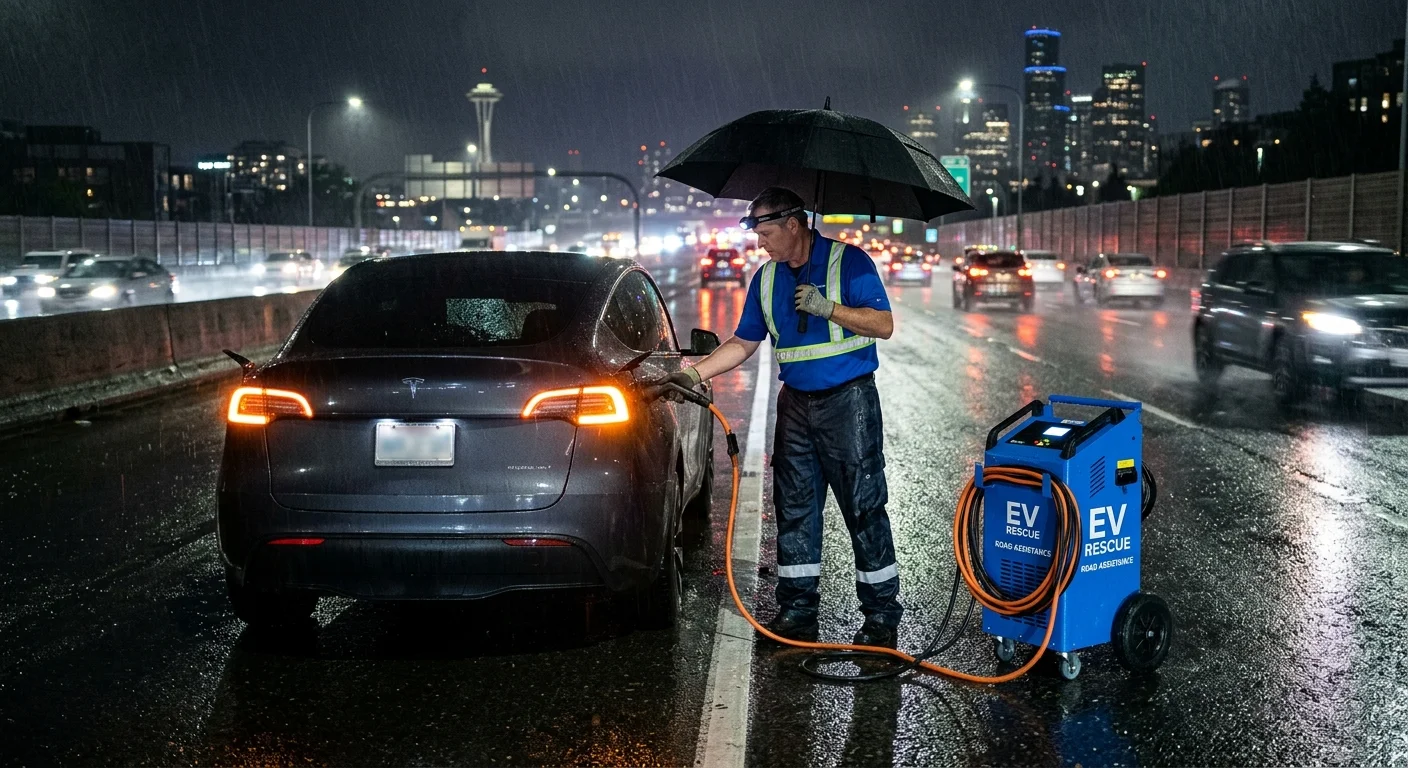
You’re on the I-5 shoulder south of downtown Seattle, hazards on, rain on the glass, and a Tesla roadside ticket just opened. You want a wait in minutes. Tesla does not publish a verified typical wait for the Puget Sound region, so the live estimate in the Tesla app is the number to use for this stop.
Why Tesla wait time is not a fixed number
How long Tesla roadside assistance takes is not one clock. A ticket in Belltown and a ticket on US-2 in Gold Bar do not share a crew. Tesla’s published materials for this page do not list a typical wait in minutes for King, Pierce, or Snohomish County. If another site quotes 20 minutes or an hour, treat that figure as unconfirmed. Open the Tesla app and read the estimate Tesla is showing you right now.
That estimate can move after you tap request. Tesla often routes the job to a third-party contractor. The truck may already be on another call. The request type also changes the queue. A 12-volt no-start, a flat tire, a lockout, and an empty high-voltage pack are not the same dispatch. Tesla commonly sends a tow or 12-volt help. It does not always send a high-voltage charge to the car. If the pack is empty, Tesla’s path may be a flatbed to a Supercharger or a Tesla Service Center.
Coverage length is a different clock from wait time. Searchers also ask how long Tesla covers roadside assistance. That answer lives in your Tesla account and in Tesla’s current warranty and roadside documents. Tesla’s coverage years, mile caps, and tow-distance limits could not be confirmed as a single published figure for this article. Log into the app, open the vehicle warranty screen, and read what Tesla lists for your VIN. For a plain-language walkthrough of what the program tends to include, see what Tesla roadside assistance covers.
Reliability is the same gap. There is no verified regional score for how often Tesla hits its own estimate in Seattle, Bellevue, Tacoma, or Everett. Owner stories are not a published standard. What you can trust is the live ticket, then the local conditions that stretch it.
If you need to call Tesla roadside assistance, start in the car or the app. The in-car Roadside Assistance control shares your location. A phone call without that pin can add a location step. For which path is cleaner on a Puget Sound stop, read Tesla roadside phone vs the app. Tesla’s hours for this metro, including whether Tesla roadside assistance is 24/7 here, could not be confirmed from Tesla’s published materials for this page. Check the app for whether a ticket will open at this hour.
You are not an edge case in this fleet. Washington DOL EV population data shows 122,981 Teslas, about 41% of 299,705 registered EVs statewide. King County alone has 63,017 Teslas of 144,257 EVs. Seattle, Bellevue, Redmond, and Kirkland hold a large share of that fleet. A busy Tesla network in this metro is a reason wait times vary. It is not a reason Tesla publishes a fixed number.
What slows a Puget Sound dispatch in rain or traffic
I-5 through Seattle and I-405 on the Eastside set the clock more than the ticket does. A contractor coming from Kent to a stall in Shoreline sits in the same crush you left. Evening rain on the Ship Canal, the 520 floating bridge, and the I-90 lid at the Mount Baker tunnel all stack delay. A ticket that looked short in the app can sit while the truck is still south of Boeing Field.
Night rain is its own problem. Painted lane lines go dark. Shoulders narrow under construction barrels. A driver on the I-5 shoulder in Federal Way or the I-405 shoulder in Bellevue is harder to spot. Contractors slow down because they have to. WSDOT’s Incident Response Team patrols major corridors during peak hours and is on call around the clock for state highways. Those teams cover about 1,300 centerline miles, roughly 18% of state-owned miles. Their published materials mention motorists who have run out of gas. They do not mention electric vehicles or a charge at the car. If you are on a freeway shoulder, dial 911 so WSDOT or the Washington State Patrol can protect the scene. That call does not replace Tesla. It keeps traffic from hitting you while you wait.
Mountain-pass jobs add another layer. I-90 over Snoqualmie Pass and US-2 through Gold Bar and Stevens Pass often use a different contractor set than downtown Seattle. Tire chain and traction rules under RCW 46.37.420 and WAC 204-24 change storm by storm. There is no fixed seasonal calendar. A Tesla that went quiet on the pass may wait on a truck that also has to meet traction rules.
Downtown garage access is slow in a different way. South Lake Union, Belltown, and downtown Bellevue stacks, gated HOA garages in Kirkland, and hotel basements all need a code, a roll-up door, or a height check. Tesla’s contractor has to reach the stall. If the truck cannot enter, the wait restarts at the curb. Name the floor, the row, and how a truck gets in when you open the ticket.
Nights and weekends stretch the same variables. Crew density drops. Rain lingers. For how that looks in this metro, see Tesla roadside assistance on nights and weekends in the Puget Sound.
What to do while you wait so the car stays safe
Stay with the car only if the spot is protected. On a freeway shoulder, get out on the side away from traffic if you can do it without stepping into a lane. Put the hazards on. Keep people behind a barrier or up the slope if there is one. Dial 911 if you are on a state highway and need a buffer. RCW 46.61.560 lets a disabled vehicle stop outside a city when stopping is unavoidable. RCW 46.61.590 still requires the driver to arrange prompt removal. Waiting is not camping on the line.
Keep climate use modest in the cold. Recurrent Auto’s testing across 30-plus EV models found that EVs keep about 78% of range at 32°F. AAA testing at 20°F found temperature alone cut range 10-12%, and cabin heat pushed the loss toward 40%. If the pack is already low, heat is the wait-time killer. Use seat heat first. Do not run the cabin on high just because you are bored.
Share a precise pin. A “near the stadiums” note is not a stall number. Name the city, the highway, the direction, the nearest exit, and a landmark. “I-5 southbound, right shoulder, north of the Spokane Street viaduct” is usable. “Seattle” is not. In a garage, add the floor, the row, the stall, and the entry code if you have one.
If the 12-volt system is dropping, the screens and locks can go next. Do not keep cycling the car. If Tesla is sending 12-volt help, leave the car as it is unless Tesla’s on-screen steps say otherwise.
A flat tire is a different wait. Tesla may send a tire tech or a tow, based on the ticket Tesla opens. This page does not have a verified Tesla tire-repair time for this region. Stay out of the live lane. Do not kneel on I-5 to swap a wheel. For coverage limits Tesla publishes on flats, see Tesla roadside flat tire coverage.
If Tesla is delayed, how a local operator fits in
Tesla’s job is Tesla’s. Charge Pro SEA is a referral service. It matches you with a licensed, independent local operator. It does not own trucks, it does not send a fleet, and it does not perform the work. If Tesla’s ticket is still sitting and the car is out of charge, a mobile charge from a local operator can be the fork that gets you off the shoulder.
Tesla often tows. A local EV rescue operator can often add 10 to 20 miles of range in 15 to 30 minutes of Level 2 charging once the charge starts. That window is charging time, not an arrival time. Charge Pro SEA does not quote an ETA. The operator you are connected with quotes the work and bills you directly.
Use that fork when the car is empty and you need enough range to reach a Supercharger, a home charger, or a safe lot. Use it when Tesla is sending a long tow you do not want. Use it when the 12-volt system is up but the pack is dead. Tesla roadside rescue is the path for Tesla-specific roadside matching. Out-of-charge recovery is the path when the pack is empty and you need energy at the car.
This is not a race against Tesla. If Tesla’s contractor is already close and the ticket matches what you need, stay on that ticket. If the app estimate keeps slipping, or Tesla is only offering a tow while you need a charge, that is when a local operator belongs in the plan. The pros we connect you with are licensed and insured. You contract with them, not with a brand dispatch clock.
The three-county EV fleet is large enough that this fork is common. King, Snohomish, and Pierce together have over 207,000 registered EVs. Seattle has 45,469. Bellevue has 14,383. Tacoma has 6,651. Everett has 4,786. Empty Teslas show up on I-5, I-405, SR-167, and the pass routes, not just in driveways. U.S. Department of Energy EV basics are useful context. They do not replace a live charge or a safe tow.
When to call us
If Tesla’s estimate keeps moving and the pack is empty, or you need energy at the car instead of a tow, that is a mobile EV rescue moment. Call us at (206) 202-7018 and we’ll connect you with a local EV rescue operator. The operator quotes the work. You decide if it fits this stop.