Tesla’s national 24/7 roadside line is a real program, but it is a routing layer that connects you to a contracted provider, not a truck on standby. In the Puget Sound, late-night or weekend Tesla calls often go to a contracted tow vendor outside the metro, which is why the response time you see in the app can stretch past what the app suggested when you tapped it. A local independent operator can quote separately and often get to a Bellevue or Edmonds location faster for a 12V jump or a flat tire, but only if you call one.
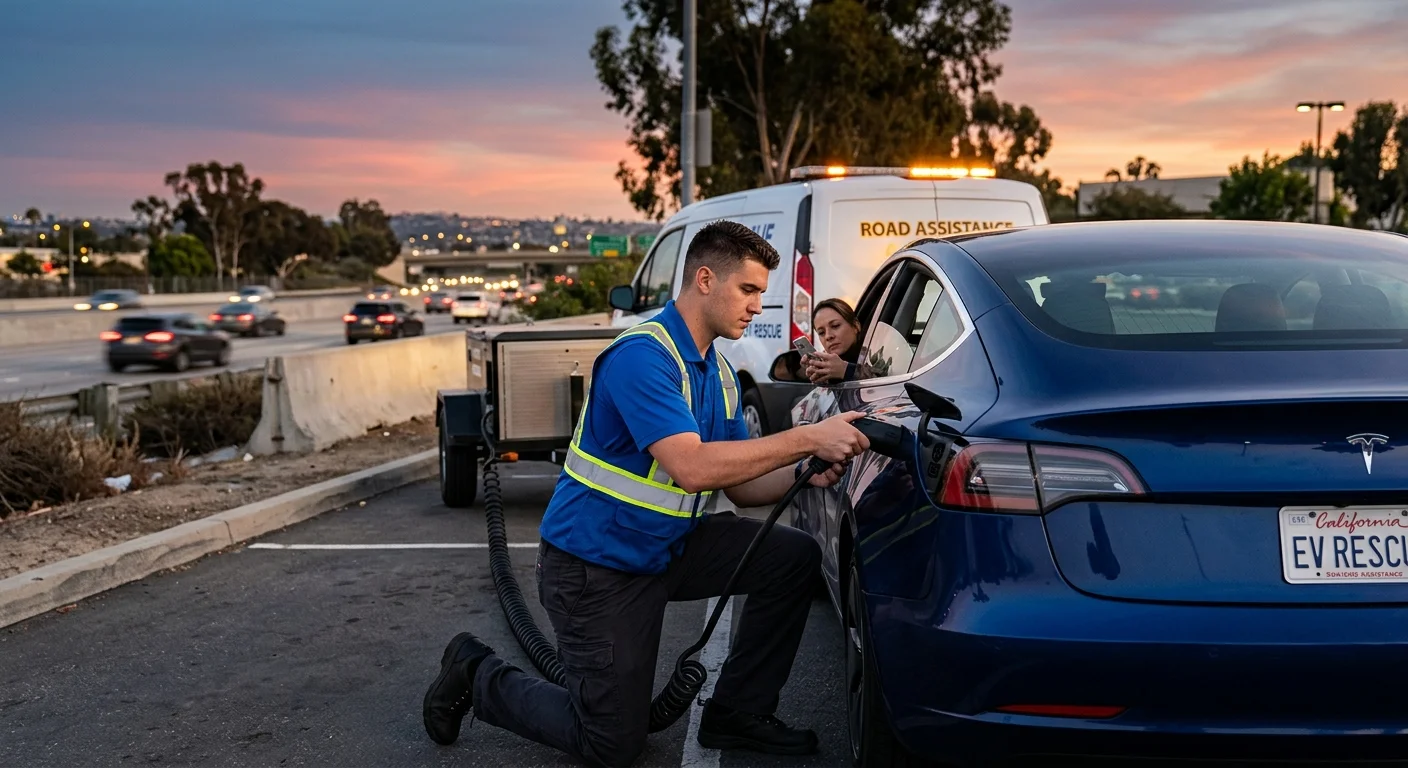
What the Tesla app actually does after hours
Tesla’s roadside flow now lives almost entirely inside the app. You tap Roadside, answer a short triage, and the system assigns a response: a Ranger where available, a contracted tow, or a loaner arrangement depending on the situation. The app shows an estimated arrival at the moment of dispatch. That estimate is set by the contracted vendor’s location, not by the moment you tapped the button.
Two things matter for a night or weekend call in the Puget Sound. First, contracted vendor coverage thins fast east of I-5. A Saturday night request from North Bend, Gold Bar, or out by Stevens Pass may hand off to a vendor an hour from your stop. Second, the dispatch system assumes a working cellular signal and enough 12V power to keep the car reachable. If the 12V is dead, the app cannot ping the car at all, and you are stuck tapping a screen that will not respond. Our Puget Sound EV roadside guide covers the call paths in detail for the entire metro.
Bellevue, Kirkland, and a 10pm I-90 stop
The Eastside has the highest EV density in Washington, with King County at roughly 144,257 registered EVs and Tesla holding about 44 percent of that count. Bellevue alone sits at 14,383 EVs and Kirkland at 8,487. A 10pm stall on I-90 near the East Channel Bridge is exactly the kind of event Tesla’s app is set up to handle. The question is who actually shows up.
If you tap Roadside from the car, Tesla routes to a contracted vendor. In the metro that is usually a local tow operator, and the wait window printed on the screen is set by their dispatch load. A flat tire on a Model Y at Factoria, a 12V that will not wake the car at Bellevue Downtown Park, a charge port stuck at the Bellevue Square Supercharger during a weekend dinner rush. None of these need a Tesla Ranger. They need a person with the right cable or the right key card, and the difference between a 25-minute wait and a 90-minute one is which vendor list you called.
Where the app falls short on weekends
Saturday and Sunday are when the gap shows. Contracted vendors run reduced dispatch on weekends, and the Eastside Tesla Supercharger network gets dense enough that stalls back up. A driver pulling into the Factoria Supercharger at 7pm on a Sunday may find every stall occupied, and the Tesla app will not route them to a private operator who could bring 240V to the car. Our Tesla roadside rescue service is the line that connects a stranded Tesla with an independent local operator in this region.
For a same-state comparison on what Tesla’s own program does and does not cover, our Tesla roadside policy 2026 explainer walks through the warranty language, the out-of-warranty costs, and the places where a third party is the faster path. None of this replaces the Tesla app’s terms. It just gives you a backup plan before you need one.
What to check in the app before assuming help is on the way
Open the Tesla app and look at the Roadside panel. If a request button appears, the system has accepted the call. If nothing appears, the app may be in a state where it cannot reach the car. Take a screenshot of whatever the screen shows. Save the dispatch confirmation if one comes through. That screenshot is the only record of who Tesla said would arrive and when, and it matters if you ever file a dispute.
Do not keep retrying a phone number pulled from an old directory. Phone numbers and contact paths change. The Tesla roadside phone versus app comparison goes through what to prepare for either path. It does not promise which one will pick up first on a Sunday at 11pm in Tukwila.
When the car is in an unsafe position
Treat immediate traffic danger as a 911 call, not a coverage question. If the Tesla is blocking an active lane, stopped on the shoulder of I-405 near Renton with traffic moving at speed, or wedged on a no-shoulder span like the I-90 floating bridge or the SR-99 tunnel, dial 911 and follow what the dispatcher tells you to do.
Once the scene is stable, pull as far off the roadway as you can. Hazards on. Note the direction of travel, the nearest exit, and a landmark. Map pins are useful but they do not replace a written location. A cell signal on the I-90 floating bridge can be flaky. Write the location down.
After the immediate danger is past, the next decision is what kind of help the Tesla needs. A tow, a mobile charge, a tire swap, or a 12V jump are not interchangeable. Our out-of-charge freeway guide walks through the same triage for an empty pack on a freeway shoulder, which is the most common late-night stop on I-5 in South King County.
When a local operator is the faster path
When Tesla’s app does not offer a clean route, when the dispatch window keeps pushing, or when you would rather not wait on a contracted vendor with no ETA you can trust, an independent local operator is another option. We connect Tesla drivers in the Puget Sound with operators who carry 240V mobile charging gear, NACS cables, and 12V jump packs, and the operator quotes the work before starting. The quote is between you and the operator. We are the referral line, not the crew.
Charge Pro SEA is a referral service. We connect drivers with licensed, independent local EV charging professionals. We do not perform roadside work, own rescue vehicles, set operator prices, or provide warranties. Confirm the operator’s service, scope, and payment terms before agreeing to work, and keep the agreement and receipt the operator provides.
For a broader set of questions beyond the Tesla program, our EV roadside assistance service describes how the referral works end to end across King, Snohomish, and Pierce counties. None of this replaces the operator’s quoted terms. It gives you a number to call before the I-90 lane closure at midnight.
Call (206) 202-7018 to reach a local operator.