You’re sitting in a quiet EV on the I-5 shoulder through SODO, AAA on the phone, asking for a charge. In Seattle that request does not always bring a charger. It often brings a 12-volt jump, a flatbed, or a referral, and you should confirm the benefit with AAA Washington before you wait.
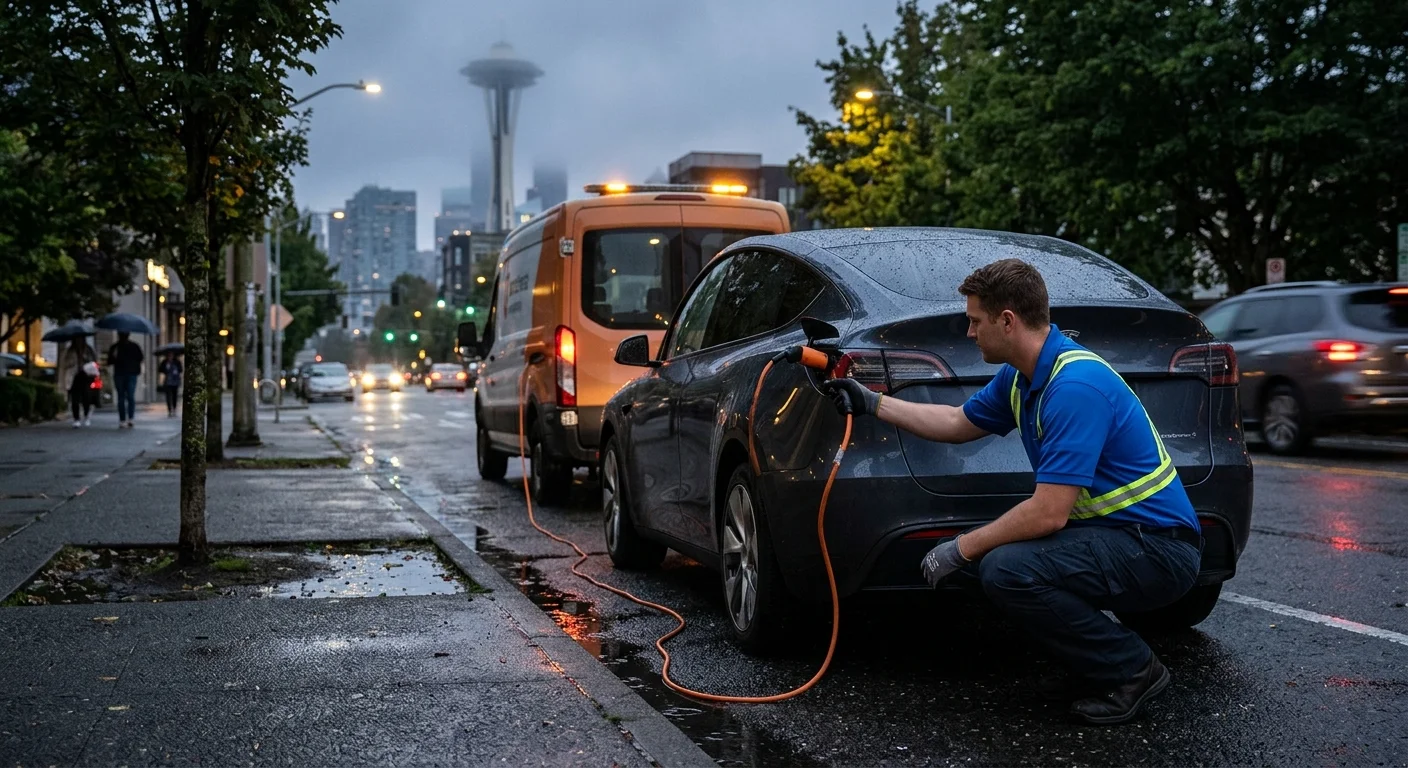
What AAA typically sends for a dead EV
AAA EV roadside assistance is a club product. Mobile charging is a narrower promise. National AAA pages talk about mobile charging in select markets. They do not publish a current, Seattle-specific confirmation that a charger on a truck is what you will get here.
So the honest answer is mixed. Some clubs advertise a roadside boost in named cities. Seattle is not a market we could confirm from public AAA Washington pages. Call your membership line and ask the dispatcher, out loud, whether they are sending a mobile charge, a 12-volt jump, a tow, or a vendor referral.
A dead EV is not one problem. A dark dash with a healthy traction pack is often the 12-volt battery. A car that still boots but shows zero miles is the high-voltage pack. A jump can wake a 12-volt. It does not put miles in a drained pack. Tell the club which one you have.
AAA roadside assistance for Tesla is also not the same as Tesla’s own roadside program. King County has 144,257 registered EVs, and about 44% of them are Teslas (63,017), according to Washington DOL Electric Vehicle Population Data. Many of those owners already have a manufacturer app. The club is a second phone tree, not a duplicate charger.
What typically gets dispatched for a dead EV in a club system is the same menu as a gas car, plus a ride to a plug. Tire, lockout, winch, 12-volt, and a tow to a stall. The charger on a truck is the piece that is market-limited. Treat any app button labeled EV charge as a request, not a guarantee. Ask what equipment is coming, and what connector it carries.
If you already compared club help north of the city, that is a different geography. AAA versus mobile charging in Everett stays in Snohomish County. This page is about Seattle streets, Seattle garages, and Seattle ferry lines.
Mobile charging vs a tow to a public stall
A true mobile charge happens at the car. The operator plugs in, adds enough range to roll, and you drive to a public stall or home. On this network, a typical rescue charge is 10 to 20 miles of range in 15 to 30 minutes of Level 2 charging. That figure is charging time, not arrival. It is enough to leave the shoulder and reach a working plug.
A tow to a public stall is a different night. The car leaves the scene. You then wait for a stall that is open, working, and compatible. Downtown Seattle adds garage ramps and attendants who may not let a wrecker idle in a paid aisle. The tow solved the shoulder. It did not guarantee electrons.
How mobile EV charging works is simple when the truck is built for it. The operator matches the port, NACS or J1772, starts a Level 2 session, and watches the car accept current. When the pack has those 10 to 20 miles, you unplug and drive. That is the point of mobile EV charging: stay with the car and add range when the only problem is an empty pack.
We cannot publish a Seattle price for a mobile charge. Charge Pro SEA does not set one. The matched operator quotes you before work starts. Club plan fees are also not something we can confirm from AAA Washington’s public pages. Do not assume the boost is included. Ask the club. Ask the operator.
Club tows still have a place if the car will not accept a charge or you are in a live lane. WSDOT’s Incident Response Team patrols major corridors, including I-5, and tells drivers to dial 911 for help on the roadway. Their published materials describe motorists who have run out of gas. They do not mention electric vehicles or EV charging. RCW 46.61.590 also requires the driver to arrange prompt removal. If the club is sending a jump for a 0% pack, that is the wrong tool.
Seattle I-5, garages, and ferry-line limits
Seattle is not a wide shoulder town. I-5 through SODO pinches between the stadiums, the busway, and the freight exits. A stopped EV there is in a live weave. SR-99 through the tunnel and along the waterfront is worse for waiting. There is no safe pocket to sit in until the club figures it out. If you are on the state highway, 911 is how you reach highway help.
Downtown garages are a second trap. You can drain a pack circling for a stall off 2nd, 4th, or the Convention Center. Once you are inside, a mobile truck may not have a legal place to idle. Height bars stop some service vehicles. Ask the garage staff where a service vehicle can stand before you request anything.
Ferry lines are the third Seattle-specific limit. Colman Dock (Seattle-Bainbridge and Seattle-Bremerton) and the Fauntleroy triangle stack cars in a queue that is not a charging bay. An EV that dies in line blocks the boat. Terminal staff will want the car moved. A club dispatcher in another city may not know the holding lanes. Get the car off the queue, then charge.
Weather makes the same trip shorter. Across 30-plus EV models, Recurrent Auto found that packs retain about 78% of range at 32°F, roughly a 22% loss. AAA testing at 20°F found temperature alone cut range 10-12%, and cabin heat pushed the loss toward 40%. A Ballard-to-Sea-Tac run that looked like 30 miles in August can be a limp to the shoulder in January.
There is charging in the city. The SEA garage has 94 EV stalls with free Level 2 charging, and regular parking rates still apply, plus two DC fast chargers in the Cell Phone Lot. That helps if you are already at the airport. It does not help on I-5 at Spokane Street. Seattle itself has 45,469 registered EVs, per the Washington DOL EV population data. More EVs means more empty packs on the same constrained streets.
For a broader map of who to call in the city, see EV roadside assistance in Seattle.
When a local charging operator is the better match
Call the club first if you already pay for it and the problem is a tire, a lockout, or a 12-volt. That is classic AAA EV roadside assistance, and it may be the right ticket. Call a local charging operator when the pack is empty, the car will accept a plug, and you need miles added where you sit.
A local operator is the better match when the club cannot confirm a charger, when the app offers only a tow, or when you are in a garage, a ferry queue, or a neighborhood street where a wrecker is the wrong shape. It is also the better match when the nearest public stall is offline, or a mile farther than you have.
Chevrolet, Nissan, BMW, Kia, and Hyundai follow Tesla in King County registrations. Those ports and apps are not identical. The person who shows up needs the right connector, not a generic EV ticket. The club’s national EV perks, trip planners, and charging cash-back cards do not move electrons onto a Seattle shoulder.
Charge Pro SEA is a referral service. It matches you with licensed, independent local operators. It does not own the truck, set the price, or promise an arrival window. The operator quotes you, does the work, and bills you. You are hiring a charging job, not waiting on a club benefit that may not exist in this city.
If you want the roadside version of that job, emergency EV roadside assistance is the path that covers a dead pack, a 12-volt, and the gray area between them. Tell the person on the phone where you are: I-5 south of downtown, a First Hill garage, the Fauntleroy holding lane. Tell them what the car shows: 0%, a 12-volt alert, or a port that will not open.
Confirm the club benefit if you have it. If the answer is a tow or a maybe, switch to a local charge while you still have a phone battery.
When to call us
If your pack is empty on I-5, in a downtown garage, or in a ferry queue, and the club cannot confirm a charger, you need a mobile EV rescue operator. Call us at (206) 202-7018 and we’ll connect you with a local EV rescue operator. The operator quotes the job, plugs in if the car will take a charge, and bills you directly.