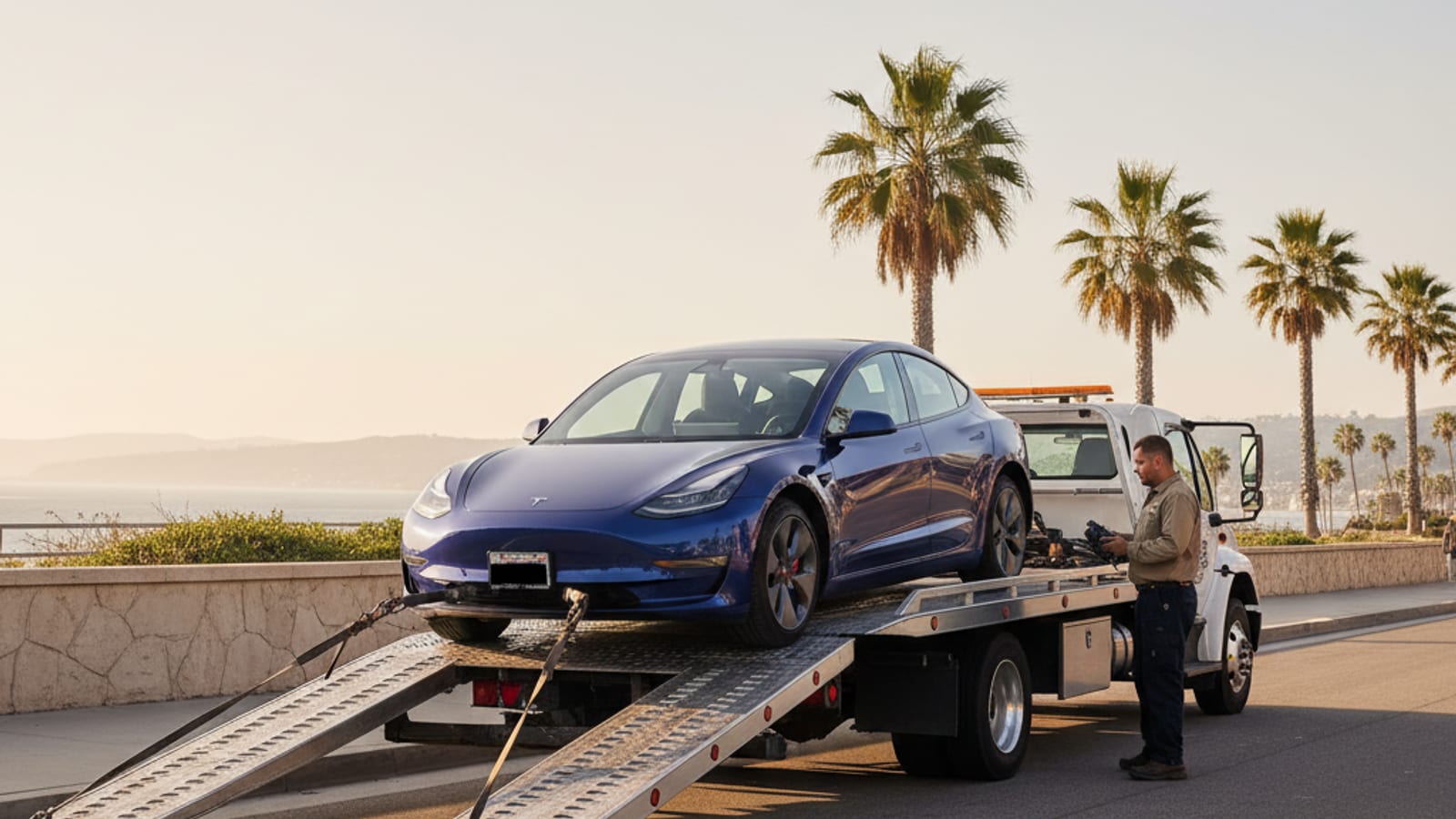
Every EV driver in Snohomish County eventually faces the same choice: call AAA or call a mobile EV rescue service. The two paths do different work. AAA gets the car off the road. A mobile EV charger puts energy back into the pack on the spot. On a Boeing shift change at Paine Field or a US 2 climb toward Snohomish, the difference can stretch into hours.
Here is how the two compare for an EV that has stopped in Everett.
What AAA does for a dead EV here
AAA dispatches a flatbed tow. The truck arrives, lifts all four wheels, and hauls the EV to a charging station, a dealership, or your home. AAA does not carry portable EV charging equipment on standard trucks in our region, and the published AAA service descriptions in this market mention running out of gas for ICE vehicles, not on-site charging for EVs.
A typical sequence for a dead EV:
- You call AAA and report a dead EV.
- The dispatcher sends the nearest flatbed.
- The truck arrives on the flatbed company’s schedule, which shifts with traffic on I-5 and SR 99.
- Your EV is loaded and taken to the nearest charging site or a shop.
- You ride along or arrange separate transportation.
- At the charger, you wait 30 to 60 minutes for enough energy to drive home.
Total time from call to driving: 2 to 6 hours, and longer if the flatbed has to cross the I-5 / US 2 interchange to reach the closest usable charger.
What a mobile EV charging service does
A mobile EV charging service connects you with an operator who brings portable charging equipment to your location.
- You call or text, report location and vehicle.
- The matched operator routes toward you from their current position in the metro.
- The operator plugs in and delivers 10 to 20 miles of range in 15 to 30 minutes.
- You drive away under your own power.
No tow, no ride to a station, no waiting at a public charger. You stay where you stopped, whether that is a Paine Field parking lot, a residential street in the View Ridge/Madison area, or the shoulder of US 2 west of Snohomish.
How the two compare in Everett
| Situation | AAA Plus | Mobile EV charging |
|---|---|---|
| Tow coverage | Up to 100 miles | Not needed |
| EV charging on-site | Not standard | 10 to 20 miles in 15 to 30 minutes |
| 12V battery jump | Yes | Yes |
| Stuck charge port | Not the focus | Often handled on site |
| Time to driving | 2 to 6 hours | 15 to 30 minutes once on site |
| Membership required | Yes | No |
The math is straightforward. AAA’s annual fee covers a tow. A mobile EV charger has no membership, the operator quotes and bills per visit. If you only need help once a year, AAA may not pay back. If time matters, a tow is the wrong tool, since you still need to wait for charging at the destination.
When AAA is the better choice
AAA makes sense when:
- The EV has a mechanical problem, not a dead battery, like suspension failure, collision damage, or a flat on a wheel that cannot take a spare.
- The car is outside mobile coverage, a remote stretch of US 2 east of Monroe or a logging-road pullout where mobile operators do not dispatch.
- You need the vehicle moved to a specific shop, warranty work at a dealership, or specialized bodywork.
- You already keep AAA for your ICE vehicles and the EV inherits the membership.
When mobile EV charging is the better choice
Mobile charging fits when:
- You are out of charge on a freeway shoulder, on I-5 near the Marine View Drive exit, on US 2 west of Snohomish, or on I-405 south toward Lynnwood.
- Your 12V battery died. Modern EVs use a small 12V system to wake up the high-voltage contactors. When it fails, the car is dead even with a full pack. Operators carry jump gear for EV systems.
- Your charge port is stuck. A charging van can free a latched port where a flatbed cannot.
- You are in a parking structure, such as the airport garage or a downtown garage, where a flatbed cannot fit and a charging van can.
- Time matters, a Boeing shift, a flight from Paine Field, or a kid pickup window.
Tesla roadside as a third path
Tesla’s own roadside covers towing, tire changes, lockouts, and some 12V jumps for in-warranty vehicles. What it generally does not cover is on-site charging. The default Tesla response to an empty pack is a tow to a Supercharger, and that path has the same 2 to 6 hour profile as AAA for many Snohomish County locations. Mobile EV charging fills that gap.
The bottom line
A dead EV is an energy problem, not a moving problem. A flatbed solves the wrong one. Mobile EV charging is the same logic as bringing a fuel can to a stranded gas car: the car is fine, it just needs energy at its location.
For a broader look at how we connect drivers across the region, our Puget Sound EV roadside guide walks through service coverage in more detail.
Need a charge in Everett or anywhere in Snohomish County? Call (206) 202-7018 to reach a local operator.