The traction pack hits zero on US-2 toward Stevens Pass and the car stops rolling. You are on a mountain state highway, past the last valley towns, in weather that can change the job from a charge to a tow. Get the hazards on, stay out of the travel lane, and report a pin a matched operator can actually use.
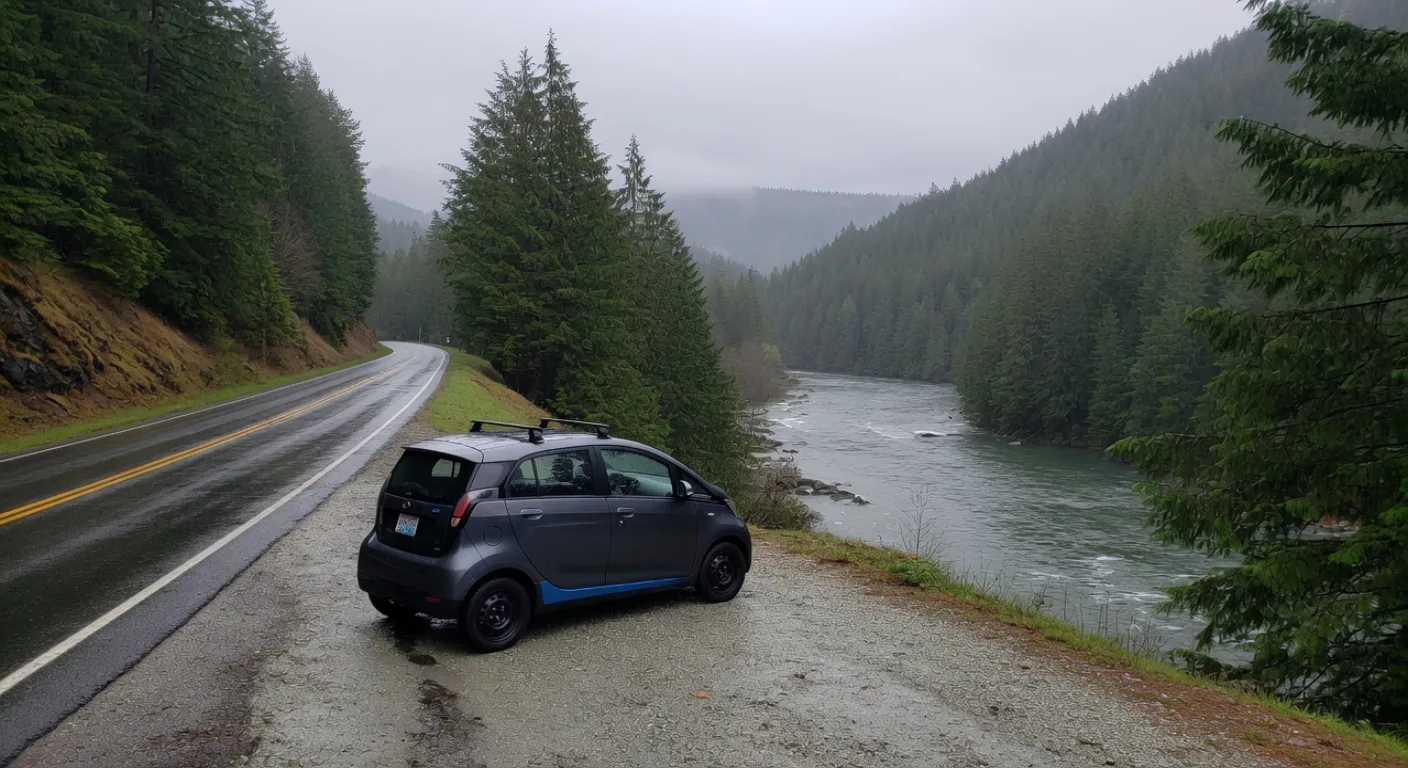
Why the pass climb is a different empty-pack job
Stevens Pass is the US-2 mountain crossing east of Monroe, Sultan, and Gold Bar. Those three towns are still in the service area. The climb itself is a committed grade. Range falls. Cabin heat runs. Traction rules can appear in the same hour.
Snoqualmie Pass on I-90 sits at 3,022 feet and is a different highway. Do not mix the two passes on the phone. If you are on I-90, say I-90. If you are on US-2, say US-2 and Stevens Pass.
A Stevens Pass summit elevation is not published here. Two sourcing attempts on WSDOT and USGS did not yield a figure we could verify. Describe the climb as a mountain grade. Check WSDOT’s pass page for live conditions.
Closures and traction-tire requirements are announced storm by storm under RCW 46.37.420 and WAC 204-24. There is no fixed seasonal calendar. If WSDOT has chain control or a closure, that is a removal problem before it is a charging problem.
WSDOT’s Incident Response Team responds to incidents on state highways, from flat tires and running out of gas to major collisions. Published IRT materials mention gas. They do not mention electric vehicles, out-of-charge packs, or mobile charging. Dial 911 to reach help on the roadway.
Gold Bar’s empty-pack page covers the stretch east of Gold Bar as the road commits. Sultan covers the town between Monroe and Gold Bar. This page is the pass climb itself: weather, traction, and the charge-versus-tow fork when you are already on the mountain.
How to report a pin on US-2
Start with the route and the direction. Toward the pass, or back toward Gold Bar and Monroe. Add the nearest visible road, a map pin, a sign, a trailhead, or a business name. Say whether you are on the roadway, a turnout, or private property.
Read labels exactly as they appear. Don’t guess at a mile marker. If your navigation app and a visible sign disagree, share both.
Also explain which side of the road you’re on. A pin can appear close while still directing someone toward the opposite side. Mention barriers, snowbanks, or closed gates.
Cellular signal thins on the climb. Send the pin while you still have a bar. If the 12V is also dying, the car may stop answering the app. Say that.
Recurrent Auto’s testing across 30-plus models found EVs keep about 78% of range at 32F. AAA testing at 20F found temperature alone cut range 10-12%, and cabin heat pushed the loss toward 40 percent. A pass climb in the wet cold spends that margin on the grade, not on a city loop.
Charge versus tow on a mountain shoulder
A 15 to 30 minute Level 2 connection adds roughly 10 to 20 miles. On a valley floor that can reach the next town. On a pass climb, 10 to 20 miles may not clear the grade, the weather, or the next traction control.
A mobile charge still wins when you are in a legal turnout, the car can take AC, and 10 to 20 miles gets you to a lot or back toward Gold Bar. The published rescue equipment is a Tesla Cybertruck with an integrated 240V / 9.6 kW bed outlet, a NACS plug, and a CCS adapter.
A tow wins when you are in a live lane, in chain control, in a closure, or past the point where a short charge still leaves you on the mountain. Chapter 46.55 RCW governs towing and impound. RCW 46.61.560 lets a disabled vehicle stop when stopping is unavoidable. RCW 46.61.590 still requires prompt removal.
Tesla Roadside states that when the battery charge is depleted, Tesla can assist, but “this is not a financially covered service.” Tesla’s North America roadside window is 4 years or 50,000 miles. Do not wait on a covered pack charge Tesla has not promised.
Charge Pro SEA is a referral service. It matches you with a licensed, independent local operator for out-of-charge recovery. It performs no work and owns no trucks. The operator quotes and bills you. Ask whether they can reach this stretch of US-2 before anyone rolls.
If the car is dark with range still showing, that is a 12V. Jump that in town before you commit to the pass.
Call (206) 202-7018 with US-2, direction, pin, weather, and whether the car still rolls.