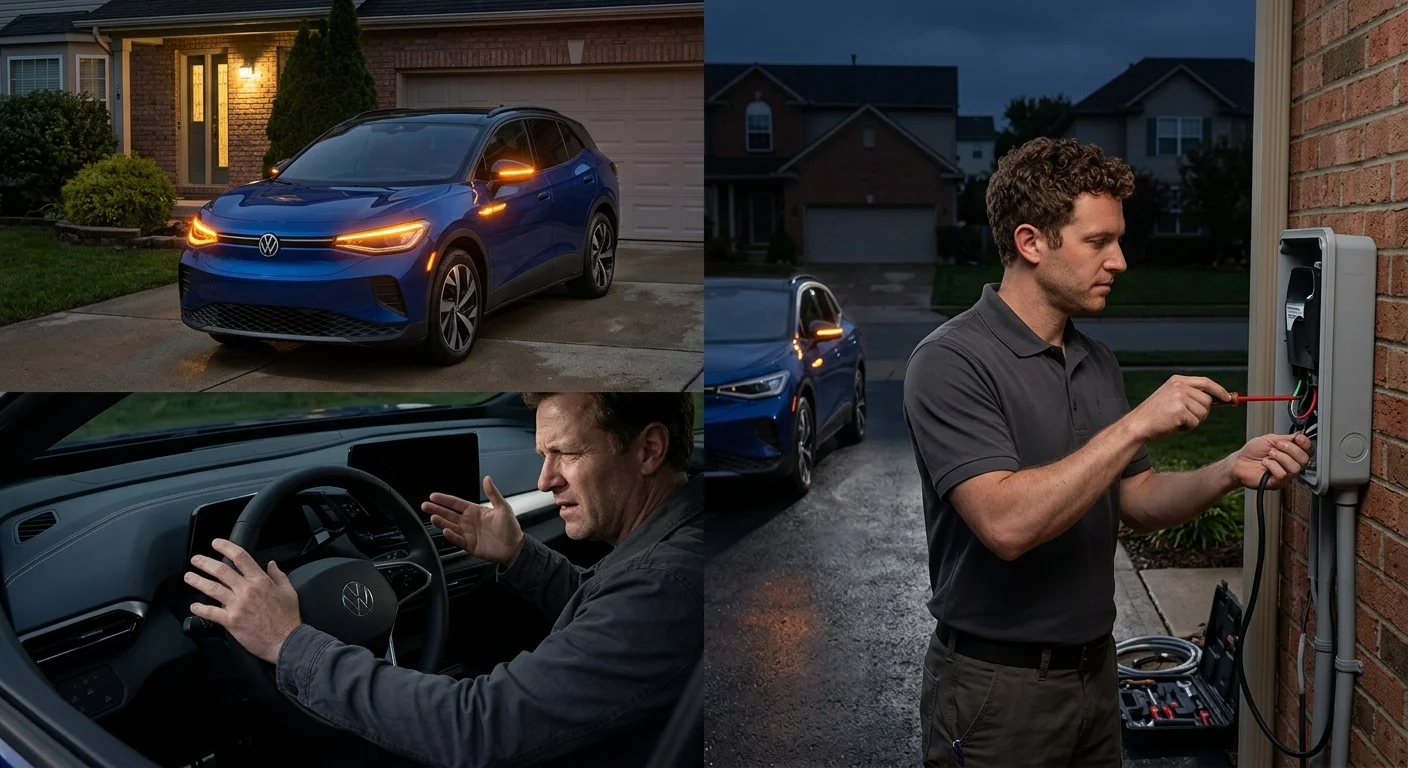
Your VW ID.4 is a solid EV, but like many modern electric vehicles, it relies heavily on a conventional 12V battery for its critical low-voltage systems. Many ID.4 owners have discovered that this smaller battery can fail prematurely, leaving their vehicle completely unresponsive. If your ID.4 will not start, or has gone dark, chances are you are facing this known 12V battery problem.
Understanding the known 12V battery issues in the VW ID.4
It is no secret among EV enthusiasts and VW ID.4 owners: the 12V auxiliary battery can be a weak link in an otherwise impressive electric vehicle. This is not unique to Volkswagen. Many modern electric vehicles experience similar issues with their 12V systems. What makes it particularly frustrating for ID.4 drivers is the frequency and often sudden nature of these failures. This small, lead-acid battery powers crucial low-voltage functions like the infotainment system, door locks, power windows, headlights, and the high-voltage contactors that connect the main drive battery to the propulsion system.
When this 12V battery dips below a critical voltage, even if your large traction battery is fully charged, your ID.4 becomes a very heavy paperweight. You cannot unlock doors, even with the key fob, engage the gear selector, or turn on the dashboard. It is a frustrating situation that often leaves owners stranded, especially since the main battery is perfectly fine. Volkswagen has issued software updates over time to better manage 12V battery health and charging, but the underlying issue still affects a meaningful number of vehicles, particularly older models or those driven in extreme temperatures. Understanding what happens when an EV 12V battery dies is key to recognizing and addressing this common problem promptly.
Why the Puget Sound speeds it up
The local climate and parking pattern compound the ID.4 12V weakness in a specific way.
Days parked in the rain without a trickle. The metro sits in a 35 to 45F band for months, and most days include measurable rain. A lead-acid 12V battery kept below 40F for weeks loses effective capacity, and the constant humidity keeps the terminals slightly damp. The ID.4’s parasitic draw on the 12V (alarm, keyless entry, network standby) adds up over a long dwell.
Older housing stock without assigned parking outlets. Roughly 46.6 percent of King County housing predates 1980. A typical pre-1980 apartment building has no outlet at the parking stall. The ID.4 owner in that building is on public charging only, with 4 to 7 days between sessions. The 12V sees the gap.
Wet snow on the passes. A driver heading to Snoqualmie or Stevens Pass in a winter storm can park at a trailhead for 4 to 6 hours. The cold soak plus the dashcam’s parking mode drops the 12V past the boot threshold. The owner returns to a dead car in sub-freezing air.
The combined effect is that an ID.4 that might last 4 to 5 years on the 12V in a milder climate shows failures at year 3 to 4 here.
Warning messages to watch for before you are stranded
Often, your ID.4 will try to tell you something is wrong with its 12V system before it completely gives up. Paying attention to these warnings can save you from a major headache. Keep an eye out for dashboard messages like “12V Battery Low,” “Electrical System Fault,” “12V System Malfunction,” or “Stop Safely Now” combined with other electrical anomalies. These are not always definitive of a 12V battery death, but they are strong indicators that something is wrong.
Beyond explicit warnings, you might notice other unusual behavior. The infotainment screen could take longer to boot up, or it might glitch more frequently. Power windows might operate sluggishly, or the automatic door locks could hesitate. Some owners report odd sensor readings or even the car randomly switching into Park mode while stationary. Do not ignore these signs. If your ID.4 starts behaving erratically, especially with its electrical accessories, it is a good idea to have your 12V battery checked by a professional. Taking proactive steps can prevent you from finding your car completely unresponsive when you least expect it, especially when you are rushing to work in I-5 traffic.
What happens when the 12V battery fails
When the 12V battery in your VW ID.4 completely fails, the effects are immediate. Your car essentially “bricks,” becoming totally unresponsive. The dashboard goes dark, the car will not respond to the key fob, and you cannot shift into drive. This happens because the 12V battery is the linchpin for all the low-voltage electronics that control the car’s operations. Without it, the car’s computers cannot boot up, communicate, or execute any commands.
Specifically, the 12V battery energizes critical relays and contactors that allow the massive high-voltage traction battery to safely connect to the rest of the car’s propulsion system and charging components. Without that low-voltage power, these contactors remain open, preventing any power flow from the main battery, even if it is fully charged. It is a fundamental safety mechanism to isolate the high-voltage system, but it also creates a vulnerability. This is why a fully charged EV can still leave you stranded due to a small, relatively inexpensive, failing 12V battery.
How to safely access the battery for a jump start
If your VW ID.4 is dead due to a 12V battery issue, a jump start can often bring it back to life temporarily. Unlike traditional gas cars, the actual 12V battery in the ID.4 is not always easily accessible or directly under the hood. Volkswagen designed specific remote jump-start terminals under the hood to make this process safer and simpler. You will find these terminals located in the front passenger side compartment, beneath a protective cover.
Here is how to safely jump start your ID.4:
- Gain access. First, you will need to open the hood of your ID.4. If the central locking is not working due to the dead 12V battery, use the physical key blade hidden inside your key fob to manually open the driver’s side door. Then, locate and pull the hood release latch from inside the car, typically in the driver’s footwell.
- Locate the jump-start terminals. Once the hood is open, look towards the passenger side of the engine bay, near the windshield washer fluid reservoir. You will find a red cap, which covers the positive terminal. Nearby, there should be a clearly designated metal ground point.
- Connect jumper cables safely.
- Connect the red positive clamp of the jumper cables to the positive terminal of the donor vehicle’s 12V battery.
- Connect the other red positive clamp to the red positive terminal under your ID.4’s hood.
- Connect the black negative clamp to the negative terminal of the donor vehicle’s 12V battery.
- Connect the other black negative clamp to the designated metal ground point under your ID.4’s hood. Do not connect it directly to the negative terminal of your ID.4’s 12V battery itself, if visible.
- Start the donor vehicle. Let the donor vehicle run for at least 5 to 10 minutes.
- Attempt to start your ID.4. With the cables still connected, try to power on your ID.4. If successful, you should hear the system come alive, and the dashboard will light up.
- Disconnect cables in reverse. Once your ID.4 is powered on, carefully disconnect the cables in the reverse order.
Remember, a jump start is a temporary fix. The underlying problem, a failing 12V battery, still needs to be addressed, usually with a replacement. If you are not comfortable performing these steps yourself, it is always best to call a professional.
Getting a mobile 12V jump in the metro for your ID.4
When your VW ID.4 will not start in the Puget Sound, navigating traffic or arranging a tow to a dealership can be a huge hassle. That is where Charge Pro SEA comes in. We connect drivers with operators who provide non-Tesla EV rescue services right to your location, whether you are at home in Edmonds, at work in Bellevue, or stranded in a parking lot in Renton. Operators know EV electrical systems, including the unique requirements and diagnostics of the VW ID.4’s 12V battery.
The operator arrives equipped with the right tools and knowledge to safely jump start your ID.4, getting you back on the road without the need for an expensive tow. We understand the specific jump point locations and safety protocols for Volkswagen electric vehicles. We also offer specialized Tesla 12V battery jump services, and our expertise extends to all major EV brands. For ID.4 owners facing a dead 12V battery, we are a fast, reliable option.
When to call
While knowing how to jump start your ID.4 is useful, it is not always practical or safe to do it yourself. You might not have jumper cables, a donor vehicle, or feel uneasy working with car electrics. The risk of improper connection can damage sensitive EV electronics. If you are stranded, unsure about the process, or simply want a professional to handle it safely, that is when you should call Charge Pro SEA. We connect drivers with local operators who can offer advice on the best next steps for a permanent 12V battery fix. For reliable, on-demand roadside assistance for your EV in the Puget Sound, we are here to help.
Call (206) 202-7018 and we will connect you with a local operator who quotes you before starting.
Frequently asked questions
Are Volkswagen ID.4 12V battery failures common?
Yes. The 12V auxiliary battery is one of the most reported weak points on the ID.4, and the failures often hit early models hardest. The battery is small for the electrical load it carries, so it wears faster than owners expect. Volkswagen has pushed software updates to manage charging better, but a lot of cars still go dead, especially ones that sit unused or live in cold damp weather.
Why does the Volkswagen ID.4 12V drain prematurely?
The ID.4’s 12V battery powers the infotainment, locks, contactors, and standby electronics, and it keeps drawing current while the car is parked. On a battery that is already undersized, that parasitic draw adds up. If the car sits for a week or two, or the battery is a few years old, it can drop below the voltage the car needs to boot. The local cold-soak in unheated garages speeds the wear up.
What are the warning signs before an ID.4 12V dies?
Watch for “12V Battery Low,” “Electrical System Fault,” or “Stop Safely Now” messages, an infotainment screen that boots slowly or glitches, sluggish power windows, and door locks that hesitate. Any of these means the 12V is failing. Have it tested before it leaves you stranded.
Does Charge Pro SEA jump a dead Volkswagen ID.4 in the metro?
Yes. Operators respond to ID.4 and all non-Tesla EVs across King, Snohomish, and Pierce counties, arrive with the right jump equipment, and know the ID.4’s under-hood jump points. The operator confirms their arrival window with you on the phone. Call (206) 202-7018 to confirm availability for your area.