A Tesla that won’t wake up may need low-voltage help, not charging. In Federal Way, a matched local operator can test the 12V system, attempt the correct jump procedure, and explain the next step.
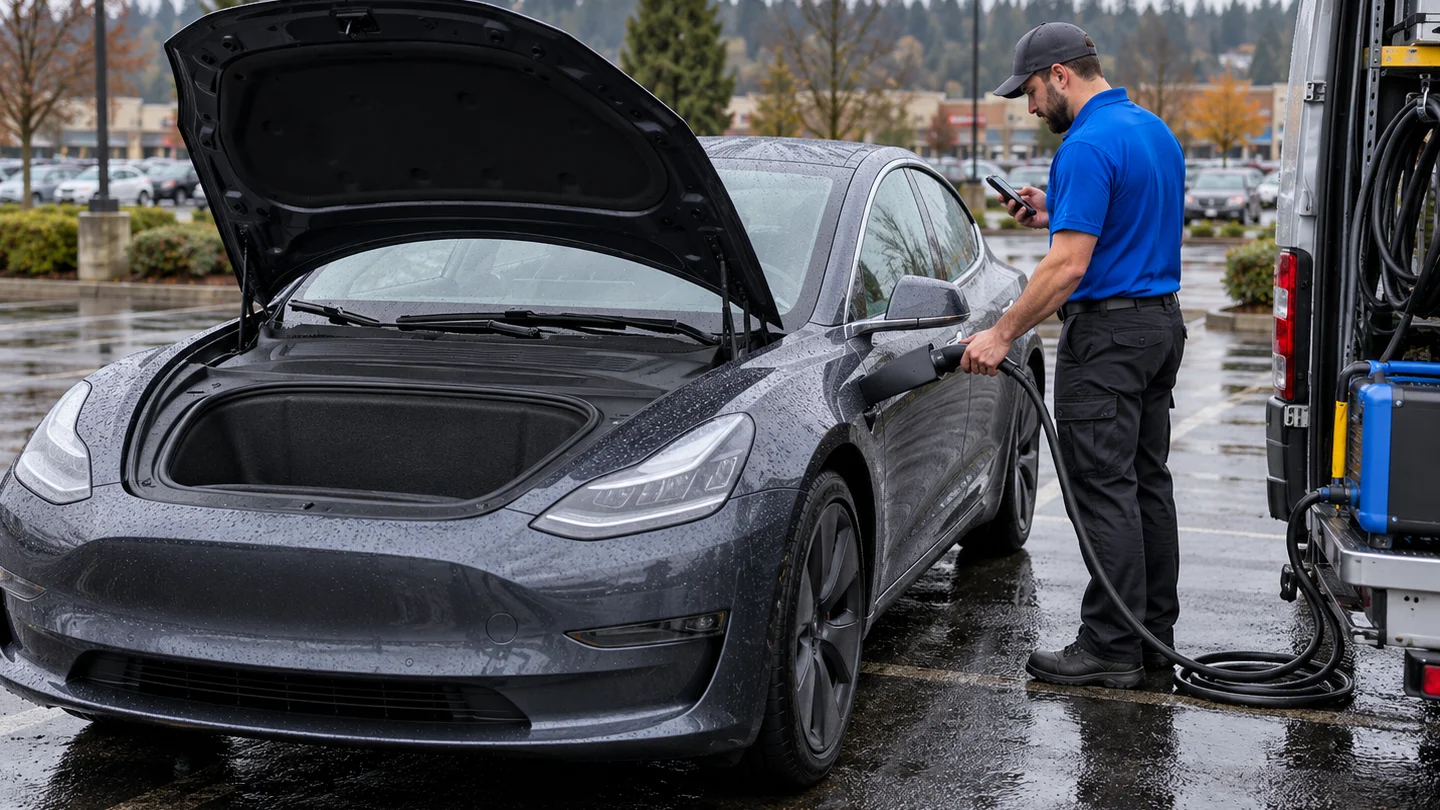
How a 12V failure differs from an empty pack
A dead low-voltage battery and an empty traction pack require different roadside services. Knowing which problem you have helps the operator bring the right equipment.
Start with the information you can still access. Note any warning shown in the Tesla app or on the vehicle display. Tell the operator whether the doors respond, the screen wakes, or the charging state remains visible. Don’t treat one symptom as a final diagnosis. Give the operator the complete picture instead.
If the main pack has usable charge but the car remains unresponsive, ask for low-voltage testing. A matched operator can jump the dead 12V system on site and load-test it. If the battery fails that test, the operator can discuss replacement. Tesla vehicles may use an AGM lead-acid or lithium low-voltage battery, depending on the model year and build details.
A completely depleted traction pack calls for a different response. That situation may need mobile charging or a tow rather than a low-voltage jump. Our guide to a dead Tesla 12V battery versus an empty main pack explains that decision in more detail.
Don’t use another Tesla as the donor vehicle. Tesla’s service documentation states that its vehicles cannot be used to jump-start another vehicle because damage can result. That warning appears across Tesla’s Model 3, Model S, Model X, Model Y, and Cybertruck documentation.
If you’re unsure which battery caused the problem, don’t guess. Request Tesla 12V battery jump help and describe what the car is doing. The operator can quote the available options before starting. You’ll contract with and pay that independent operator directly.
Federal Way lots, garages, and I-5 stops
Location changes the first priority. A Tesla sitting in a Federal Way parking lot creates a different problem from one stopped beside I-5.
In a lot or parking structure, identify the exact entrance before requesting help. Share the floor, row, stall, and nearest visible marker. If the structure has several entrances, say which street provides access. Pacific Highway South and nearby commercial areas can include several separate lots within one destination. A precise meeting point helps the matched operator understand the scene.
Check whether the vehicle has clear working space around the front. Tell the operator about barriers, restricted areas, tight walls, low clearances, gates, ramps, or blocked access. Those details affect which service approach may be practical.
For a stop near an SR-18 approach, share your direction of travel and the nearest safe landmark. Don’t describe your position only as “near Federal Way.” The same rule applies around I-5. Give the direction, nearby exit, and whether the car is on a shoulder, ramp, lot, or surface street.
Roadway safety comes first. The WSDOT Incident Response Team handles incidents on state highways, including disabled vehicles. WSDOT directs drivers to dial 911 for roadway help. Washington law also requires drivers to arrange prompt removal of a disabled vehicle.
Once you’re safely away from moving traffic, request the service that matches the symptoms. The broader Federal Way EV roadside guide covers towing, charging, and other roadside situations. A Tesla-specific low-voltage call should identify the model, model year, location, and visible warnings.
What Tesla’s manual says about jump points
This page doesn’t provide a universal jump-point instruction. Check the current Tesla documentation for your exact vehicle before touching covers, leads, or terminals.
Tesla’s service documentation identifies a battery chemistry change tied to production. Vehicles built in Gigafactory Shanghai before about October 2021, and Fremont before about December 2021, have a lead-acid low-voltage battery. Vehicles built after those dates have a lithium-ion low-voltage battery.
That split matters when arranging service. Don’t identify the battery type from the registration year alone. If you don’t know the factory or production timing, say so. The operator can use the vehicle details and current model documentation to choose the correct approach.
Avoid following a photo from another model. A Model 3 image doesn’t establish the correct jump points for a Model S, Model X, Model Y, or Cybertruck. Even two cars with similar body styles may not share the same low-voltage setup. That’s why this page doesn’t repeat a universal cable sequence.
Tesla’s published warning about donor use is clear. A Tesla must not be used to jump-start another vehicle. That instruction applies even when another stranded driver only needs a low-voltage jump.
If you plan to inspect the procedure before help arrives, use Tesla’s current service documentation for your model.
Our model-by-model Tesla jump guide provides more context, but the current manual remains the authority for the vehicle in front of you. When the model, build, or battery type remains uncertain, a local operator can inspect the setup before attempting a jump.
When to request a local jump operator
Request a local jump operator when your Tesla has usable main-pack charge but won’t wake or respond normally. It’s also the right request when a low-voltage warning appeared before the car became unresponsive.
Have the model, model year, exact location, and visible messages ready. Mention whether the car is inside a garage, behind a gate, beside I-5, near Pacific Highway South, or close to an SR-18 approach. Describe access without guessing at the battery type.
Charge Pro SEA is a referral service. We connect Federal Way drivers with licensed, independent local operators. We don’t perform the jump, own roadside equipment, set the operator’s price, or promise an arrival time.
The matched operator can attempt an on-site low-voltage jump and load-test the battery. If testing shows the battery has failed, the operator can discuss on-site replacement using the battery type appropriate for the model year. Availability can vary, so confirm the service and quote before work begins.
If the traction pack is empty instead, say that during the request. A low-voltage jump doesn’t replace energy in the main pack. Tesla roadside rescue may involve mobile charging, low-voltage assistance, or another recovery plan based on the actual problem.
Keep your request focused. “Tesla won’t start in Federal Way” is useful, but more detail is better. State whether the app connects, whether the display wakes, what charge level is shown, and whether any low-voltage message appeared. While waiting, gather the vehicle details and keep the current Tesla manual available for the operator.
If you’re in moving traffic or an exposed highway position, contact emergency services first. A battery diagnosis can wait until the scene is safe.
When to call us
Call when your Tesla won’t wake, shows low-voltage trouble, or needs testing before a jump or replacement decision. A mobile EV rescue operator can inspect the vehicle and quote the appropriate service.
Call us at (206) 202-7018 and we’ll connect you with a local EV rescue operator.