The traction pack hits zero on SR-520 and the car stops rolling. You’re on a state route over Lake Washington, not a city block with a charger around the corner. Get the hazards on, stay out of live lanes, and work the next move from the spot you actually stopped: the Montlake approach, the Evergreen Point Floating Bridge, or the Bellevue landing toward I-405.
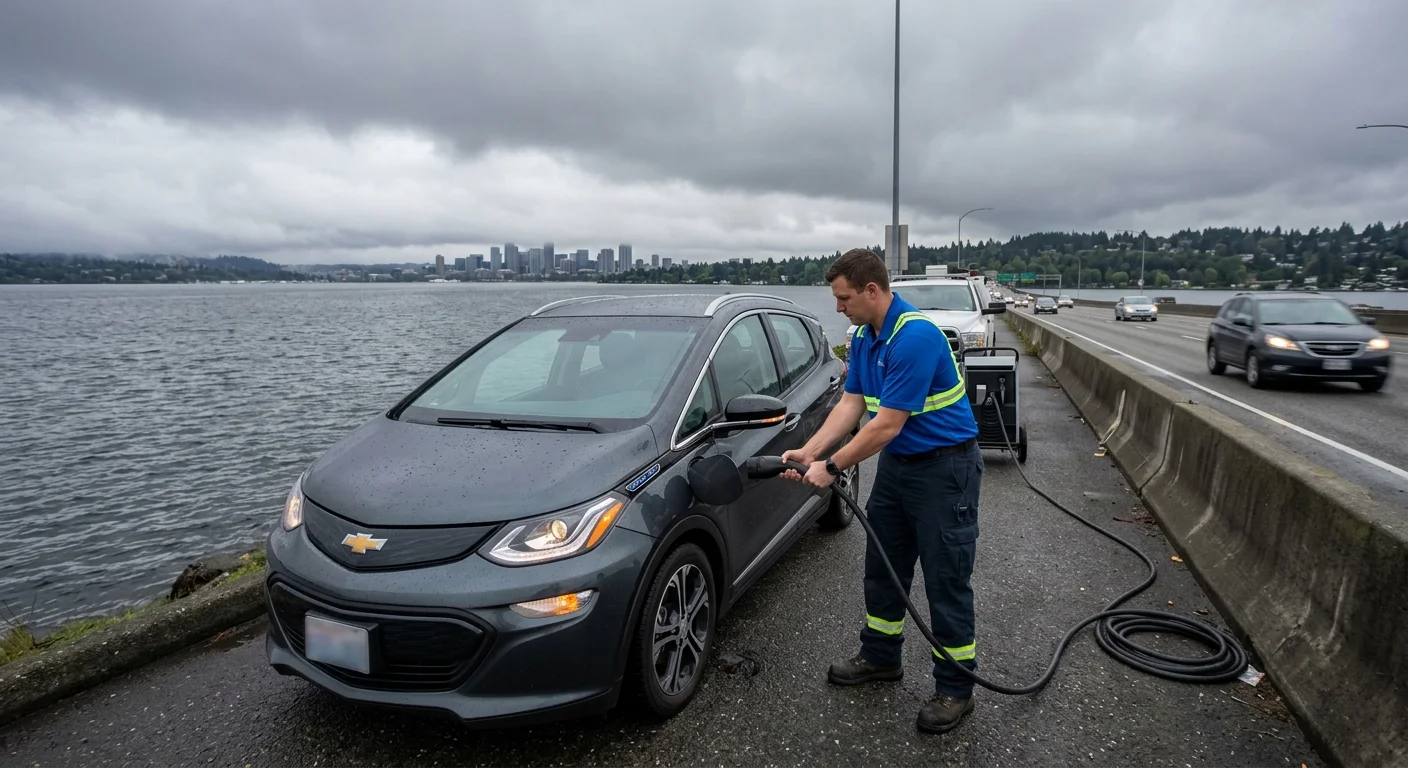
Why 520 is a hard place to go empty
SR-520 is a cross-lake commute, not a wide inland freeway. The west end leaves Seattle at Montlake and Portage Bay. The middle is the Evergreen Point Floating Bridge, still a floating span on Lake Washington. The east end comes ashore through Medina and the Evergreen Point lids, then feeds Bellevue toward I-405.
Water sits on both sides of the span, and the right-of-way is tight. A public charger on the open lake wasn’t confirmed as a usable rescue option from WSDOT’s public materials. Plan as if you stay with the car until a matched operator or Washington State Patrol can help.
King County holds 144,257 registered EVs, per Washington DOL figures on data.wa.gov. Seattle accounts for 45,469. Bellevue has 14,383. Redmond has 10,135. Kirkland has 8,487. Those counts feed this crossing every weekday. Tesla makes up about 44% of King County’s EV fleet. The car beside you is often electric. That still doesn’t put a plug in the middle of the lake.
Winter makes the trap sharper. Recurrent Auto’s testing across 30-plus models found EVs keep about 78% of range at 32F, a 22% loss. AAA testing at 20F found temperature alone cut range 10-12%, and cabin heat pushed the loss toward 40%. A Bellevue commute that looked fine in August can fail over the water in January.
The current SR-520 toll wasn’t confirmed for this page. WSDOT sets it, and it changes by time of day. Check the agency’s SR-520 toll information or your Good To Go account once you’re safe. An empty pack is the emergency. The bill isn’t.
Whether the bridge is closed is a live WSDOT call. Use the WSDOT travel map or 511. Specific wind-closure thresholds weren’t confirmed here.
If you’re already stopped in a travel lane, treat it as a roadway incident. WSDOT’s Incident Response Team responds to incidents on state highways, from flat tires and running out of gas to major collisions. Teams are on call 24/7 and patrol major corridors during peak hours. Published IRT materials mention motorists who’ve run out of gas. They don’t mention electric vehicles, out-of-charge packs, or mobile charging. Dial 911 to reach help on the roadway.
Montlake, the bridge, and the Bellevue landing
Say where you are in plain words. A matched operator, and WSP, need a side of the lake and a direction, not “I’m on 520.”
Montlake
The west approach sits in Seattle by Montlake Boulevard, the Montlake Cut, and Portage Bay. Ramps stack, and lids cover parts of the highway. If you go empty here, you’re still in the city, but you’re on a state route with freeway speeds. Don’t assume a neighborhood charger is a short, legal walk. Stay with the vehicle unless a trooper tells you to move. Note whether you’re westbound toward I-5 or eastbound toward the lake, and say Montlake.
The floating bridge
The Evergreen Point Floating Bridge is still a floating bridge. Pontoons hold the deck on the lake. Shoulder rules for this span weren’t confirmed on WSDOT’s public pages for this article, so follow posted signs. If you’re in a live lane, stay in the car with the hazards on and wait for WSP. Don’t climb the barrier or walk the deck looking for a charger. If you can give a milepost, a direction, and “on the floating bridge,” say all three.
This crossing isn’t the I-90 bridge. Mercer Island sits on I-90, south of here. If you meant the island, use the Mercer Island charging guide. Mixing the two floating bridges wastes the first phone call.
The Bellevue landing
East of the lake, 520 comes ashore through Medina and the Evergreen Point lids, then runs into Bellevue toward I-405. It’s still SR-520 until you actually leave it. If you stop on the lids, say Medina or Evergreen Point, plus eastbound or westbound. If you stop at the 405 merge, you’ve left the 520 problem and entered an Eastside freeway problem. That’s a different corridor, covered in our out of charge on I-405 guide. Don’t count on coasting into a Bellevue charger if the car has already stopped. Stay put, make the safety calls, then line up a mobile charge or a tow.
Charge, jump, or wait for a tow
First, separate an empty pack from a dead 12-volt battery. They feel similar from the driver’s seat, and they’re not the same job.
An empty pack is a traction battery at or near 0%. The car drove until it couldn’t. Screens may still work. That’s an out-of-charge recovery job. A local operator brings a charger to the car, or the car is towed to a charger. Charge Pro SEA doesn’t bring the truck. It matches you with a licensed, independent operator who quotes you and bills you directly.
A typical rescue charge adds 10 to 20 miles of range in 15 to 30 minutes of Level 2 charging. That window is charging time, not travel time to you. Nobody here can promise when a truck arrives. Once there’s enough range, the usual goal is the nearest charger you can actually reach, not a full pack on the shoulder.
A dead 12-volt is different. Lights and screens go dark. The big pack can still hold range. Jumping the 12-volt can wake the car. Charging the traction pack won’t, if the 12-volt is the failure. Tell the operator what the dash did before it died. They’ll sort it on site. Don’t stand in a 520 lane with jumper cables.
Mobile EV charging is the on-the-spot option when the car is stable and the pack is the problem. A tow is the option when you can’t be reached safely, the car has to leave the roadway now, or charging on site isn’t workable. Chapter 46.55 RCW governs towing and impound in Washington, including the registered tow truck operator system. RCW 46.61.590 requires the driver to arrange prompt removal. You don’t get to camp on 520 because a charger is “on the way.”
If WSP or IRT is already on scene, follow their instructions over any app. They own the live roadway. Price is between you and the operator. Charge Pro SEA sets no fees, discounts, or waivers. Ask for the quote before work starts.
How to stay safe until a local operator is matched
Put the hazards on. If you’re in a travel lane, stay inside unless the car is on fire or a trooper tells you to get out.
Dial 911 if you’re blocking traffic, you can’t get out of a live lane, or you feel unsafe. That’s how WSDOT tells the public to reach roadway help. Ask for Washington State Patrol. Give eastbound or westbound, Seattle or Eastside, and Montlake, the floating bridge, Medina, Evergreen Point, or the Bellevue landing. Add a milepost if you can see one.
RCW 46.61.560 generally prohibits stopping on the roadway outside incorporated cities and towns, with an exception for a vehicle so disabled that stopping is unavoidable. Montlake and Bellevue are in cities. The open span is a different setting. Don’t litigate that from the driver’s seat. Follow posted signs and WSP. Specific 520 shoulder restrictions weren’t confirmed on WSDOT’s public pages for this article.
If you’re on a lid or a ramp, say so. Lids hide you from drivers who are still at speed. Ramps have short sight lines.
Keep passengers in the vehicle if you’re on the span. Don’t send someone walking toward Bellevue or Montlake along the deck. Wind on the lake is real, and the water is right there.
Once the scene is stable, call for a match. Charge Pro SEA connects stranded EV drivers with local rescue operators. The brand doesn’t charge the car, jump the 12-volt, tow, or own a truck. Stay on the line long enough to describe the car, the pack vs 12-volt clues, and the exact 520 segment.
If a second call goes to roadside membership or the automaker, tell them you’re already on a state highway incident. Duplicate trucks don’t help on a floating bridge.
When to call us
Call when the car is done moving on SR-520 and you need a mobile charge or a clear next step, not a guess. If the pack is empty, or you can’t tell empty pack from a dead 12-volt, a local EV rescue operator should take it from there. Call us at (206) 202-7018 and we’ll connect you with a local EV rescue operator.