Driving an electric vehicle on Mercer Island offers quiet neighborhoods, lakeside walking, and a short commute into either Seattle or Bellevue. But the island’s geography creates a specific set of EV range challenges that drivers from elsewhere don’t have to think about. The I-90 floating bridge, the only road connection to the mainland in both directions, has no usable shoulder. A car that runs out of charge on that span creates a hazard for everyone.
This guide covers what Mercer Island EV drivers need to know about home charging, public charging, range planning for the bridge, and mobile rescue when something goes wrong.
The Mercer Island EV lifestyle: a bridge commute
Mercer Island sits between Seattle and Bellevue, connected to both by the I-90 floating bridge. Island residents drive across that bridge at least once a day, often twice, and the trip is short enough that many drivers treat it as routine. They underestimate how fast range disappears when the bridge traffic slows or the weather turns cold.
A round trip across the bridge to a downtown Seattle office and back is roughly 16 miles of driving, plus a couple miles for local errands. That fits inside any modern EV’s range with room to spare, but the bridge itself is the choke point. The floating span has no usable shoulder. A car that loses power mid-span has to be towed off in a way that disrupts traffic across both directions.
When the air temperature drops into the 35 to 45 range for weeks at a time, as it does from November through March on the Eastside, EVs retain roughly 78% of their rated range according to Recurrent Auto data. The drain comes from the cabin heater and defrost, not a hard freeze, but it adds up. A driver who plans a bridge commute at 80% charge in October may find themselves at 30% by the time they get home in January.
Home charging: the foundation for island EV ownership
Most Mercer Island EV owners charge at home. The island’s residential lots are generous, and many homes have dedicated garages with 240V outlets ready for a Level 2 charger installation. That makes daily EV use practical and predictable.
Level 1 charging: trickle power for occasional use
Every EV comes with a Level 1 portable charger that plugs into a standard 120V wall outlet. This provides approximately 2 to 5 miles of range per hour. For someone driving short distances daily, or if the EV primarily sits overnight, Level 1 might suffice. However, for an EV with a large battery, a Level 1 charge can take days to fully replenish a depleted pack. It’s often best for maintaining charge or for occasional use.
Level 2 charging: the everyday solution
A Level 2 charger is typically installed as a dedicated wall unit, requiring a 240V circuit, similar to an electric dryer outlet. This delivers 20 to 60 miles of range per hour, fully charging most EVs overnight or in a few hours. For Mercer Island homes, installing a Level 2 charger is a standard upgrade, ensuring the EV is always ready for the next bridge trip.
Key benefits of Level 2 home charging:
- Speed: Much faster than Level 1, ensuring a full charge overnight
- Cost-effectiveness: Charging at home is generally cheaper than public charging
- Convenience: Wake up to a full battery every morning, with no detour to a public station
PSE runs the Up & Go Electric program for PSE customers across the Eastside, including Mercer Island. The Flex EV rate rewards off-peak charging. Confirm the current program status with PSE before work begins on any installation.
Installation considerations for Mercer Island homes
Given the generous property sizes on Mercer Island, consider the optimal placement of your Level 2 charger. You might want it in your garage, a detached carport, or even a covered driveway spot. Consulting a licensed electrician familiar with EV charger installations is important. They can assess your home’s electrical panel capacity and ensure proper wiring and permitting through the City of Mercer Island.
Public charging on and near Mercer Island
While home charging covers most needs, public charging stations matter for longer trips, unexpected detours, or when you need a quick boost. Mercer Island has limited public charging compared to Bellevue or Seattle proper, which makes planning ahead more important for island residents.
On-island public charging
A handful of Level 2 stations are available at commercial centers and municipal lots on the island. They are suitable for adding 20 to 30 miles of range during a shopping trip or a lunch stop, but coverage is uneven, and some stations are reserved for specific user groups.
Bellevue just across the bridge
For DC fast charging, drivers typically cross the I-90 bridge to Bellevue. The Bellevue area has a denser network of public chargers, including fast-charge stations at major shopping centers and along the I-405 corridor. Crossing the bridge for a charge is a small detour for most island residents, but it means the bridge commute always needs margin.
Seattle across the other way
Crossing westbound brings you to Seattle, where public charging is denser still. Capitol Hill and South Lake Union have multiple Level 2 and DC fast-charge stations. The SEA garage holds 94 free Level 2 EV stalls for travelers, but those are designed for airport parking rather than commuter use.
Understanding EV range and Mercer Island factors
Your EV’s advertised range is an estimate. Real-world range is affected by several factors, especially in the Eastside’s climate.
Weather impacts on range
The Mercer Island climate is moderate but damp. Winters sit in the 35 to 45 range for months, with rain more common than snow. Cabin heating pulls steady current off the traction battery, and cold-soaked batteries deliver slightly less usable energy. Recurrent Auto data shows EVs retain about 78% of range at 32F; AAA studies show cabin heat alone can push that loss to about 40% at 20F.
Bridge driving and elevation changes
The I-90 floating bridge itself is relatively flat, but the approaches on both ends include steady grades. Eastbound climbing out of Seattle toward Mercer Island and the Eastside, the road rises steadily. Westbound drops into Seattle but ends at the tunnel and downtown surface streets, which adds stop-and-go wear on the pack.
Driving habits and speed
Aggressive driving, rapid acceleration, and high speeds significantly reduce EV range. Maintaining a steady speed, using regenerative braking effectively, and anticipating traffic can extend range considerably. For many Mercer Island residents, the slower, more relaxed pace across the bridge helps conserve battery life.
When range anxiety becomes reality: Mercer Island EV rescue
Despite careful planning, sometimes things go wrong. Perhaps you miscalculated your range, encountered unexpected bridge traffic, or a public charger was out of service. Running out of charge on or near the I-90 floating bridge, which has no usable shoulder, can be stressful and dangerous. This is where a reliable mobile EV roadside rescue service becomes invaluable.
Traditional tow trucks can transport your vehicle to a charger, but that means waiting for a tow, paying for the tow, and then waiting again while your car charges. Our mobile EV charging referral service provides a better solution: the matched operator brings the charge directly to you.
Mobile EV charging: power on demand
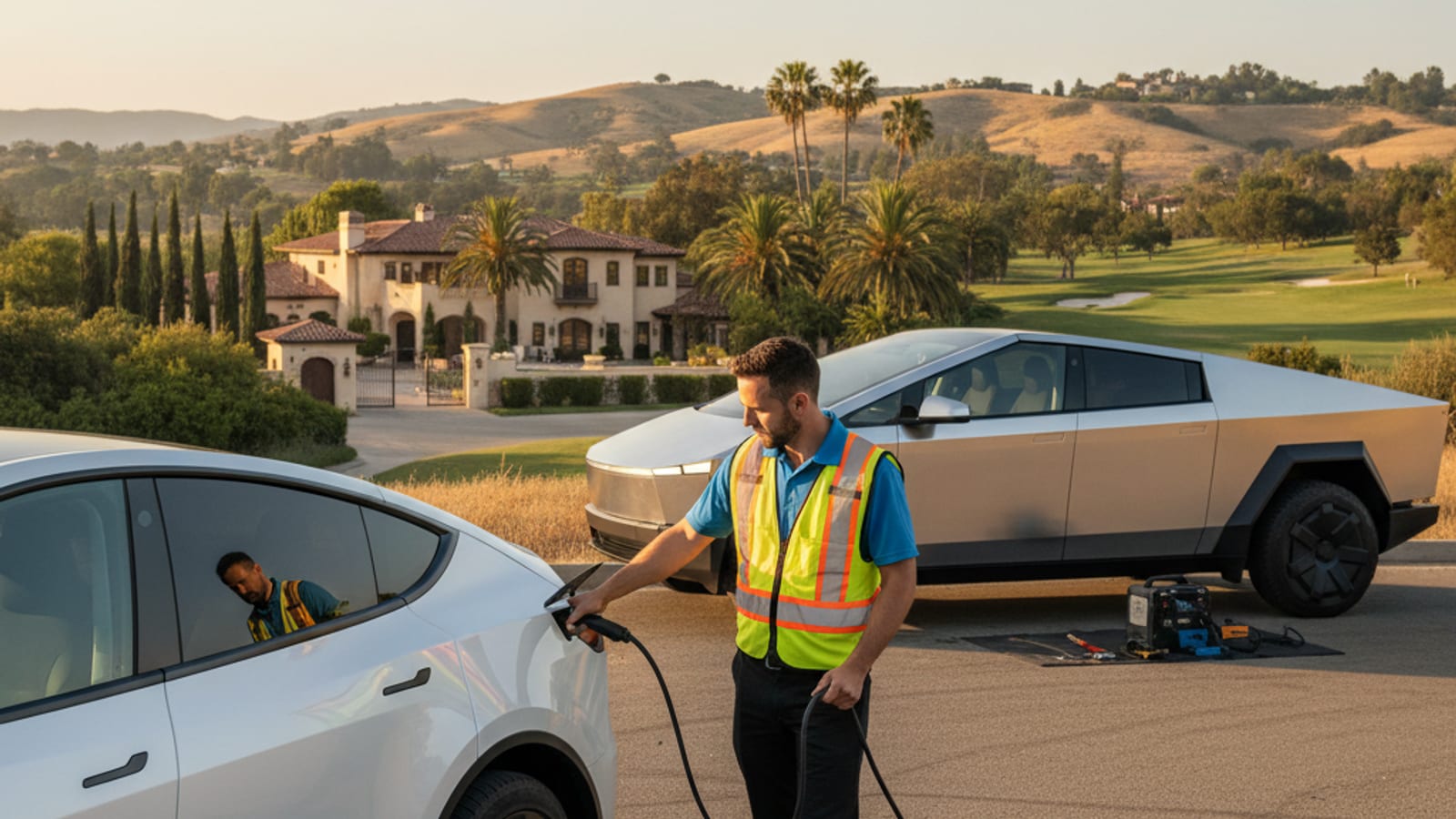
The matched operator brings a vehicle equipped with a 240V Level 2 source and adapters for both NACS and CCS connectors. The mobile charging unit delivers Level 2 charging speeds directly to your stranded EV. This means we can provide a significant boost of range in a short amount of time, often enough to get you to the nearest charger or back home.
The operator’s mobile charging vehicle is outfitted with both a NACS plug for Teslas and a CCS adapter for non-Tesla EVs, ensuring assistance for nearly any electric vehicle on the road. Whether you drive a Tesla, Rivian, Lucid, Hyundai Ioniq 5, or any other EV, the matched operator is prepared.
When you’re facing an out-of-charge situation, our service saves you time and hassle. Instead of a tow, you get a direct charge, allowing you to continue your journey quickly.
Beyond an empty battery: other EV roadside needs
While running out of charge is a common concern, EVs can experience other roadside issues. One frequent problem is a dead 12V battery, especially in Teslas. EVs still rely on a traditional 12V battery for powering auxiliary systems, even though the main battery powers the drivetrain. If this 12V battery dies, your EV won’t start or even unlock.
Our Tesla 12V battery jump service handles this on-site across the Eastside. The matched operators are trained in the specific procedures required for safely jump-starting EVs. If your Tesla won’t start, or you suspect a 12V battery issue, we can connect you with an operator who can diagnose and provide a jump start on-site.
When to call us
Embracing EV ownership on Mercer Island is a smart choice, offering quiet commutes and a smooth ride across one of the most scenic bridges in the region. With a solid understanding of home charging, public charging, and range management, you’ll enjoy countless miles of emission-free driving.
However, should you ever find yourself needing a charge, a jump start, or any other EV roadside assistance, our referral service connects you with a licensed, independent local operator who brings the help to your location.
For prompt and professional EV roadside assistance anywhere on Mercer Island or the broader Puget Sound region, call (206) 202-7018 to reach a local operator.