Your Hyundai, Kia, Chevy, or Nissan can stall in Seattle with a dead pack, and Tesla’s roadside button will not send help for that car. Charge Pro SEA matches you with a licensed local operator who can add range on site so you can reach a working charger. Seattle has 45,469 registered EVs, and King County’s mix is only about 44 percent Tesla.
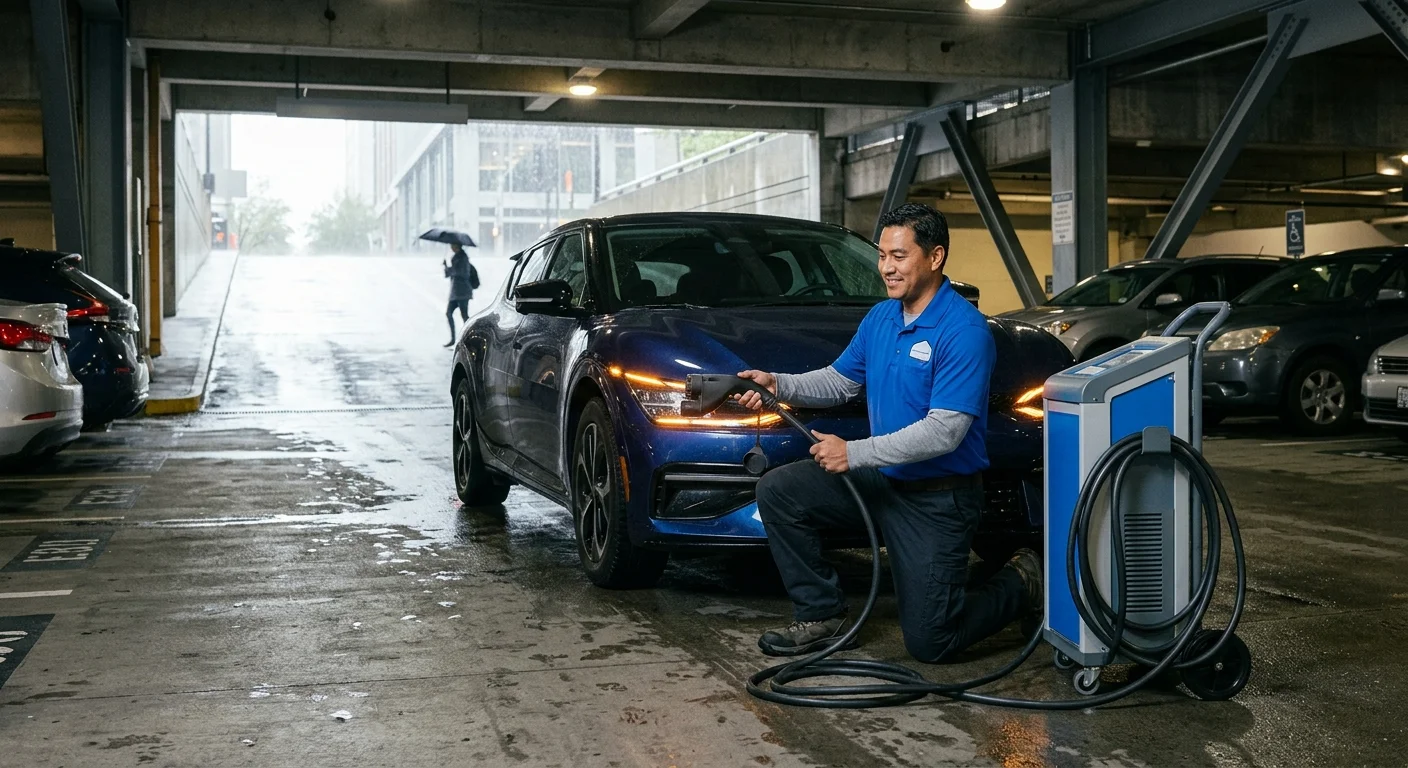
Why the Tesla button is the wrong first tap
Tesla built roadside into the car for Tesla owners. The app, the in-car button, and the Supercharger map assume a NACS Tesla. A Bolt, an EV6, an i4, or a Leaf is a different vehicle with a different port. That Tesla tile does not put your car in Tesla’s queue.
King County’s file makes the mix plain. Teslas are about 44 percent of registered EVs there, 63,017 of 144,257. Chevrolet, Nissan, BMW, Kia, and Hyundai are the top makes after Tesla. Seattle itself holds 45,469 registered EVs. Your stalled car may be one of those other makes. It still needs a port the Tesla button was never built to serve.
Insurance roadside and classic tow apps have the same gap. Many of those calls send a truck that can hook a bumper. They do not send a 240-volt source and a CCS adapter. If the pack is empty and the 12-volt is still awake, you need energy, not a hook. That is the job behind EV roadside assistance in Seattle: add enough miles to roll to a public charger, then finish the long charge there.
Tesla’s own service docs close another idea. Tesla states that a Model 3 cannot be used to jump start another vehicle. The same sentence appears for Model S, Model X, Model Y, and Cybertruck. A friendly Tesla in the next stall is not a rescue plan for your Hyundai.
If screens are dark and the car will not wake, you may have a 12-volt failure, not an empty traction pack. That is a different call. For a car that still talks to you and shows zero miles, stay on the empty-pack path. Tell the matcher the make, the model year, and that this is not a Tesla.
Washington’s EV population data is public. Statewide, Tesla is about 41 percent of 299,705 registered EVs. The rest still need a plug Tesla Roadside was never meant to serve.
Downtown garages, I-5, and West Seattle approaches
South Lake Union and the downtown core park in concrete garages. Ramps are tight. Cell service drops on the lower floors. A non-Tesla that hits zero on a spiral ramp blocks the lane behind it. Put the hazards on. Park as far to the side as the stall allows. Get people out of the travel path. Then call from a landing where your phone has a signal.
I-5 through the Convention Center lid is covered and tight. There is little room to sit and wait. If you are on the interstate, WSDOT’s Incident Response Team is the highway path. Dial 911. WSDOT’s published materials cover disabled vehicles, flat tires, and running out of gas. They do not mention electric vehicles, out-of-charge stops, or charging. The team can protect the scene. They are not a mobile charger. After you are clear of live lanes, a matched EV operator can add range.
SR-99 through SoDo has the same traffic pressure without the lid. Stadium nights and port trucks leave a dead EV sitting in a freight stream. The West Seattle Bridge approach climbs out of that industrial floor. A low state of charge on that grade in the rain can end the trip short of West Seattle. Hills plus cabin heat eat range. Across 30-plus EV models, Recurrent found cars keep about 78 percent of range at 32F, a 22 percent loss. AAA testing at 20F found temperature alone cut range 10 to 12 percent. Cabin climate control pushed the loss toward 40 percent.
Seattle City Light serves the city. That matters at home. It does not put a charger on the West Seattle Bridge. Public stalls in downtown garages fill, and some are Tesla-only. If your port is CCS or J1772, that stall will not charge you. Confirm the connector on the pedestal before you crawl toward it on fumes.
RCW 46.61.590 requires a driver to arrange prompt removal of a disabled vehicle. On a downtown ramp or a SoDo shoulder, that clock starts when you stop. A tow is one way to satisfy it. A short Level 2 charge that puts 10 to 20 miles back is another. It keeps the car under its own power. You are still responsible for getting the car out of the way.
CCS, NACS, and what the operator needs to know
Name the plug in plain language. Tesla vehicles use NACS, also published as SAE J3400. Most other cars take AC Level 2 on SAE J1772. A J1772 or CCS adapter is the ordinary way a non-Tesla EV takes AC Level 2 power from a NACS source. The U.S. Department of Energy’s electric vehicle pages describe those charging levels. Level 2 AC runs 240-volt residential power, or 208-volt commercial, in a published 2.9 to 19.2 kW band.
Matched operators for this work bring a Tesla Cybertruck with an integrated 240-volt, 9.6 kW bed outlet, a NACS plug, and a CCS adapter. That 9.6 kW is the same power level as a typical home wall connector. It is not a DC fast charger. It will not refill a large pack on the ramp. It will add enough miles to leave.
A 15 to 30 minute connection adds roughly 10 to 20 miles. That figure describes the size of a charge, not how fast anyone arrives. Roughly 30 miles of range per hour is the derived rate at 9.6 kW against typical EV efficiency. Treat both as hedges, never as a promise for your exact car.
Model year matters. The 2025 and later Hyundai Ioniq 5 has a native NACS port. An operator who only packs a CCS lead needs to know that before they park. Chevrolet, Kia, Nissan, and BMW ports vary by year too. A 2026 adapter-mandate rule for every brand could not be confirmed from a manufacturer public page. Do not assume the car in front of you follows a rumor. Look at the inlet. Tell the operator what you see: round NACS, J1772, or a DC CCS combo.
A dark Mercedes EQS is a different job. Mercedes-Benz tells owners to have starting assistance and 12-volt charging done only at a qualified specialist workshop. Empty-pack rescue on a Hyundai, Kia, Bolt, or BMW i-series is a connector and a Level 2 lead. Keep those two failures separate when you call.
Non-Tesla EV rescue is the service path for that connector work. Bring the make, model, year, port, and a pin drop. A photo of the charge door helps more than a brand slogan.
How a local match gets you to a working charger
Charge Pro SEA does not roll a truck. We are a referral service. We connect you with a licensed, independent local operator. That operator quotes the job, does the work, and bills you directly. The brand sets no price and promises no arrival window.
Once the operator is on site, the sequence is short. They confirm the port, fit the adapter, and start a Level 2 session from the Cybertruck bed outlet. You sit with hazards on. After 15 to 30 minutes of charging you typically have about 10 to 20 miles. That is enough to leave a downtown garage, clear the West Seattle Bridge approach, or reach a public charger in SoDo or South Lake Union. It is not a full recharge. Park at a working pedestal and finish there.
Mobile EV charging is the same on-site energy idea for any EV that needs miles, Tesla or not. For a non-Tesla, the adapter step is the part generic tow dispatch often skips. Ask the operator, before they start, what lead they will use on your inlet. They quote the charge. You accept or you don’t. No work starts on a shrug.
If you are already on I-5, stay with 911 until the scene is safe. Then make the referral call. A mobile charge on a live freeway lane is not the plan. A charge in a garage stall, a SoDo side street, or a legal pull-out after the lid is.
For the rest of the metro, the pattern is the same and the streets are not. Non-Tesla EV rescue across the Puget Sound region covers that wider map. This page is Seattle proper: the garage, the lid, SR-99, SoDo, and the West Seattle climb.
Keep the car in Park. Keep people off the ramp. Keep the charge door clear of rain if you can. Washington rain finds an open inlet. When the operator arrives, they handle the connection. You handle the pin drop, the port photo, and the yes or no on the quote.
When to call us
Call when a non-Tesla EV is out of range in a Seattle garage, on I-5 after you are clear of live lanes, on SR-99, in SoDo, or on the West Seattle Bridge approach, and you need miles added on site instead of a long tow. Call us at (206) 202-7018 and we’ll connect you with a local EV rescue operator.