The dash is a Hyundai, Kia, Chevy, Nissan, or BMW, and the pack is at zero on Bellevue Way. Tesla roadside is the wrong first tap for that car. Charge Pro SEA connects you with a licensed local operator who can run a CCS or NACS feed on site, quote the work, and bill you directly.
Why Tesla dispatch is the wrong first tap
Bellevue has 14,383 registered electric vehicles, per Washington DOL EV population data read in September 2026. Tesla accounts for about 44 percent of King County’s 144,257 EVs, and about 41 percent of the 299,705 EVs statewide. The rest of the Eastside mix is Chevrolet, Nissan, BMW, Kia, and Hyundai. Those cars sit outside Tesla’s app.
A Model Y driver can open Tesla roadside and stay in the right program. An Ioniq 5, EV6, Bolt, Leaf, or i4 driver tapping the same line is in the wrong queue. Tesla’s roadside path is built around Tesla vehicles. Non-Tesla EV roadside assistance in Bellevue starts with the inlet on your bumper, not with a Tesla account.
A conventional club dispatch often means a flatbed. A wrecker can clear a stall. Miles come from a charge. Washington’s Chapter 46.55 RCW governs towing and impound. RCW 46.61.590 requires the driver to arrange prompt removal. Waiting on the wrong dispatcher leaves the car in a Lincoln Square ramp or on an I-405 shoulder longer than it needs to be.
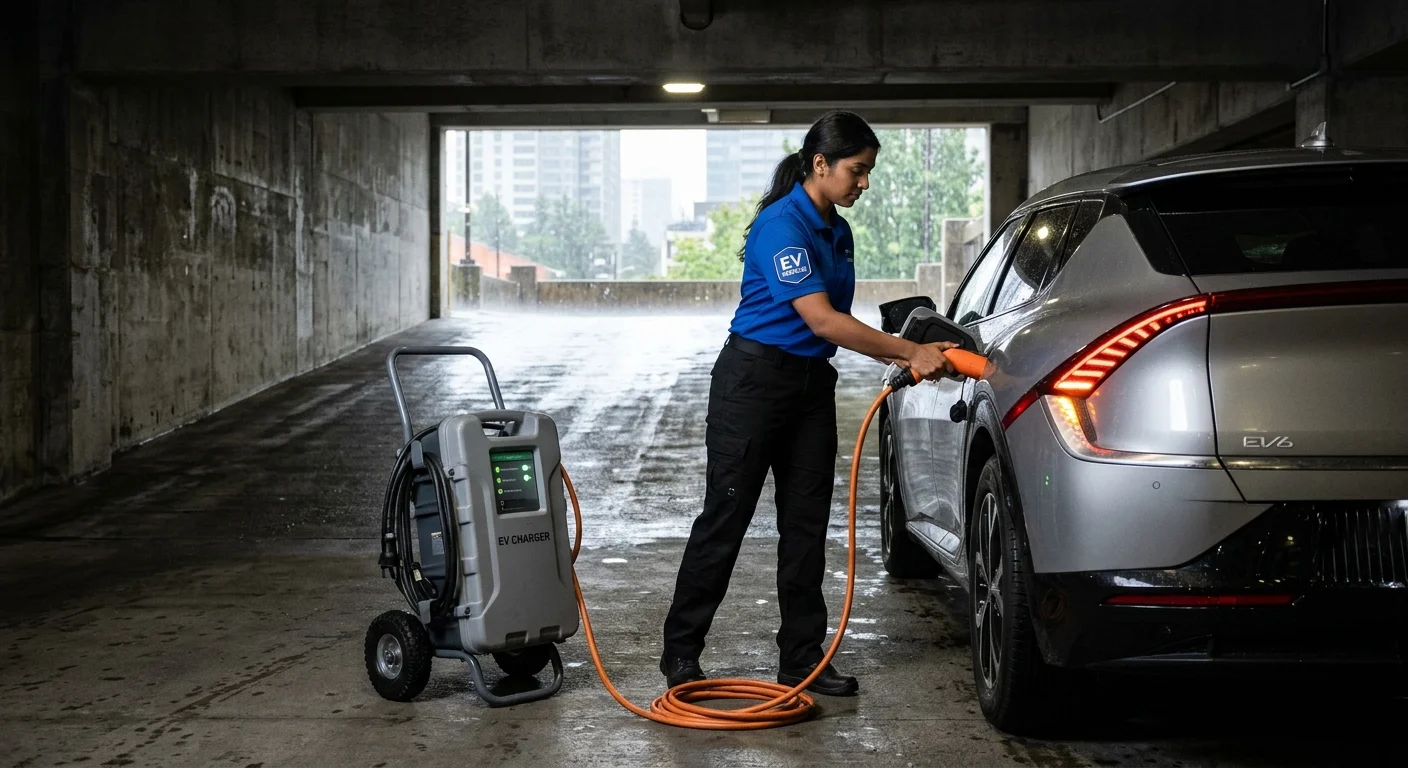
What you want is a non-Tesla EV rescue match. That is a licensed local operator with Level 2 gear and a CCS adapter. Charge Pro SEA makes that match. The brand owns no fleet and holds no trade license. The operator is licensed and insured, quotes the job, and bills you. You are hiring a local pro.
For 12V no-starts, tires, and general coverage, read EV roadside assistance in Bellevue. This page stays on the empty-pack, wrong-app problem. If the pin is west of Lake Washington, use non-Tesla EV rescue in Seattle. Campus lots in Redmond are non-Tesla EV rescue in Redmond. Downtown Seattle and I-5 are a different job than Lincoln Square, Factoria, and the 520 landing.
Lincoln Square, Factoria, and I-405 ramps
Downtown Bellevue hides the stall under concrete. Lincoln Square and the downtown garages have tight ramps, low clearance, and rain at the daylight exit. A Hyundai or Kia with hazards on looks like a parking snag until staff need the stall. Give the operator the garage name, the level, and whether the car can roll.
Bellevue Way is the surface spine between downtown and the freeway. If you came off I-405 and died at a light, you are in city traffic. Factoria is the south node, with retail lots and I-90 at the 405 stack. A dead EV on I-90 at Factoria is still in freeway traffic. An empty pack on an I-405 ramp is a highway incident.
WSDOT’s Incident Response Team covers incidents on state highways, from flat tires and running out of gas to collisions. Published IRT pages mention gas. They do not mention electric vehicles, out-of-charge stops, or mobile charging. To reach help on the roadway, dial 911. IRT can protect the scene. A CCS EV rescue in Bellevue still needs a charging operator after the lane is safe.
The SR 520 landing is a tolled crossing. A stall on the Eastside approach is on a tolled WSDOT facility. Stay in the car when a live lane makes it unsafe to step out, and call 911 first. Ask for a charge match after you are out of the travel path.
Puget Sound Energy serves Bellevue. PSE’s Up & Go Electric and Flex EV rate are home programs, not a truck in a Factoria lot. Public chargers around downtown and Factoria help once you can roll.
Cold cuts the last bar. Recurrent Auto, looking across 30-plus EV models, found EVs keep about 78 percent of range at 32F, about a 22 percent loss. AAA testing at 20F found temperature alone cut range 10-12 percent, and cabin heat pushed the loss toward 40 percent. An Eastside hill and a wet garage ramp spend that last mile fast.
If you can coast into a garage, a Factoria stall, or a legal curb, do that. Then say the pin: Lincoln Square, Bellevue Way, Factoria at I-90, an I-405 ramp, or the 520 landing.
CCS, NACS, and what to tell the operator
Level 2 AC charging runs 240 volts at home, or 208 volts in many commercial buildings, in a published 2.9-19.2 kW band. The U.S. Department of Energy lists the connectors as SAE J1772, plus J3400 (NACS) for Tesla vehicles. A J1772 or CCS adapter is the ordinary way a non-Tesla EV takes AC Level 2 power from a NACS source. Name the port on the call.
Matched operators bring a Tesla Cybertruck with an integrated 240V / 9.6 kW bed outlet, a NACS plug, and a CCS adapter. That output is 240V AC at 9.6 kW, the same power level as a typical home wall connector. It is Level 2 AC, not DC fast charging.
Hyundai’s 2025 and later IONIQ 5 has a native NACS port. For earlier Ioniq years, the inlet on those cars could not be confirmed from the sources this site is allowed to cite. A 2026 adapter rule that would treat every non-Tesla make the same way could not be confirmed from manufacturer public pages. Look at the port on your car.
Four details speed the match. Give the make, model, and model year. Name the inlet: NACS, CCS, or J1772. Say whether the 12V still wakes the dash, or the car is fully dark. Give the pin: garage level, Factoria lot, I-405 ramp, or 520 landing.
If the 12V is dead, the main pack may refuse a charge until the low-voltage battery is recovered. The operator quotes that path before starting, then bills you. Charge Pro SEA does not set the price and does not promise an arrival window.
Pack a portable adapter if you already own one. The operator’s CCS adapter is how a NACS bed outlet feeds many non-Tesla inlets. Confirm the physical fit before the cable locks.
The Department of Energy’s electric vehicle pages explain charging levels in plain terms. They will not send anyone to Lincoln Square. Hyundai and Kia drivers who need mobile EV charging in Bellevue want a local operator with the right plug, on the ramp where the car sits.
How a local match gets you to a working charger
Charge Pro SEA is a referral service for the Puget Sound region. It matches stranded drivers with licensed, independent local operators. The brand performs no physical work, employs no crews, and owns no trucks. You contract with the operator. The operator quotes, does the work, and bills you. The customer pays the professional directly. That is how a Bellevue stall gets a real quote from the person doing the work.
Mobile EV charging is the on-site tool. The operator connects Level 2 at 9.6 kW. A 15 to 30 minute connection adds roughly 10 to 20 miles of range. That sentence is about the size of a charge. It is not an arrival time. Roughly 30 miles of range per hour is a derived figure: 9.6 kW against a typical 3.0-3.5 miles per kWh. Treat it as a hedge. It is not a guarantee, and it is not a DOE number.
Ten to twenty miles is usually enough to leave a Lincoln Square ramp, take Bellevue Way, and reach a working public charger. It is enough to get off an I-405 ramp and into a Factoria lot. You are buying an exit from the stall, not a full pack.
The operator should confirm the adapter, the inlet, and the quote before the cable goes in. If the car is in a live lane, or the 12V will not wake, a tow may be the safer first move. A quiet garage level is a charge scene. A 405 shoulder is a 911 scene first.
Bellevue’s 14,383 EVs are why this city page exists. Tesla-only dispatch leaves the Chevrolet, Nissan, BMW, Kia, and Hyundai share of that fleet without a port that fits. That is the search behind non tesla ev roadside assistance bellevue: a non-Tesla, empty pack, Eastside pin. Those drivers need a CCS or NACS-aware operator on this side of the lake.
Stay with the car when it is safe. Keep hazards on. On a state highway, 911 remains the first call. Once the scene is stable, a local match is how range returns without a wrecker as the default.
When to call us
Call when a non-Tesla EV is sitting dead in a Bellevue garage, on Bellevue Way, at Factoria, or on an I-405 or 520 approach, and you need a mobile EV rescue operator to put range back in the pack. Call us at (206) 202-7018 and we’ll connect you with a local EV rescue operator.