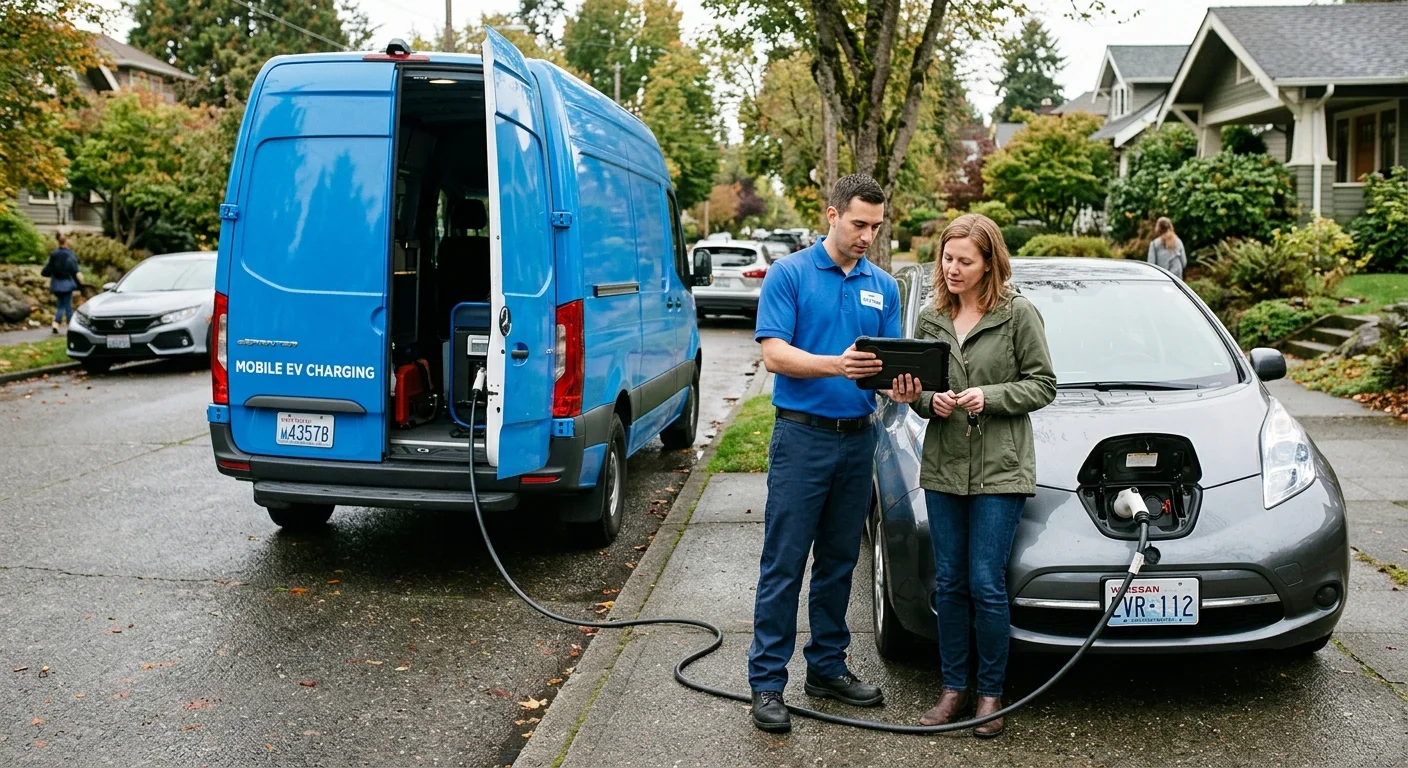
The car is sitting on a Capitol Hill curb with 3 percent left. You need a dollar figure before anyone plugs in. Mobile EV charging service cost in this metro is not a poster on a wall. The independent operator who rolls sets the bill. Charge Pro SEA does not.
Why there is no single posted rate
Searchers want one number they can screenshot. The Puget Sound does not publish one. Charge Pro SEA is a referral service. It matches drivers with licensed, independent local operators. It sets no prices, owns no charging vans, and does not bill the job. The operator quotes you. You pay that operator directly.
Washington has 299,705 registered EVs, per Washington DOL Electric Vehicle Population Data. King County holds 144,257 of them. Seattle alone has 45,469. That is a lot of packs, ports, and adapters. A Model Y on a Queen Anne block is not the same job as a Bolt on the I-90 shoulder east of North Bend. One posted rate cannot cover both.
Operators also run different gear. Some bring a Level 2 unit for a short rescue charge. Others advertise faster hardware. We looked for a verified, current dollar rate for a local ev mobile charging service in this market. No verified figure turned up. A page that invents a flat fee is guessing. The only number that counts is the operator’s quote on your car, at your curb, on that day.
Club coverage is a separate question. Drivers ask whether AAA will send a mobile charge. Membership rules change by plan and year. Read our note on AAA mobile EV charging in Seattle and confirm the current benefit with AAA before you assume it pays the bill.
A full home fill is a different product too. People search how much it costs to charge an electric car for 300 miles and land on a rescue page. That math lives on your utility bill. Seattle City Light and Puget Sound Energy publish their own EV program pages. We do not publish a cents-per-kWh figure. The utilities set those rates, and they move. Tesla owners comparing home and public charging can use our Puget Sound utility charging cost guide. A roadside rescue is usually a short boost, not 300 miles of energy.
What operators usually price: energy, travel, and time
Independent operators usually stack three things. Energy delivered. Travel to you. Time on site. If a quote hides one of those, ask for it in the open.
Energy is the kilowatt-hours that actually enter the pack. A typical rescue charge is 10 to 20 miles of range in 15 to 30 minutes of Level 2 charging. That is time on the cable, not a promise about when a van shows up. Charge Pro SEA does not quote arrival windows. The operator tells you how many kWh they plan to add, and what that line costs. More energy costs more. A car at 1 percent that still has to climb I-90 toward Hyak needs a bigger boost than a car that can roll downhill to a South Lake Union stall.
Travel is the metro. I-5 through downtown, I-405 on the Eastside, SR 99, the I-90 floating bridge, and the passes all change the miles the operator has to cover. A stall in a South Lake Union garage is a different trip than a shoulder on US 2 near Gold Bar. Some operators add a distance line. Some fold it into one number. Either way, the pin on the map has to be in the quote.
Time is everything else. Tight garage clearance in Belltown. A charge port that will not open in the rain. A long wait while a pack accepts a slow Level 2 feed on a First Hill curb. Night work, if the operator even takes the job, often prices differently. We could not confirm a published after-hours surcharge in this market. If the hour matters, put it in the quote request before anyone rolls.
Hardware you buy vs a rescue visit
How much a mobile EV charger costs is usually a shopping question. People mean a portable unit they can keep in the trunk. That is a purchase. A rescue visit is a service billed by an independent operator. This page is about the service. A unit you own does not replace a van when you are already at 2 percent on Rainier Avenue.
The 80 percent rule on a roadside boost
DC fast charging often tapers after about 80 percent to protect the pack. That is station behavior, not a rescue rule. A mobile Level 2 boost is usually aiming at the next working charger, not a full battery. You do not need 80 percent on a Capitol Hill block if 10 to 20 miles gets you to a stall you can sit at. The U.S. Department of Energy keeps plain-language background on how EVs take a charge. Use that for pack behavior. Use the operator’s quote for the bill.
Seattle vs Eastside vs pass-corridor factors
Seattle’s grid is hills, one-way streets, and garages. Queen Anne, Capitol Hill, First Hill, Ballard, and Belltown make curb access the first cost driver. If the operator cannot reach the port, the quote changes. Seattle City Light territory is the home-charging backdrop inside the city. SCL names a residential EV charger rebate, a Public Charging Incentive Program, a Fleet Electrification Program, and a Multifamily EV Charging Program. Those are home and site programs. They are not a roadside discount.
The Eastside is a different map. Bellevue, Redmond, Kirkland, and Sammamish sit on I-405 and the SR 520 corridor. Puget Sound Energy is the common utility there. PSE names its home programs Up & Go Electric and Flex EV. Check those pages for home charging. An Eastside rescue still prices energy, travel, and time. The travel just runs through Bellevue traffic instead of downtown ramps.
South King County and Pierce add warehouse districts, mall decks, and airport approaches. Kent, Renton, Tukwila, SeaTac, and Tacoma do not price like Capitol Hill. Sea-Tac’s garage has 94 EV stalls with free Level 2 charging. Regular parking rates still apply. Stalls sit in Rows E/F on Floor 7 in general parking and Floor 4 in reserved parking. Two DC fast chargers sit in the Cell Phone Lot. A mobile charge at the airport is a last resort when you cannot reach those stalls.
The pass corridors are the expensive kind of simple. I-90 east of North Bend and US 2 through Sultan and Gold Bar add grade, weather, and fewer public stalls. Across 30-plus EV models, packs keep about 78 percent of range at 32F, about a 22 percent loss, per Recurrent Auto. AAA testing at 20F found temperature alone cut range 10-12 percent. Cabin heat pushed the loss toward 40 percent. A Snoqualmie Pass job can need more energy than a Fremont alley for that reason. Traction and chain rules on the passes are announced storm by storm under RCW 46.37.420 and WAC 204-24. There is no fixed seasonal calendar.
On a state highway, the WSDOT Incident Response Team handles incidents from flat tires to collisions. Their materials mention running out of gas. They do not mention electric vehicles or a mobile charge. Dial 911 for help on the roadway. RCW 46.61.560 generally bars stopping on the roadway outside cities, with an exception for a vehicle so disabled that stopping is unavoidable. RCW 46.61.590 then requires prompt removal. A quote for out-of-charge recovery has to include where the car actually sits.
How to get a quote before anyone rolls
Do not roll on a handshake. Get the operator’s number first. Our quote-before-work walkthrough covers the conversation. This page is the bill itself.
Tell the operator the city and the exact spot. A loading zone on Pine is not a driveway in Shoreline. Give the make and the remaining percent. Say whether you need a Tesla NACS port or a CCS adapter. Tesla is about 41 percent of registered EVs statewide, and about 44 percent of King County’s 144,257 EVs, so adapters come up a lot. Mention garage height, a stuck charge port, and the charger you plan to reach after the boost.
Ask them to split energy, travel, and time, or to give one total that includes all three. Ask what happens if the pack will not accept charge. Ask who you pay. You contract with the operator. Charge Pro SEA does not bill you for the work.
Compare that quote to a tow. A dead EV on a hook can add wait time, a flatbed requirement, and impound risk under Chapter 46.55 RCW. Read the hidden costs of towing a dead EV before you pick the hook by default. If the car can take a 10 to 20 mile boost, mobile EV charging is often the cleaner path. The operator still has to confirm the car can charge where it sits.
If two operators quote, compare the same kWh and the same destination. Compare the same access notes too. A cheap number that skips garage height is not a cheaper job. It is an incomplete one.
When to call us
If you are too low to reach a working stall in Seattle, Bellevue, Tacoma, or along I-90, you need a local EV rescue operator on the quote, then on the cable. Call us at (206) 202-7018 and we’ll connect you with a local EV rescue operator.