A Hyundai Kona Electric that refuses to start in the Puget Sound almost always has a dead 12V auxiliary battery, not a flat traction pack. The traction battery can show 70 percent and the car will still sit dark because the contactor never closed. A jump start at the correct terminals wakes the car in minutes. The lift in range comes after.
Kona Electric and Kona petrol share a name, and a quick check matters here. If your Kona has a fuel filler door, the fault tree is a conventional one and any standard roadside service will do. This guide covers the electric Kona and the 12V behavior that follows it through the metro.
Why apartment renters run into this first
Across the metro, most pre-1980 housing sits in Seattle, Burien, Tacoma, and parts of unincorporated King County. Roughly 46.6 percent of King County’s housing stock and 43 percent of Pierce County’s predates 1980. A typical pre-1980 apartment building has a single outlet in the parking stall or none at all. The Kona owner in that building relies on public charging, which means the car often sits for 36 to 72 hours between sessions. The 12V sees the gap.
Cold rain is the other half. The metro sits in a 35 to 45F band for months. Lead-acid batteries lose effective capacity below 40F. Park a Kona in an unheated garage in Bellevue, Kirkland, Edmonds, or Renton for a week and the 12V can fall below the threshold the contactor needs.
Signs that point at the 12V, not the traction pack
| Symptom | 12V is the problem | Traction pack is low |
|---|---|---|
| Dashboard stays dark | Yes | No, warnings show |
| Key fob won’t unlock | Yes | No |
| Center screen won’t wake | Yes | No |
| ”Ready” light never appears | Yes | Yes |
| Car drove then died | No | Yes |
| Range warning before stop | No | Yes |
| Charge port door opens | Often no | Yes |
Press Start and get nothing back, no chime, no light, no click. The traction pack is likely fine. The 12V cannot boot the computers, and the contactor stays open.
For the broader picture on how every EV 12V behaves the same way, our guide on what happens when an EV 12V battery dies walks through the contactor path and recovery options.
Where the 12V lives on the Kona Electric
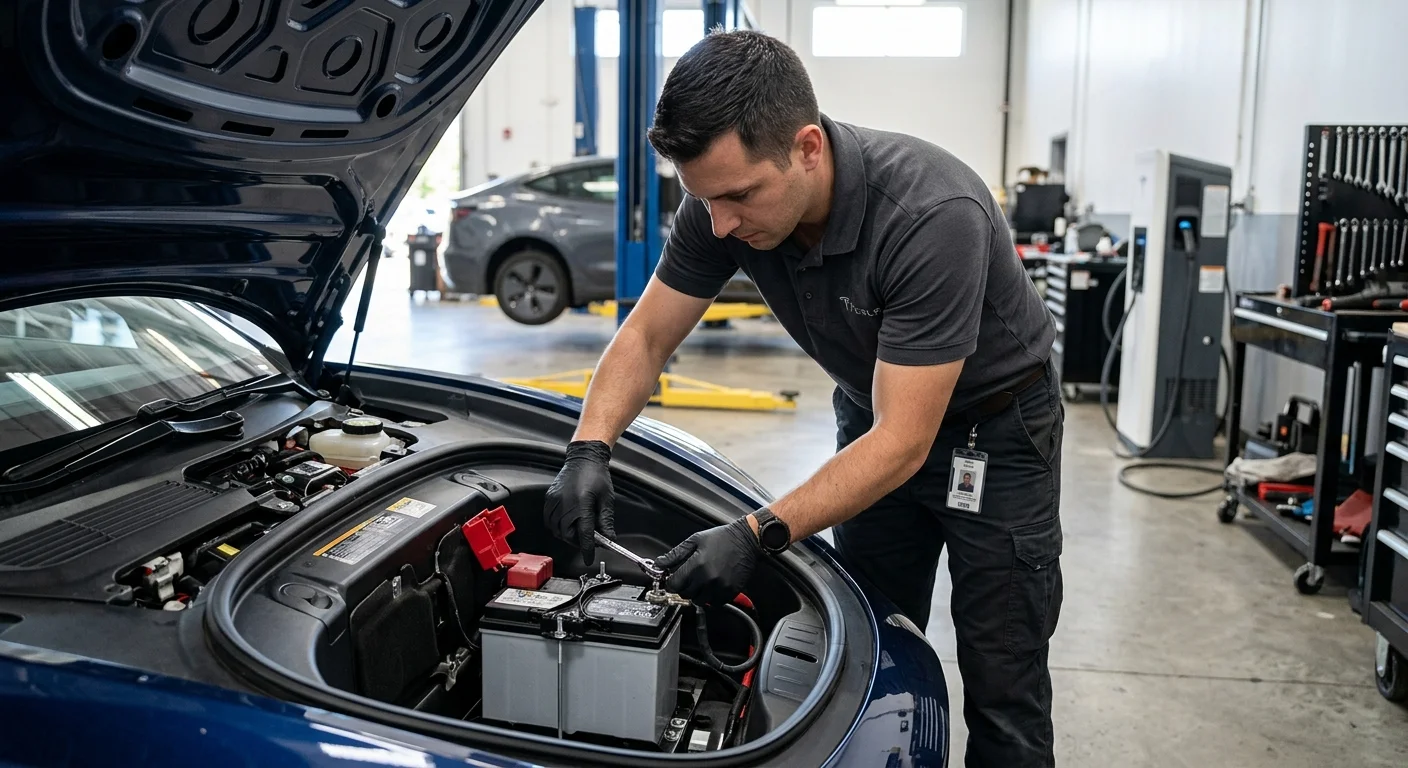
The Kona Electric places the 12V under the hood, on the driver’s side toward the rear of the engine bay. It is a standard 12V AGM battery, roughly the size used in a small gas car.
Access steps:
- Pull the interior hood release. If the 12V is fully dead and the latch is electronic, the manual release is a pull cord near the driver-side fender.
- Open the hood and look toward the rear driver’s side.
- The battery sits in a plastic tray. The positive terminal has a red cover, the negative terminal is bare or has a black cover.
The location is easier than many EVs because the Kona does not tuck the battery under the cargo floor.
The Kona’s auxiliary battery save function
Hyundai added a 12V Battery Save function to the Kona Electric starting with the 2019 model year. It pulls a small current from the high-voltage pack to top up the 12V when it falls below a threshold. The setting is under Settings > Vehicle > Charge Settings > 12V Battery Save on most model years.
Limits to know:
- A fully dead 12V leaves the screen dark, so the function won’t appear until you restore power.
- The feature does not replace a failing 12V. If you find yourself enabling it every week, the battery is aging out.
- After a successful jump, enable the function as a safety net for the drive home.
Hyundai owners in Bellevue and Kirkland have reported phantom drain events after over-the-air updates that affect sleep mode. If your car died within days of an update, mention it at your dealer.
How to jump the Kona Electric
The Kona has dedicated jump terminals under the hood rather than posts on the battery itself.
What you need: a portable lithium jump pack rated at least 400A peak, or a second vehicle with standard jumper cables. Do not use another EV as the donor. EVs are not designed to source cranking current and a donor can throw fault codes.
Step by step:
- Open the hood. If the electronic release will not trigger, use the manual pull cord.
- Lift the red cover on the positive jump post, driver’s side of the engine bay.
- Connect positive clamp to the Kona’s positive jump post.
- Connect the other positive clamp to the jump pack or donor battery positive.
- Connect negative clamp to the jump pack or donor battery negative.
- Connect the other negative clamp to a clean unpainted metal ground point on the Kona chassis, away from the 12V battery itself.
- Wait 2 to 3 minutes.
- Press Start with your foot on the brake. The Ready light should appear.
Once running, drive to a Level 2 charger and leave the Kona plugged in for at least an hour. The traction pack will top up the 12V while it sits. If the 12V dies again within a day or two, the battery itself is failing and needs replacement.
Common Puget Sound scenarios
Parking garages in downtown Seattle and South Lake Union. Cars left for multi-day work trips or cruise embarkations drain the 12V over 5 to 10 days in standby. A driver returning to a dark car in a structure with concrete walls and tight clearances cannot safely run jumper cables. Call a mobile operator.
Apartment lots in Bellevue, Kirkland, and Edmonds. Older pre-1980 buildings without assigned parking power leave Kona owners on public charging only. The 12V sees long dwell times and the rain band keeps humidity high. A 12V load test at year 3 is worth scheduling.
I-5 and I-405 commutes. Short daily drives under 20 minutes do not give the traction pack enough time to top up the 12V. Drivers in Shoreline, Mountlake Terrace, Lynnwood, and Bothell who commute by surface streets see slow drain over weeks. An occasional longer drive or a weekly Level 2 session resets the cycle.
Stranded on a shoulder and not safe to wait: call (206) 202-7018 to reach a local operator. Charge Pro SEA connects you with operators who carry jump gear and quote before starting.
For coverage by city, see our EV roadside assistance in Bellevue page. The same drain pattern shows up on the Nissan Leaf and other older EVs across the metro.
Frequently asked questions
How do you jump a Hyundai Kona Electric?
Connect a portable lithium jump pack to the dedicated positive terminal under the hood and a clean chassis ground for negative. Wait 2 to 3 minutes, then press Start with your foot on the brake. After a successful wake-up, drive to a Level 2 charger and let the car top up the 12V over an hour.
Why does the Kona Electric 12V battery drain fast?
The Kona Electric, particularly 2018 to 2021 builds, uses a less aggressive sleep mode than some peers. Background systems keep drawing from the 12V longer. Software updates in 2022 and 2024 improved this, but cars without those updates are more prone to drain. The local cold-soak in unheated garages shortens life further.
What does the 12V Battery Save mode do on a Kona Electric?
It draws a small amount of power from the traction pack to keep the 12V above a minimum threshold. It is a protective feature, not a permanent fix. If you find yourself enabling it regularly, the 12V is aging out and needs replacement.
Does Charge Pro SEA help Kona Electric owners?
Yes. Operators serve all non-Tesla EVs, including every Kona Electric model year, across the metro. Our non-Tesla EV rescue covers 12V jumps and traction top-ups. The operator confirms the arrival window on the call.
What if a jump does not fix the Kona?
If the Kona does not respond after a proper jump attempt, the most common causes are a fully failed 12V that will not hold a charge, a blown fuse in the junction box, or a BMS fault that blocks the high-voltage system. The operator can assess on-site and tell you whether a flatbed is the right next step.
If your Kona Electric is sitting dark in a Bellevue garage, on the I-405 shoulder near Renton, or in your driveway in Edmonds, call (206) 202-7018 to reach a local operator.