A Ford F-150 Lightning that will not start on a Kent warehouse curb still has to move. Same story on a Fife job site, or on I-5 in the rain with the hazards on. The useful split is empty pack, dead 12V, or a Pro Power drain, and whether you need a charge at the curb or a tow.
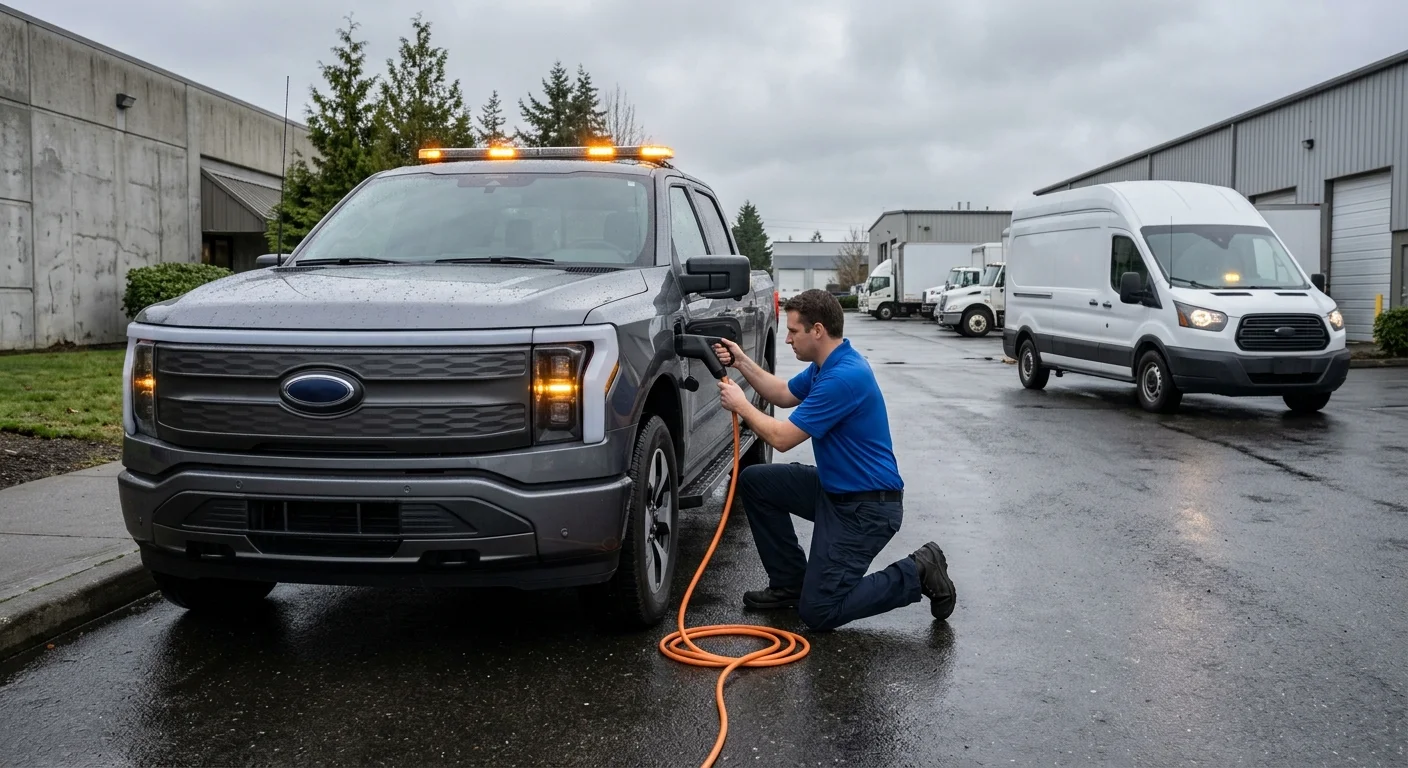
Empty pack, dead 12V, or Pro Power drain
Three Lightning stalls look the same from the sidewalk. Screens are dark. The truck will not start. Doors and locks may not behave. Ford F-150 Lightning roadside assistance only helps if you name the failed system first.
An empty traction pack is the simple case. You used the miles. Rain, cabin heat, and a loaded bed used more. The truck is out of usable range. A matched operator on a non-Tesla EV rescue brings a mobile Level 2 charge to the curb. Rescue equipment in this network is a Tesla Cybertruck with an integrated 240V / 9.6 kW bed outlet, a NACS plug, and a CCS adapter. A typical connection adds roughly 10 to 20 miles of range in 15 to 30 minutes of charging. That figure is the size of the charge. It is not a promise about when anyone arrives. Roughly 30 miles of range per hour is the derived rate at 9.6 kW. Treat it as a rough rate, never a guarantee. The operator quotes the job and bills you directly. Charge Pro SEA does not set that price.
A dead 12V is a different job. The big pack can still hold plenty of energy. The small battery that runs computers and contactors can still be flat. The truck will not start. Lights may flicker or stay off. The diagnostic path lives in Ford F-150 Lightning won’t start, 12V. This page is not that walkthrough. On the roadside, a matched operator jumps a dead 12V on site, load-tests it, and can replace a failed 12V on site, AGM lead-acid or lithium, per model year. The operator prices both options before starting. That is the same service definition as the Tesla 12V battery jump work in this network. The Lightning is not a Tesla. The 12V still has to wake the truck before the pack can drive the motors.
Pro Power Onboard is the third trap. The Lightning can feed tools, lights, a trailer, or another vehicle from the bed. That power comes out of the same pack you drive on. A long day on a Fife job site with saws and a compressor can leave a truck that will not make I-5. If you planned to charge another EV from the bed, read whether an F-150 Lightning can charge another EV before you treat that as a backup. Ford’s public pages did not give a verified drain rate for Pro Power in real work, so a figure could not be confirmed here. Watch the remaining range on the cluster. The bed outlets are not free energy.
A Ford lightning dead battery roadside call is often the 12V, not the pack. Say which lights still work. Say whether the charge port door will open. Say whether Pro Power was running. That is what the operator prices.
Grades, wet range, and work-site stalls
Puget Sound is not a flat parking lot. Issaquah sits on grades that pull range on the way up. Some of it comes back on the way down. A Lightning that looked fine leaving a site can hit the climb with a number that no longer matches the drive home. Cold rain makes it worse. Across 30-plus EV models, Recurrent Auto found that EVs retain on average 78 percent of range at 32F, about a 22 percent loss. AAA testing at 20F found temperature alone cut range 10 to 12 percent. Cabin climate control pushed the loss toward 40 percent. Those are fleet averages, not Lightning-only lab numbers. They still explain a wet I-5 evening in January, when a Lightning EV stranded in Seattle traffic is burning heat and lights while you wait.
Kent is a warehouse and freight corridor. Washington DOL’s EV file, updated 2026-09-15, shows 5,243 registered EVs in Kent and 45,469 in Seattle. Fife has 700. Issaquah has 4,367. King County as a whole has 144,257. A Lightning on a loading dock in Kent, or on a Fife site off the SR-167 express toll lanes, is doing work-truck duty. Payload, a trailer, and idle climate while you wait for a forklift all spend the pack. Public DC fast charging is not always next to the bay. Warehouse Level 2 is often reserved, occupied, or a different connector than the one in the frunk. Puget Sound Energy serves most of the Eastside, South King County, and much of Pierce County outside Tacoma, which covers Kent, Issaquah, and Fife. That matters for a wall connector at the shop later. It does not put a charger on the curb while you wait.
If you stall on a state highway, Washington’s rules are specific. RCW 46.61.560 generally prohibits stopping on the roadway outside cities, with an exception for a vehicle so disabled that stopping is unavoidable. RCW 46.61.590 then requires the driver to arrange prompt removal. The WSDOT Incident Response Team patrols major corridors during peak hours, covers about 1,300 centerline miles, and is on call around the clock. Their published materials describe helping motorists who have run out of gas. They do not mention electric vehicles, out-of-charge situations, or EV charging. To reach help on the roadway, dial 911. IRT can make the shoulder safer. They are not a mobile charger.
A tow still has to happen if the truck cannot roll and a charge cannot be connected. Arrange that promptly. Do not sit in a live lane hoping range returns.
What Ford roadside usually sends vs a charge
Ford F-150 Lightning roadside assistance is a Ford product. It is not a Charge Pro SEA product. FordPass is the usual place owners start. A single coverage term for every Lightning could not be confirmed from Ford’s public roadside or FordPass pages. Some trucks still sit in a new-vehicle window. Some owners bought extra coverage. Some plans lapsed. How long Ford provides roadside assistance is a VIN question. Open FordPass and read the roadside screen for this truck. The glove-box booklet is the other source. If those sources disagree, treat the app as current and contact Ford through that channel.
Coverage length and the Ford Assist number
The phone number for Ford Assist is the same kind of gap. A public Ford Assist number could not be confirmed from Ford’s roadside pages at the time this was written. Search results mix dealer service lines, old ads, and third-party call centers. Use the number inside FordPass. If the 12V is dead and the app will not load on the truck’s screen, log into FordPass on another phone you already use for that account. Do not use a number from a sponsored listing.
What Ford roadside often dispatches, in the pattern most OEM programs use, is a conventional truck: a jump if the 12V is the story, a tire change, a lockout, or a tow to a charger or a dealer. We will not claim Ford publishes a mobile Level 2 Lightning charge as a standard benefit. That claim could not be confirmed on Ford’s public pages. If the app offers a tow to the nearest open DC fast charger, that can be the right call when the charger is close, the truck can be loaded the way Ford specifies for this model, and you have time. A Lightning is a heavy electric pickup. Towing it wrong is a separate problem from charging it. Maximum towing capacity of the Lightning as a tow vehicle is also not a figure logged for this site. Read the door sticker and the owner’s manual for the rating on your VIN. Do not plan a job around a number from a review.
A mobile charge is a different product. The operator comes to the truck. They connect Level 2 AC at 240V, 9.6 kW, the same power band as a typical home wall connector. Connectors in this work are SAE J1772 plus J3400 (NACS) for Tesla vehicles. A J1772 or CCS adapter is the ordinary way a non-Tesla EV takes that AC power from a NACS source. The Lightning’s exact port by model year is not a figure logged here, so confirm the port on your truck before you describe the job. Fifteen to 30 minutes is enough, on a typical rescue, to add roughly 10 to 20 miles. That is often enough to reach a DC fast charger or a yard with a wall connector. It is not a full charge. It is not a dealer visit. Background on how EV charging levels work sits at the U.S. Department of Energy. Washington’s registered EV counts sit on data.wa.gov.
Price sits with the operator. Charge Pro SEA is a referral service. It sets no price, quotes no fee, and does not bill the driver. The operator you are matched with quotes before work starts and bills you directly. This brand publishes no arrival window.
When a local operator should take the call
A local EV rescue operator should take the call when the truck needs energy or a 12V at the curb, and a tow would cost you the rest of the shift. That is the Kent warehouse at changeover. That is a Fife site with tools still in the bed. That is I-5 in the rain with hazards on, where you need enough miles to get off the highway legally and promptly.
A local operator should take the call when FordPass is offering a tow you do not want, or when the app is silent. A local operator should take the call when the 12V is dead and you need a load test and a possible replacement on site, not a ride to a dealer that may not have the battery. A local operator should take the call when Pro Power used the pack down to a number that will not climb the Issaquah grade, and you still have work to finish.
Stay with Ford roadside when the problem is a tire, a winch-out, or a lockout the app actually covers for this VIN. Stay with Ford when the truck has a fault that needs a Ford shop, not a charge. A charge will not clear a failed module. If you are on a state highway and traffic is a hazard, 911 is still the first call so IRT can protect the scene. Then arrange the charge or the tow.
Charge Pro SEA matches you with licensed, independent local operators across the Puget Sound region. The brand performs no work, owns no trucks, and holds no trade license. The pros we connect you with are licensed and insured. You contract with the operator. You pay the operator. Ask what they will do for this Lightning: a Level 2 top-off, a 12V jump and test, a 12V replacement, or a recommendation to tow. Get that quote before anyone opens a cover. Name the city. Name whether the pack is empty, the 12V is dead, or Pro Power was running. That is the whole job on a wet Seattle curb.
When to call us
When the Lightning is out of charge, the 12V is dead, or Pro Power used the pack down on a Puget Sound job, you need a mobile EV rescue operator at the truck. Call us at (206) 202-7018 and we’ll connect you with a local EV rescue operator.