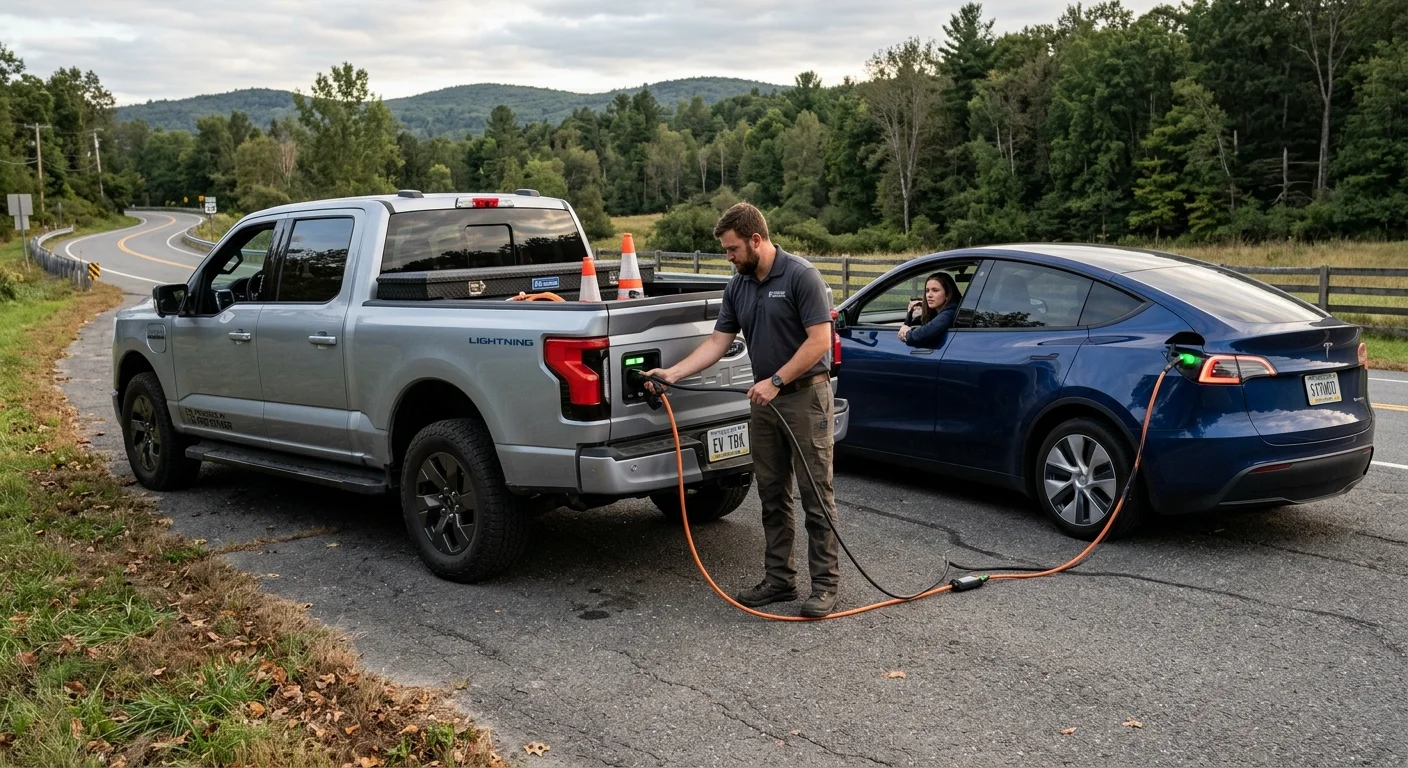
Picture this: you are coming back from a job site in Federal Way or a pass run on US-2 in your F-150 Lightning, and a Tesla or Mach-E is sitting on the shoulder with the hazard lights on. Your truck has a big pack, the bed outlets are sitting right there, and a thought crosses your mind. Can the Lightning actually charge another EV from its own battery, and how practical is it really? The short answer is yes, but the speed and the limits matter more than the existence of the feature.
What Pro Power Onboard actually does
The F-150 Lightning’s Pro Power Onboard system turns the truck into a mobile power station. Output depends on trim: the standard setup delivers 2.4 kilowatts from the cabin outlets, mid trims push 7.2 kilowatts through the bed outlets, and the top configuration goes to 9.6 kilowatts.
Originally designed to run job site tools, camping equipment, or a home backup circuit during a Pacific Northwest outage, Pro Power Onboard also functions as a Level 2 EV charging source. The truck does not push power out of its DC fast charging port, it pushes AC out of the bed outlets, and you bring the EVSE that plugs into those outlets. This distinction is what governs how fast the receiving car actually charges.
What you need to share power from truck to car
You cannot just lay an extension cord across the asphalt. The Lightning’s bed outlets are standard NEMA 14-50 or 5-15 depending on configuration, and you need a portable Level 2 EVSE with the matching plug to convert those outlets into actual charging current. Most portable Level 2 units ship with a NEMA 14-50 plug.
For Tesla, Rivian, and Ford EVs, the connector is NACS. For everything else, you need a J1772 connector or a CCS fast charger, which the Lightning does not offer through its outlets. A NACS to J1772 adapter is the bridge you need if the stranded EV is a Hyundai, Kia, Chevy, or BMW. A typical setup looks like: bed outlet to portable EVSE, EVSE to the adapter, adapter to the car.
This is similar to the general concept of EV-to-EV charging, but tailored to the Lightning’s onboard AC output. Always inspect cables and adapters before connecting. Damaged insulation on a wet Puget Sound morning is a real concern.
How much range can the truck actually deliver
This is where expectations need to be honest.
A 2.4 kilowatt setup delivers roughly 8 to 10 miles of range per hour to a typical EV. The 7.2 kilowatt setup, the more common configuration on mid-trim Lightnings, delivers around 20 to 25 miles per hour. The top 9.6 kilowatt setup delivers roughly 30 to 35 miles per hour.
These numbers sound reasonable until you compare them to what a stranded EV actually needs. A Model Y on the shoulder of I-5 through Federal Way at 4 percent needs enough range to clear the next interchange and find a working charger. Waiting 45 minutes for 15 miles of range from a 7.2 kilowatt export is not safe on a busy interstate shoulder, and it is not fast enough to clear an active lane.
A professional mobile EV charging service uses commercial-grade equipment that delivers substantially more power per minute than the Lightning’s Pro Power Onboard. Our operators carry a 240V Level 2 source sized for emergency rescue, not for tailgating, and a CCS adapter for non-Tesla EVs. The result is faster, safer, and built for roadside work rather than recreational use.
When the Lightning trick is genuinely useful
It is a great idea when:
A neighbor’s apartment EV sat too long and just needs a few miles to reach the workplace charger. The Lightning can plug in overnight in their driveway and hand off a useful morning top-up without anyone rushing.
A camping or trailhead scenario where neither vehicle is in a hurry. A friend ran a Rivian down hunting near Gold Bar and needs just enough to reach the next town. The Lightning can sit with them for an hour and that is fine.
It is not a great idea when:
The car is dead on a busy interstate shoulder. Waiting for trickle-charge range on I-5 is unsafe and slow. The operator’s mobile truck is built for this scenario.
You need significant range, 50 miles or more, fast. The Lightning’s 9.6 kilowatt Level 2 output is too slow for that, and the drain on the truck’s own pack gets heavy. A flatbed or a faster mobile charge is the right call.
How the truck’s own range factors in
Sharing power costs you miles. A 9.6 kilowatt export pulling 7 kilowatts sustained for one hour is roughly 7 kWh out of the truck’s 131 kWh pack, which is around 5 percent of the truck’s own range on a good day and a much larger percentage in winter. On a cold Snoqualmie morning with the truck’s own battery at 40 percent, sending 30 miles of range to a stranded EV can leave you stranded yourself.
Treat the Lightning’s Pro Power Onboard as a courtesy tool, not a tow replacement. When you actually need range fast on a freeway shoulder or in a downtown garage, a mobile charge truck is the right answer.
When to call us
If you or another EV driver is truly stranded across the Puget Sound, from Bellevue to Everett, Federal Way to Tacoma, our operators carry commercial-grade 240V Level 2 charging equipment and confirm pricing before they start. The Lightning can do a small favor, but it cannot replace a proper roadside rescue.
For more on how the Lightning’s onboard export compares to professional charging, our mobile EV charging service page explains what operators carry and what they do on-site.
Call (206) 202-7018 to reach a local operator.
Frequently asked questions
Can an F-150 Lightning charge another EV?
Yes, through the bed outlets and a portable Level 2 EVSE with the right plug. Output tops out at 9.6 kilowatts in the highest trim, which is roughly 30 to 35 miles of range per hour for a typical EV.
How fast does Pro Power Onboard charge another car?
The 2.4 kilowatt base setup adds 8 to 10 miles per hour. The 7.2 kilowatt mid-trim adds 20 to 25 miles per hour. The 9.6 kilowatt top setup adds 30 to 35 miles per hour.
Does using Pro Power Onboard drain the truck’s battery?
Yes, meaningfully. A 7 kilowatt sustained draw for an hour pulls roughly 7 kWh, which is 5 percent or more of the truck’s own range depending on conditions.
Is Pro Power Onboard faster than a mobile EV charging service?
No. A commercial mobile charging truck carries higher-output Level 2 equipment built for roadside rescue and can add range noticeably faster, with adapters for both NACS and CCS vehicles.
What if the stranded EV is a Tesla?
A Tesla uses the NACS connector. With the right portable EVSE and a NACS plug, the Lightning can charge a Tesla directly without an adapter. For non-NACS EVs you need a J1772 or CCS adapter.
Call (206) 202-7018 to reach a local operator.