A GEICO roadside call from a dead EV on I-5 usually produces a 12V jump or a wrecker. GEICO’s published Emergency Roadside Service menu does not list a charge into the high-voltage pack. Read the benefit in the app before you wait on the shoulder for the wrong truck.
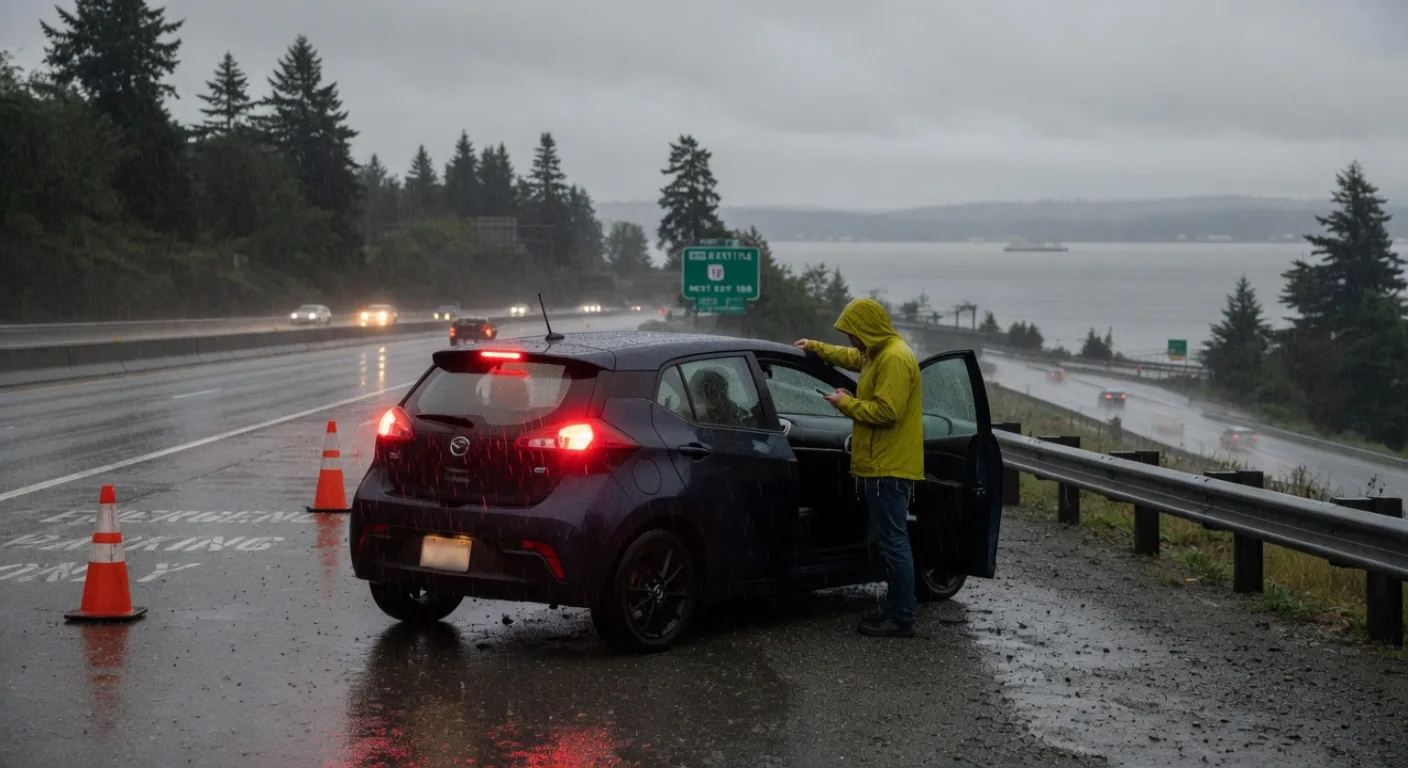
Jump, tow, and a pack charge are different jobs
When an EV will not roll, you are looking at one of three jobs.
A 12V jump is for the small battery that wakes the car. Screens dark, locks dead, no Drive: that is often the 12V. GEICO’s ERS landing page says coverage may include battery jump-starts, including for electric vehicles. That is a 12V jump. It is not miles in the traction pack. Tesla’s manuals say a Tesla cannot be used to jump start another vehicle. A gas-era jump pack still belongs on that 12V job.
A tow is for moving a disabled vehicle. GEICO ERS lists towing to the nearest qualified repair facility, with mileage limits. In most states GEICO says towing is covered up to 15 miles to the nearest qualified repair facility. Extra miles are yours. Chapter 46.55 RCW governs towing and impound in Washington. On a state highway, WSDOT’s Incident Response Team can help after you dial 911. Their published materials describe motorists who have run out of gas. They do not mention electric vehicles or EV charging.
A pack charge is Level 2 power into the high-voltage battery. Local rescue operators in this network run 240V AC at 9.6 kW. A 15 to 30 minute connection adds roughly 10 to 20 miles. That figure is the size of a charge, not an arrival time. GEICO’s public ERS pages do not list on-site high-voltage charging. Treat pack charging as unconfirmed on GEICO until your policy and the app say otherwise.
GEICO Emergency Roadside Service is optional. GEICO advertises it for as little as $14 a year per car. In North Carolina it is called Towing and Labor Coverage. Only GEICO auto insurance policyholders are eligible. Coverage may not apply to every vehicle on the policy.
What to confirm in the GEICO app first
Open the GEICO Mobile app on the policy that lists the EV. Find Emergency Roadside Service. Confirm it is on this vehicle. Screenshot the screen.
GEICO says you can request help in the app, online, or by phone. GEICO works with service providers nationwide. It does not state that GEICO employees perform the roadside work.
Ask four plain questions. Is a jump-start included. Is towing included, and to what kind of destination. Is there any written EV or charging benefit. Who actually shows up.
Tell them the car is electric. Then tell them which battery failed. “The dash is black and the doors will not wake” is a 12V story. “The car drove, the range hit zero, and it will not go into Drive” is a pack story.
GEICO’s battery-service note: they send help for a jump start. If the vehicle cannot be restarted, towing follows the towing limits. The cost of replacing a battery is not included. Lockout is listed up to $100 for covered causes. Winching is listed if the vehicle is stuck within about 30 feet of a publicly maintained roadway. Fuel delivery does not fill an EV, and fuel cost is not included.
GEICO states that typically, contracted providers can reach the service location within 60 minutes. That is GEICO’s published typical. It is not a Charge Pro SEA arrival promise, and it is not a promise that the truck can charge the pack.
Charge Pro SEA is not GEICO and does not partner with GEICO. If you call this referral line, you are matching with a local operator. The operator quotes, does the work, and bills you. The brand sets no price and promises no ETA.
If you carry more than one roadside product, read each one the same way. State Farm roadside for a dead EV, Allstate roadside assistance for EVs, USAA roadside assistance for a dead EV, and Progressive roadside assistance for a dead EV all hit the same fork: jump, tow, or charge.
Puget Sound cases where a tow still makes sense
On I-5 through Everett or Tacoma, a dead EV on the shoulder is a traffic hazard first. RCW 46.61.560 lets a disabled vehicle stop outside a city when stopping is unavoidable. RCW 46.61.590 still requires the driver to arrange prompt removal. Dial 911 for help on the roadway.
A downtown Seattle garage is a tow case when the stall is tight or the attendant will not let a charging vehicle in. If a charging van cannot reach the port, the car has to move.
Snoqualmie Pass sits at 3,022 feet. Closures and traction-tire rules on the passes are announced storm by storm under RCW 46.37.420 and WAC 204-24. An empty pack on the pass is a removal problem.
GEICO ERS does not cover repair costs, replacement parts, fuel purchases, towing beyond the mileage limit, or extensive on-scene labor beyond the emergency. A 15-mile tow to the nearest repair facility may not be the charger you wanted.
When a local charging operator is the better match
Picture a Redmond office park after dark. The 12V is fine. Range is at zero. You need enough miles to reach a public charger.
That is a mobile EV charging job. A matched operator brings Level 2 power to the car. NACS for Tesla. J1772 for many others. A J1772 or CCS adapter is the ordinary way a non-Tesla takes AC Level 2 from a NACS source. Fifteen to 30 minutes on a 9.6 kW connection is roughly 10 to 20 miles.
Washington had 299,705 registered EVs in the DOL file updated 2026-09-15. King County 144,257, Snohomish 37,818, Pierce 25,042. Recurrent Auto’s testing across 30-plus models found EVs keep about 78% of range at 32F. AAA testing at 20F found temperature alone cut range 10-12%, and cabin heat pushed the loss toward 40%. None of that is a GEICO benefit.
If GEICO covers the jump and the pack is empty, the jump will not add range. If the app covers a tow and you would rather charge where you sit, that is your call.
Call (206) 202-7018 when the dash still wakes, the range is gone, and you want Level 2 at the car. Charge Pro SEA connects you with a local EV rescue operator.