The range is at zero, and Progressive is the name on the insurance card. Classic Progressive roadside still sounds like a 12-volt jump or a tow, not a high-voltage charge at the curb. That mismatch is the whole night on I-5 through Tacoma, in a Redmond office park, and in a downtown Seattle garage.
Jump, tow, and a pack charge are different jobs
A dark EV is not one problem. It is one of three jobs. Mix them up and you wait for the wrong truck.
A 12-volt jump wakes the computers while the traction pack still holds miles. The dash is black. The doors may not unlatch. The phone app will not talk to the car. A matched operator jumps a dead 12-volt on site, load-tests it, and can replace a failed 12-volt on site, AGM lead-acid or lithium, per model year. The operator quotes both options before starting and bills you directly. Tesla’s manuals say a Model 3, Model S, Model X, Model Y, or Cybertruck cannot jump another vehicle. Give Progressive the make, model, and year so a gas-car booster does not land on the wrong posts.
A tow moves the car. It does not add range. Washington’s disabled-stop rule, RCW 46.61.560, lets you remain outside a city when the car is so disabled that stopping is unavoidable. RCW 46.61.590 still requires you to arrange prompt removal. A tow fits a crash, a wheel that will not roll, a charge port that will not release, or a shop you already chose. It is the wrong tool when the pack is empty and the car can take Level 2 power where it sits. The same fork shows up when an electric car dies and you have to pick charge, jump, or tow.
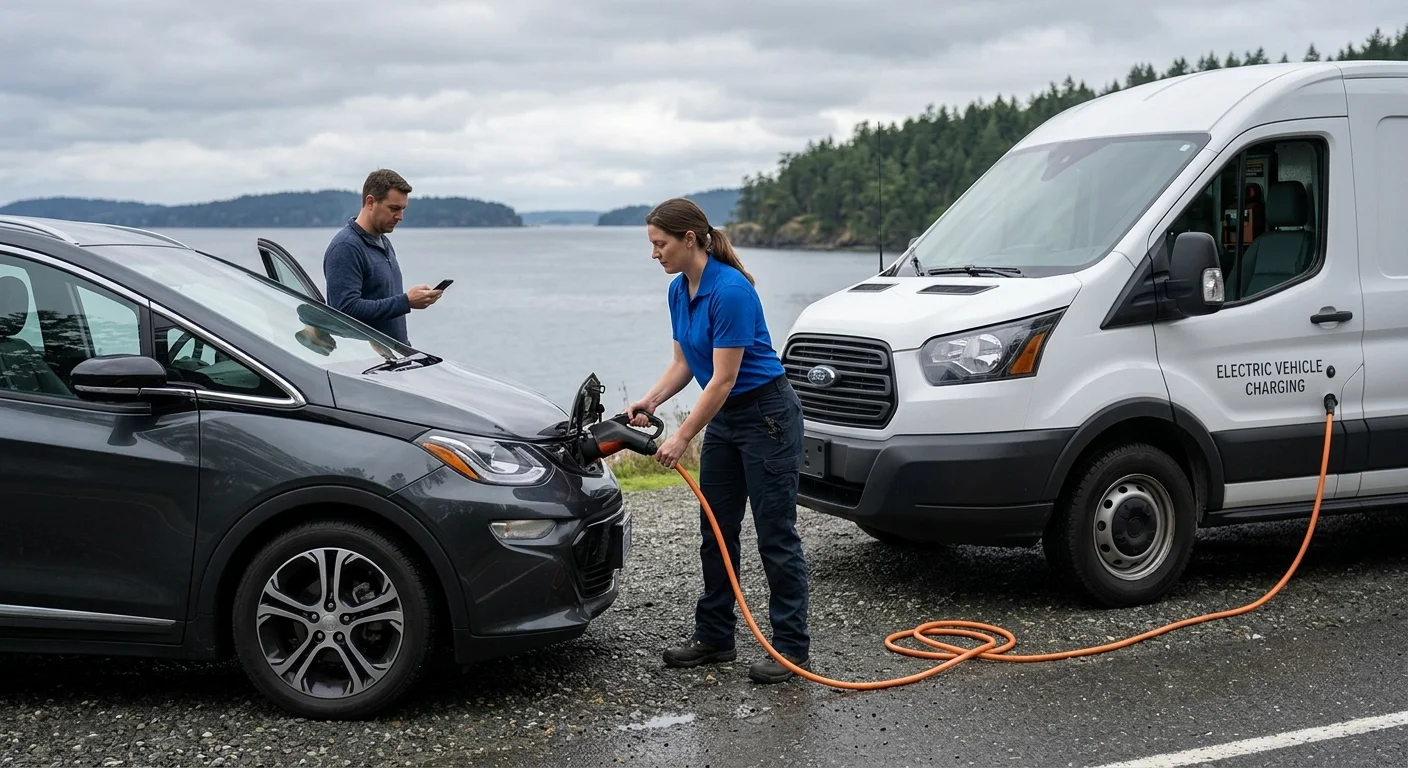
A pack charge puts 240-volt AC into the high-voltage battery. The U.S. Department of Energy puts Level 2 AC in a 2.9-19.2 kW band. Connectors are SAE J1772 and J3400 (NACS) for Teslas. A J1772 or CCS adapter is the ordinary way a non-Tesla takes AC Level 2 from a NACS source. Operators in this network bring a Tesla Cybertruck with an integrated 240V / 9.6 kW bed outlet, a NACS plug, and a CCS adapter. That output matches a typical home wall connector. Roughly 30 miles of range per hour is the derived figure from 9.6 kW. A 15 to 30 minute connection adds roughly 10 to 20 miles. That number is the size of a charge. It is not an arrival time.
Progressive roadside is an optional add-on on many auto policies. It is not a dedicated EV rescue product Charge Pro SEA can quote. Charge Pro SEA is not Progressive and does not partner with Progressive. Current EV charging benefits, tow mile limits, add-on prices, rental-car coverage, and event caps could not be confirmed. Classic roadside language still sounds like a jump, fuel, a spare tire, a lockout, and a tow. Fuel delivery does nothing for a traction pack at zero. If a dispatcher says they will charge the car, ask whether that means a 12-volt jump, a tow to a public charger, or a mobile Level 2 session at the curb.
What to confirm in the Progressive app first
Do not wait on the shoulder for a mystery truck. Open the Progressive app and your declarations page before you assume roadside is even on this VIN. A discount program or a liability-only policy is not proof. Have them read the endorsement for this vehicle.
Say the failure in plain words. “The car is dark and the doors will not open” is a low-voltage lockout. “The dash still wakes and the range reads zero” is an empty pack. Mix those up and you may get a jump for a car that needs miles, or a tow for a car that only needs a 12-volt wake-up.
Ask these, in this order, and write the answers down. Is roadside on this vehicle for this policy period. If it is not listed, you are hiring help on your own dime. Do they dispatch a jump, a tow, or a mobile charger. If they say “roadside,” push for the actual task. Does roadside assistance include EV charging is the same fork at other carriers. Allstate roadside for EVs and USAA roadside for a dead EV come down to the same three jobs.
If they send a jump, confirm it is for the 12-volt or low-voltage battery. A booster pack on the wrong posts can make a bad night worse.
If they send a tow, ask how far and to where. Progressive’s published tow distance for this page could not be confirmed. Get the mile limit in the app or on the recorded call. Ask whether the destination is the nearest public charger, a dealer, or home. A tow from I-5 in Tacoma to a random south-end lot is a different bill than a short pull to a working DC stall.
If they mention a battery charge for an electric car, ask whether anyone is bringing Level 2 power to you. A tow to a charging facility is not a curb-side charge. Whether you pay for that electricity under the policy could not be confirmed here.
Rental-car coverage, trip-interruption dollars, and how many roadside events you get this term could not be confirmed either. Those figures change by state and by endorsement. Searchers often ask whether Progressive is as good as AAA. That is a coverage question, not a ranking we can publish. Read both documents. Then decide whether the covered task matches the failure in front of you.
Stay out of the travel lanes. On a state highway, WSDOT’s Incident Response Team responds to incidents from flat tires and running out of gas to major collisions. Teams are on call 24/7 and patrol major corridors during peak hours, covering roughly 1,300 centerline miles. Published IRT materials do not mention electric vehicles, out-of-charge packs, or EV charging. Dial 911 for help on the roadway. A state truck can protect the scene. It will not fill a traction pack.
Puget Sound cases where a tow still makes sense
A tow is still the right call in this metro when the car cannot take a charge where it sits, or when leaving it creates a traffic hazard you cannot clear.
On I-5 through Tacoma, a dead EV in a travel lane is a removal job first. WSDOT IRT can shield the scene. RCW 46.61.590 still puts prompt removal on you. If the pack is empty and you already accept the nearest working DC stall as the destination, take the Progressive tow if your policy covers it. Stop guessing on the shoulder. If the car will not roll, the charge port will not release, or a wheel is damaged, a mobile charge cannot fix that. Get the flatbed. Chapter 46.55 RCW governs towing and impound in Washington, including private-property impounds. If a garage or lot is about to hook the car, moving it on your terms is cheaper than arguing with an impound later.
Winter range makes that call more often. Across 30-plus EV models, Recurrent Auto found EVs retain on average 78% of range at 32F, about a 22% loss. AAA testing at 20F found temperature alone cut range 10-12%, and cabin climate control pushed the loss toward 40%. A commute that worked in July can strand you on the Tacoma tideflats in January. Snoqualmie Pass sits at 3,022 feet. Closures and traction rules are announced storm by storm under RCW 46.37.420 and WAC 204-24. There is no fixed seasonal calendar. A pack that dies on the climb, or a car that needs chains you do not have, is a tow. Do not sit in a travel lane waiting for a charger that cannot reach you.
A downtown Seattle garage can go the same way. If the car is wedged in a stall, a rescue vehicle cannot reach the charge port, or the building will not let that vehicle in, you need a tow to a curb or a public stall. Seattle City Light serves the city. The garage’s house charger, if it exists, is a building issue, not Progressive roadside. King County has 144,257 registered EVs, with 45,469 in Seattle alone, per Washington DOL EV population data. Volume does not create a charger in that stall.
Redmond is different geography and the same rule. Puget Sound Energy serves most of the Eastside. An office-park car that will not move, or a collision in the garage, is still a tow. An empty pack in a legal stall, with room for a rescue vehicle, is not. Tacoma Power serves the city of Tacoma. Cross into unincorporated Pierce County and you are often in PSE territory instead. Name the utility only so you know whose public chargers sit nearby. None of them dispatch a truck to your bumper.
When a local charging operator is the better match
The better match is a local charging operator when the car can accept Level 2 power, you want to keep the car where it is, and Progressive is sending a tow you do not want.
Picture a Redmond office park after the last meeting. The dash still wakes. Range is zero. The car is in a legal stall. A tow to the nearest public charger means a flatbed, a wait at that stall, and a second trip back for the car tomorrow. A mobile EV charging session is a 15 to 30 minute connection that adds roughly 10 to 20 miles, enough to reach a working charger on your own. Redmond has 10,135 registered EVs. None of that changes the physics. The pack needs kilowatts, not a hook.
The same math holds on a quiet I-5 shoulder once you are out of the travel lane and the car can still take a plug. Tacoma has 6,651 registered EVs. King, Snohomish, and Pierce counties together hold more than 207,000 registered EVs. A tow through Pierce County traffic to a charger you could have rolled to with 15 miles is a long way around. Read when mobile charging beats a tow before you accept the first truck that is offered.
Charge Pro SEA is a referral service. It matches you with licensed, independent local operators. It performs no work, owns no trucks, and sets no price. The operator quotes and bills you directly. Ask for that quote before anyone plugs in. Emergency EV roadside assistance is the path when you are not sure whether the failure is a 12-volt or an empty pack. The matched operator can sort that on site: jump and load-test the 12-volt, or connect Level 2 if the pack is the problem.
Do not wait on a Progressive “charge” that turns out to be a tow you never confirmed. Current Progressive EV charging benefits, mile limits, and add-on prices could not be confirmed for this page. Check the app. If the covered task is a jump or a tow, and you need miles in the pack where you sit, hire the operator who does that job.
When to call us
Call when the dash still wakes, the range is gone, and you want Level 2 power at the car instead of a tow you have not confirmed. Call when the car is dark and you need a 12-volt sort-out, not a guess from a gas-car playbook. Call us at (206) 202-7018 and we’ll connect you with a local EV rescue operator.