Your pack is empty on I-405 and the club on your card answers. The dispatcher talks about a jump or a flatbed. Most roadside assistance EV charging calls still get those two jobs, not a high-voltage plug.
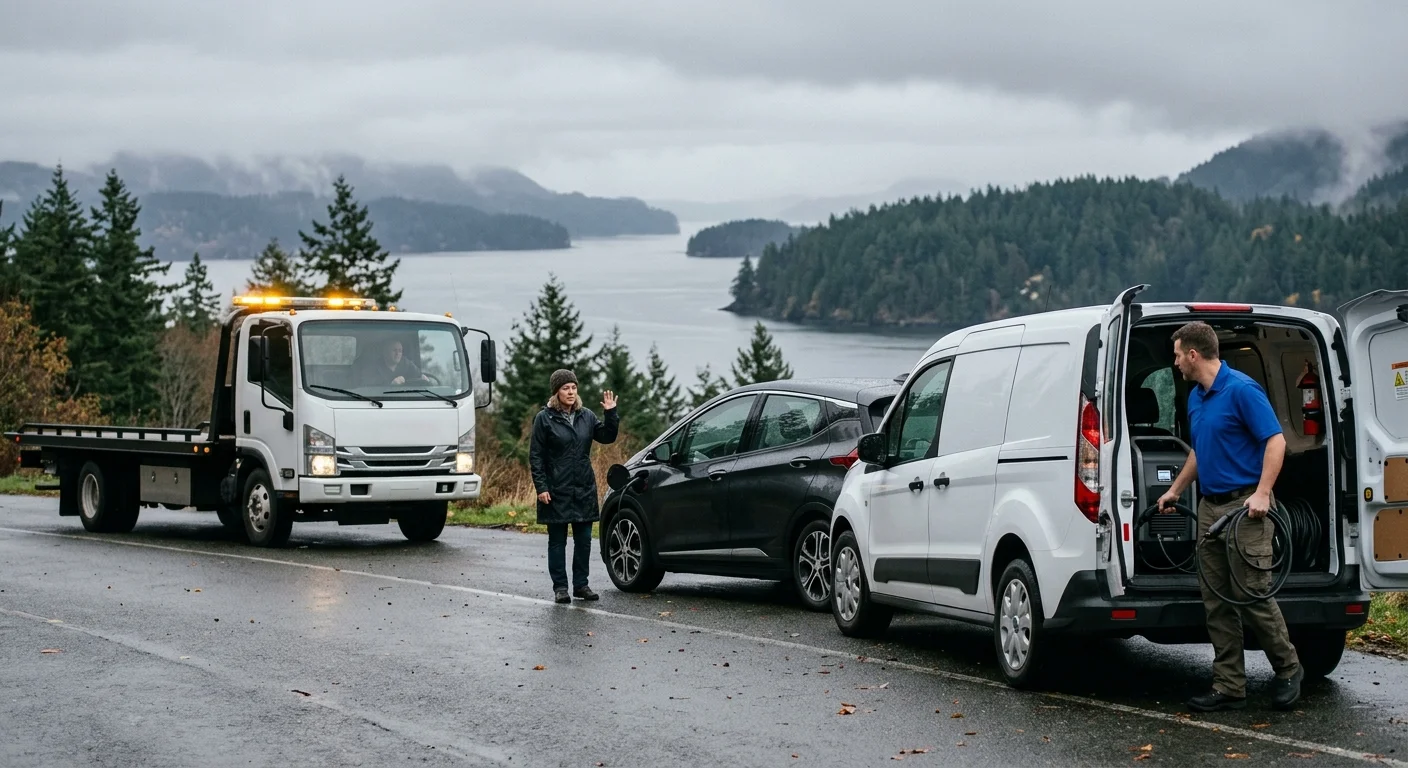
Jump, tow, and a real charge are different jobs
A 12V jump wakes the small battery that runs computers, locks, and contactors. It doesn’t put miles in the traction pack. A dead 12V in a Ballard alley looks like a dead EV. Screens stay dark. The charge port may not open. The car won’t roll. A jump or a 12V swap can bring it back. That’s not EV charging roadside assistance. Seattle has 45,469 registered EVs, the most in the three counties, and a lot of them live on street parking.
A tow moves the car. On a Puget Sound shoulder, that often means a flatbed. Chapter 46.55 RCW governs towing and impound in Washington. RCW 46.61.590 also requires the driver to arrange prompt removal. A tow gets you off the lane. It doesn’t add range.
A real charge puts energy into the high-voltage pack. Local operators who do mobile EV charging bring a Level 2 setup to the car. Charge Pro SEA connects you with those licensed, independent operators. We don’t own trucks, and we don’t perform the work. A typical rescue charge adds 10 to 20 miles of range in 15 to 30 minutes of Level 2 charging. That’s charging time, not travel time. The operator quotes the job. We set no price.
These three jobs get mixed up because gas-era roadside language still dominates. “Fill it” and “jump it” don’t map onto an EV. Portable gas cans don’t exist for a high-voltage pack. A consumer portable charger you keep in the frunk is a different tool from a van-mounted rescue charger. If the traction pack is empty, you need energy, not a spark. Ask which job is coming before you hang up.
If you want the wider map of clubs, OEM apps, and local operators, start with our Puget Sound EV roadside assistance guide. This page is only the include-a-charge decision.
What national clubs and insurers usually send
National plans still grew up around gasoline. Roadside assistance for EV drivers in the Puget Sound still usually means a tow. The default send is a jump, a tire change, a lockout, or a tow to a shop or a charger. EV charging roadside assistance is a separate product. It isn’t a given on a standard card.
We don’t publish what AAA, Tesla, Allstate, or USAA include this year. Unconfirmed details couldn’t be verified against each plan’s live page at writing. Read the current benefit page for your membership before you assume a mobile charge is on the ticket.
For AAA, check the club’s own EV roadside materials, then compare that language with how Seattle drivers actually get help in our AAA mobile EV charging notes.
Tesla Roadside is its own channel through the app and Tesla’s published roadside page. Confirm there whether your model and plan list charging, towing, or a 12V event.
Allstate members should read Allstate’s current roadside page. Our related post on Allstate roadside assistance for EVs walks the decision without restating a benefit list we can’t confirm.
USAA members should do the same on USAA’s site. The related note on USAA roadside assistance for a dead EV is a companion, not a substitute for the policy.
If the dispatcher only offers a tow, that’s still a valid rescue. Ask one clear question: will someone bring a charger, or only a truck. If the answer is a truck, you can still request out-of-charge EV recovery from a local operator and compare the two paths. Charge Pro SEA matches you with the operator. The club may or may not reimburse.
Washington DOL data shows 299,705 registered EVs statewide, with more than 207,000 in King, Snohomish, and Pierce Counties combined. Clubs built for a smaller fleet still send the old toolkit first.
When a mobile charge gets you moving again
Mobile EV charging roadside assistance wins when the car is safe to sit, the pack is empty or near empty, and a public plug is close enough that 10 to 20 miles will finish the trip. That’s the classic out-of-charge recovery case.
Picture I-405 on the Eastside. Range hit zero in stop-and-go. The car is on a wide shoulder or a nearby lot, not blocking a live lane. A Level 2 rescue charge for 15 to 30 minutes is often enough to reach a DC fast charger in Bellevue, Renton, or Kirkland.
A Supercharger queue in Tacoma is another fit. The lot is full, the pack is low, and a short charge lets you leave for another site. For the tow-versus-charge split, see mobile EV charging or a tow.
Roadside-capable mobile chargers exist. Independent operators mount Level 2 equipment in vans and connect NACS or J1772 at the car. Charge time depends on the car’s onboard AC limit and the operator’s output. The 10 to 20 mile, 15 to 30 minute figure is the typical rescue charge for this service, not a promise for every model. A roadside charge isn’t a full pack. You’re buying enough range to roll to a public stall or a home plug, then you stop. Sitting for an hour on the shoulder to chase a high percentage is the wrong use of the tool.
Cost is quoted by the operator on the job. Charge Pro SEA sets no fees, no waivers, and no published rate. If you want a Seattle-area cost conversation in general terms, read mobile EV charging service cost in Seattle and ask the operator for the current number before work starts.
Cold days shrink the window. Recurrent Auto’s testing across 30-plus models found EVs keep about 78% of range at 32F, roughly a 22% loss. AAA testing at 20F found temperature alone cut range 10-12%, and cabin heat pushed the loss toward 40%. An empty-pack rescue on a wet I-405 night needs those extra miles more than a July afternoon does.
Puget Sound cases where a tow still wins
A charge is the wrong tool when the car is in the way, the 12V is the real failure, or the next charger is farther than a short Level 2 boost can cover.
If you’re stopped on a state highway, safety comes first. The WSDOT Incident Response Team handles incidents on state highways, from flat tires and running out of gas to major collisions. WSDOT IRT teams are on call 24/7 and patrol major corridors during peak hours. To reach help on the roadway, dial 911. WSDOT’s published IRT materials mention motorists who’ve run out of gas, and they don’t mention electric vehicles or charging.
Outside incorporated cities and towns, RCW 46.61.560 generally prohibits stopping on the roadway, with an exception for a vehicle so disabled that stopping is unavoidable. You still have to arrange prompt removal under RCW 46.61.590. On a narrow US-2 shoulder toward Gold Bar, a flatbed is often the clean exit. A 10 to 20 mile boost may not reach the next open stall if weather, grade, and cabin heat eat the rest. In that corridor, a tow to a working charger can be the honest job.
A 12V brick in a Ballard alley is the other miss. Jump the 12V, or replace it, before you order a pack charge. The traction battery may still have range left. Charging a pack that won’t close contactors wastes the call.
Pass country is its own case. Traction and chain rules under RCW 46.37.420 and WAC 204-24 change storm by storm. Closures on Snoqualmie or Stevens can trap an EV with a low pack far from a plug. A mobile charger that can’t reach you through a chain-control backup isn’t a rescue. A tow to the nearest powered lot is.
When the car is leaking, crashed, or on fire, you want fire and police, not a charger. Use the U.S. Department of Energy EV pages for charging basics.
When to call us
If the pack is empty, the car is safe to sit, and a short Level 2 charge would reach a plug or your driveway, you want a mobile EV rescue operator, not a default tow. Charge Pro SEA matches you with a licensed local operator who quotes and performs that charge. Call us at (206) 202-7018 and we’ll connect you with a local EV rescue operator.