A State Farm roadside call from a dead EV on I-5 through Everett usually produces a 12V jump or a wrecker. It does not usually produce a charge into the high-voltage pack. Read the benefit in the app before you wait on the shoulder for the wrong truck.
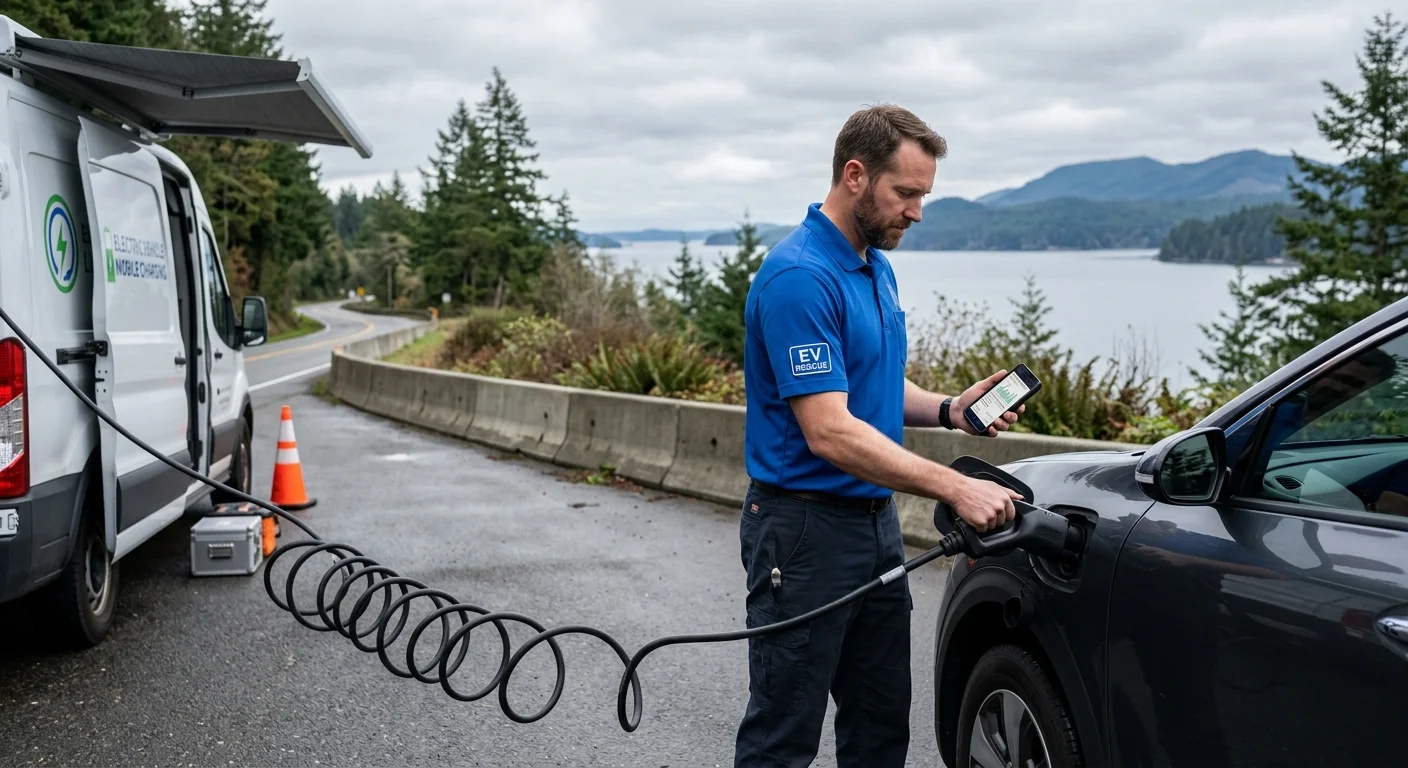
Jump, tow, and a pack charge are different jobs
When an EV will not roll, you are looking at one of three jobs. Mixing them up is how people wait for equipment that cannot help.
A 12V jump is for the small battery that wakes the car. Screens dark, locks dead, no Drive: that is often the 12V. A matched local operator can jump it, load-test it, and quote a replacement if it failed. Tesla’s own manuals say a Model 3 cannot be used to jump start another vehicle. The same sentence appears for Model S, Model X, Model Y, and Cybertruck. A gas-era jump pack still belongs on that 12V job. It does not refill the traction pack.
A tow is for moving a disabled vehicle. Chapter 46.55 RCW governs towing and impound in Washington. On a state highway, WSDOT’s Incident Response Team can help after you dial 911. Their published materials describe motorists who have run out of gas. They do not mention electric vehicles, out-of-charge situations, or EV charging. A tow still makes sense after a crash, a leak, a locked drivetrain, or a stall where a charging van cannot reach the port.
A pack charge is Level 2 power into the high-voltage battery. The U.S. Department of Energy lists Level 2 AC in a 2.9-19.2 kW band, with SAE J1772 and J3400 (NACS) as the ordinary connectors. Local rescue operators in this network run 240V AC at 9.6 kW, the same power class as a typical home wall connector. A 15 to 30 minute connection adds roughly 10 to 20 miles. That figure is the size of a charge, not an arrival time. Roughly 30 miles of range per hour is the derived rate at that output.
State Farm roadside, on policies that include Emergency Road Service, is built around the older menu: jump-start, lockout, flat tire, fuel delivery, and towing. Fuel delivery does not fill an EV. A current public State Farm page that lists on-site high-voltage charging as a roadside benefit could not be confirmed for this article. Treat pack charging as unconfirmed until your policy and the State Farm app say otherwise.
That is why most state farm ev roadside assistance calls still resolve as a jump or a tow. If the traction pack is empty and the 12V is fine, you are asking for a different trade than the one the insurer typically dispatches.
What to confirm in the State Farm app first
Do this before you stand on a fog line waiting.
Open the State Farm app on the policy that lists the EV. Find roadside or Emergency Road Service. Confirm the coverage is on this vehicle, not only on a household gas car. Screenshot the screen. What your State Farm roadside assistance covers lives in that policy, not in a ranking page.
Ask the in-app flow or the roadside line four plain questions. Is a jump-start included. Is towing included, and to what kind of destination. Is there any written EV or charging benefit. Who actually shows up, a contracted tow operator or someone with a 240V outlet.
Tell them the car is electric. Then tell them which battery failed. “The dash is black and the doors will not wake” is a 12V story. “The car drove, the range hit zero, and it will not go into Drive” is a pack story. Those two sentences change the truck. Does State Farm roadside charge an EV? Not unless your documents say so. A public, current charging benefit could not be verified here.
If the app cannot confirm a pack charge, do not wait as if one is coming. Use the jump if the 12V is the problem. Use the tow if you need the car moved to a charger or a shop. How you know if towing is covered is the same check: declarations page, app, listed vehicle. Mile limits, add-on fees, and advertised arrival windows are not published here because current public figures could not be verified without guessing.
Charge Pro SEA is not State Farm and does not partner with State Farm. If you call this referral line, you are matching with a local operator. The operator quotes, does the work, and bills you. The brand sets no price and promises no ETA.
If you carry more than one roadside product, read each one the same way. Allstate roadside assistance for EVs, USAA roadside assistance for a dead EV, Progressive roadside assistance for a dead EV, and GEICO roadside for a dead EV all run into the same fork: jump, tow, or charge. The logos differ. The physics do not.
Washington had 299,705 registered EVs in the DOL file updated 2026-09-15, including 45,469 in Seattle and 10,135 in Redmond. Plenty of State Farm households in this metro now park an EV. The policy paperwork often still describes a gas job.
Puget Sound cases where a tow still makes sense
A tow is the right call when the car should not sit, or cannot take a charge where it is.
On I-5 through Everett, a dead EV on the shoulder is a traffic hazard before it is a charging puzzle. Everett has 4,786 registered EVs. RCW 46.61.560 lets a disabled vehicle stop outside a city when stopping is unavoidable. RCW 46.61.590 still requires the driver to arrange prompt removal. Dial 911 for help on the roadway. WSDOT IRT teams are on call 24/7 and patrol major corridors at peak hours. They cover roughly 1,300 centerline miles, about 18% of state-owned centerline miles. They are not a mobile Level 2 service.
A downtown Seattle garage is another tow case when the stall is tight, the ramp is steep, or the attendant will not let a charging vehicle in. Seattle City Light serves the city. The garage is private property. Access rules sit with the garage operator, not with your insurer. If a charging van cannot reach the charge port, the car has to move.
Snoqualmie Pass sits at 3,022 feet. Closures and traction-tire rules on the passes are announced storm by storm under RCW 46.37.420 and WAC 204-24. An empty pack on the pass, in snow, with chain control, is a removal problem. Get the car to a safe lot, then charge.
Tow also wins after a collision, a warning that points at the high-voltage system, or a 12V that will not hold after a jump. Emergency EV roadside assistance is the broader match when you do not yet know which failure you have. A shop destination beats a charger when the car itself is the repair.
Confirm the tow company’s rate before they hook the car. This site does not publish dollar figures for tows. Chapter 46.55 RCW and the Washington State Patrol’s posted maximum impound rates govern impound. They do not set a private roadside add-on.
Sea-Tac’s garage has 94 EV stalls with free Level 2 charging. Regular parking rates still apply. Stalls are marked with green striping: 64 in Rows E/F on Floor 7, and 30 in Rows E/F on Floor 4. Two DC fast chargers sit in the Cell Phone Lot. If you can roll there under your own power, a short charge may be enough. If you cannot roll, you are back to a tow or an on-site charge.
When a local charging operator is the better match
Picture a Redmond office park after dark. The car is in a surface stall. The 12V is fine. Range is at zero. You need enough miles to reach a public charger, not a ride to a body shop.
That is a mobile EV charging job. A matched operator brings Level 2 power to the car. NACS for Tesla and newer native-NACS models. J1772 for many others. A J1772 or CCS adapter is the ordinary way a non-Tesla takes AC Level 2 from a NACS source. Fifteen to 30 minutes on a 9.6 kW connection is roughly 10 to 20 miles. That is often enough to leave the lot.
King County has 144,257 registered EVs, Snohomish 37,818, Pierce 25,042. Combined, over 207,000 in the three counties (Washington DOL EV population data). Redmond alone has 10,135. The Eastside commute, I-405, SR 520’s toll crossing, and a cold snap all shrink range. Recurrent Auto’s testing across 30-plus models found EVs keep about 78% of range at 32F. AAA testing at 20F found temperature alone cut range 10-12%, and cabin heat pushed the loss toward 40%. None of that is a State Farm benefit. It is why a Puget Sound EV dies short of a charger more often in January than in July.
Charge Pro SEA is a referral service. It matches you with licensed, independent local operators. It performs no work, owns no trucks, and holds no trade license. The operator quotes, does the work, and bills you. Compare that with waiting on an insurer dispatch that may only send a wrecker.
If State Farm covers the tow and you would rather not take the tow, that is your call. If the app covers a jump and the pack is empty, the jump will not add range. If you already compared Allstate, USAA, and Progressive and still have a dead EV in a place a van can reach, match the job: a pack charge on site.
The U.S. Department of Energy’s EV pages explain charging levels. Your State Farm policy explains your roadside add-on. Use both. Do not let a gas-era menu decide a pack-empty night in Redmond.
When to call us
When the 12V is alive, the pack is empty, and a local operator can reach the stall, a mobile charge is the job. Call us at (206) 202-7018 and we’ll connect you with a local EV rescue operator.