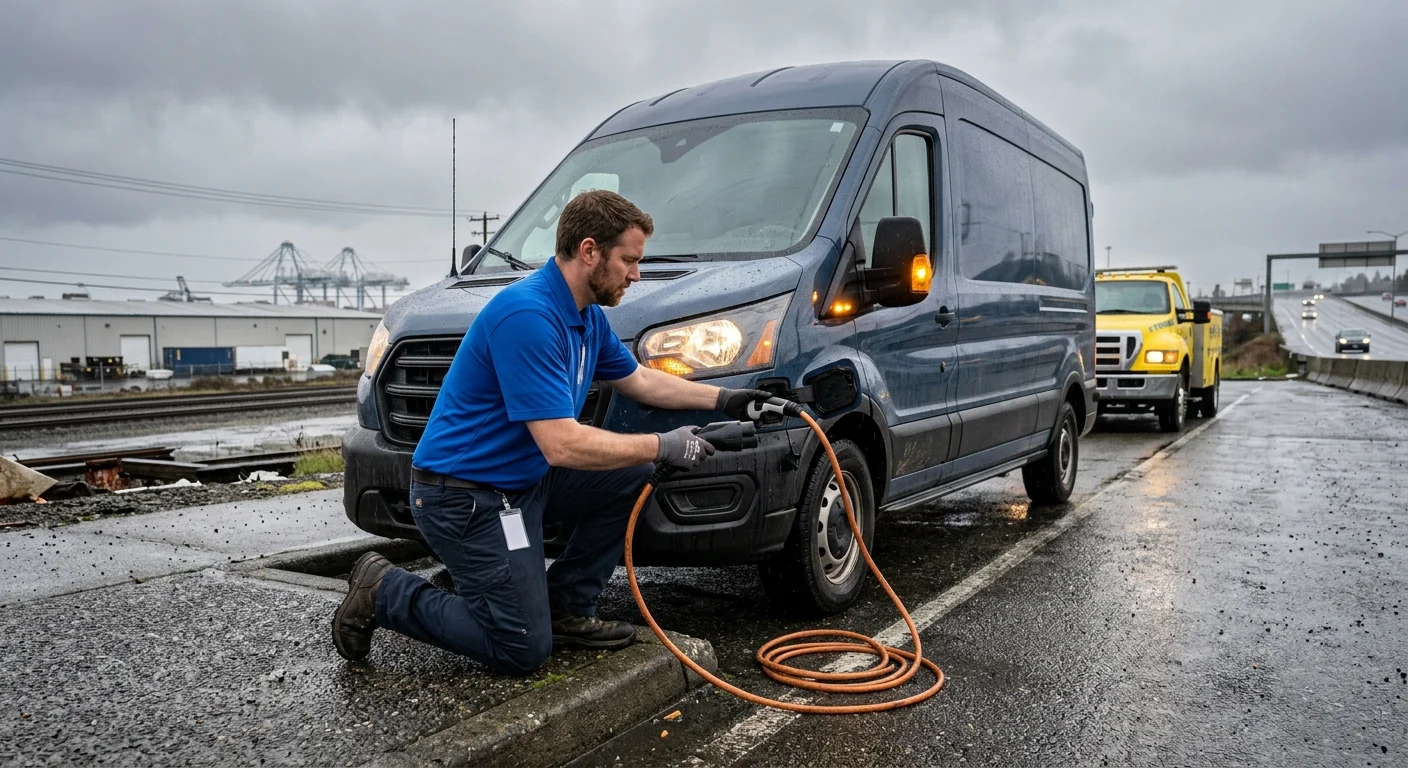
When a van dies on 20th Street E, the next dock is often still in sight. The pack hit zero after a Port of Tacoma run, or the 12V quit in the rain, and the car is not rolling to a charger on 99. Charge Pro SEA connects Fife drivers with a licensed local operator who can add range at the curb or jump a dead 12V, and you pay that operator directly.
I-5, the port, and warehouse-shift stalls
Fife sits on I-5 between Tacoma and Federal Way, hard against the Port of Tacoma edge. The ACS 2019-2023 population is 10,902. The 2024 Census estimate is 11,077. Washington DOL counted 700 registered EVs in Fife in the file updated September 15, 2026. Pierce County as a whole had 25,042 in that same read.
20th Street E is warehouse frontage: distribution, last-mile, and shift parking. Pacific Highway, signed 99, is the older commercial run through town. The Fife Curve is the I-5 bend. The Puyallup River bridges carry I-5 and 99 over the water. A night-shift van that leaves a terminal with a thin buffer can stall on any of those stretches before the next gate opens.
Cabin heat on a wet Pierce County evening uses range the dash did not show at noon. Recurrent’s testing across 30-plus EV models found cars keep about 78% of range at 32F, about a 22% loss. AAA testing at 20F found temperature alone cut range 10-12%, and cabin climate pushed the loss toward 40%. Eight leftover miles can disappear between the port fence and a 20th Street E driveway.
If the car is on the I-5 shoulder, stay out of the travel lanes, keep hazards on, and dial 911. WSDOT’s Incident Response Team responds to disabled vehicles on state highways. Their published materials cover motorists who have run out of gas. They do not mention electric vehicles or on-site charging. RCW 46.61.590 still requires the driver to arrange prompt removal.
A gated terminal is a different stop from the interstate. We could not confirm a published public rule for EV rescue inside Port of Tacoma terminals or private yards on 20th Street E. Follow posted site security. Ask the gate or your dispatcher before an operator comes on the property.
The same I-5 lane continues south into EV roadside help in Tacoma and north toward Federal Way. The plateau west of the valley is EV roadside assistance in Edgewood. Fife is the short industrial strip in between, and that is the geography this page is for.
Empty pack vs a dead 12V on a Fife curb
Two failures look the same from a warehouse sidewalk. The car is silent. Lights are dead or the screen is locked. You cannot creep to a charger on Pacific Highway.
An empty traction pack is an out-of-charge stop. A matched operator connects Level 2 power at the car: 240V AC at 9.6 kW, the same power level as a typical home wall connector. Level 2 AC runs 240V residential (208V commercial) in a 2.9-19.2 kW band, the range the U.S. Department of Energy publishes for that class. Connectors are SAE J1772 and J3400 (NACS). A J1772 or CCS adapter is the ordinary way a non-Tesla takes AC Level 2 from a NACS source. A 15 to 30 minute connection adds roughly 10 to 20 miles. That is the size of the charge, not a promise about when anyone arrives. Roughly 30 miles of range per hour is the derived rate at 9.6 kW against typical EV efficiency. Ten to twenty miles is enough to leave 20th Street E, clear the Fife Curve, and reach a public charger or a depot if the car accepts the plug. That is out-of-charge recovery.
A dead 12V is a different job. The big pack can still hold range. The small battery that runs computers, locks, and contactors has failed. A matched operator jumps it on site, load-tests it, and can replace a failed 12V (AGM lead-acid or lithium, per model year). The operator quotes both options before starting and bills you. Tesla’s manuals say a Tesla cannot jump another vehicle. Do not pull jump leads from the next Model Y in the lot.
Tesla is about 41% of registered EVs statewide, so name the badge. Tell the person what the dash shows, whether the charge port opens, and whether the car was already at 0% when it stopped. That is how they match a charger, a 12V jump, or a wrecker.
Mobile charge vs a tow toward Tacoma
A mobile charge keeps the car in Fife. Matched operators use a Tesla Cybertruck with an integrated 240V / 9.6 kW bed outlet, a NACS plug, and a CCS adapter. They quote the job. Charge Pro SEA sets no price. The driver pays the operator.
A tow is the right call when the car will not take a charge, when WSP wants the I-5 shoulder cleared, or when a 12V failure has left the car unable to roll. Mercedes-Benz tells EQS owners that a discharged 12V can keep the drive system from starting and the parking brake from releasing, and it recommends transport rather than a conventional tow. Other makes can fail the same way. Chapter 46.55 RCW governs towing and impound in Washington, including private-property impounds and the maximum rates the Washington State Patrol posts.
If you are already on I-5, 911 is the first call. WSDOT incident response handles the highway. A local operator can charge on the shoulder only if that stop is allowed to continue. On 20th Street E or Pacific Highway, a Level 2 connection at the bumper is often the whole job. The operator adds roughly 10 to 20 miles, unplugs, and you drive.
From 20th Street E you can cover a lot of the port edge and the warehouse strip on that bump. From the Fife Curve you can clear I-5 into Tacoma or north toward Federal Way. Confirm a live charger on your map before the operator unplugs. This page does not publish a Fife charger list. We could not verify a stable public inventory worth putting in print.
Towing toward Tacoma still leaves you needing a charger or a shop that will take an unpowered EV. Charging in Fife leaves the van on the same street as the dock it missed. Ask the operator to quote both paths before anyone hooks a winch. Emergency EV roadside assistance is the service for this mix of empty packs, dead 12Vs, and Fife streets.
How to request a local operator from the shoulder
Keep hazards on. Stay out of the travel lane. If you are on I-5, call 911 first and ask for incident response. Then call Charge Pro SEA so we can connect you with a licensed local operator.
Name the place in Fife terms. 20th Street E near the warehouses. Pacific Highway by the river. I-5 southbound at the Fife Curve. The Puyallup River bridge. The Port of Tacoma edge, and whether you are outside the fence or inside a gate.
Give the make and model. Say empty pack or dead 12V if you know. Say whether the charge port opens. If you are in a yard, say so, because posted security controls who can enter.
If you cannot stand behind a barrier, stay belted in the car with hazards on. Share a map pin. If a trooper or a WSDOT truck is already there, tell them you have requested a mobile EV operator so they know a charger may be coming. They still control the shoulder.
Charge Pro SEA is a referral service. The operator who takes the job quotes before work starts and bills you. The operator sets the price and the schedule. Fife’s 700 registered EVs, per the Washington DOL EV population data, share a short list of roads. A clear pin and a badge on the car is enough for the match.
If the car is inside a terminal, wait on the gate’s instructions. We could not verify a public Port of Tacoma rule for mobile charging trucks. Your dispatcher or the posted sign is the authority.
On a city street, RCW 46.61.590 still requires you to arrange prompt removal. A stall in a warehouse lot is simpler than the Fife Curve. The operator comes to the car. Bring your key card or phone, because some cars will not unlock the charge port with a dead 12V until the small battery has power again. If the port is stuck, say so on the call.
When to call us
Call when the EV is stuck on 20th Street E, Pacific Highway, the Puyallup River bridges, the Port of Tacoma edge, or the I-5 shoulder through Fife, and you need a licensed operator to add range or jump a 12V. If you are on I-5, call 911 first. Call us at (206) 202-7018 and we’ll connect you with a local EV rescue operator.