Your battery hits zero somewhere between the Port of Tacoma and the Narrows Bridge on-ramp. The nearest public charger is several miles away, which might as well be on the moon in shift-traffic. That is the specific, frustrating situation Pierce County EV drivers face more often than the regional averages suggest, and it is exactly what our emergency EV roadside assistance team exists to solve.
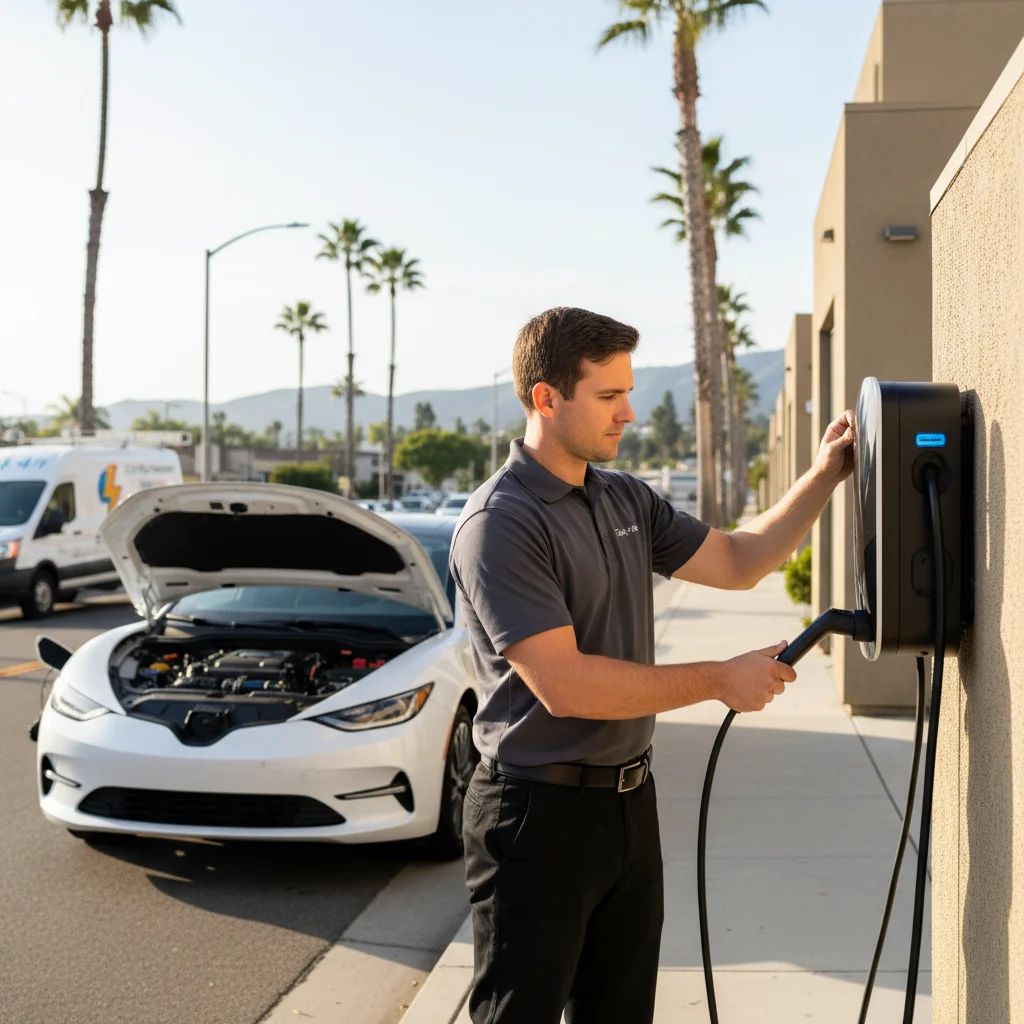
Why Tacoma EV drivers get stranded
Tacoma is the third-largest city in the metro, but its charging infrastructure has not kept pace with its EV adoption rate. The city’s older neighborhoods, including parts of the Hilltop, the South End, and the Proctor district, have a high share of pre-1980 housing where on-site parking rarely includes a working Level 2 outlet. Residents rely on public chargers or a slow Level 1 cord across the driveway.
There is also a climate factor that is easy to overlook. Pierce County winters are wetter and slightly colder than the rest of the metro, with overnight lows sitting in the 30s for months. Heat in the cabin plus the defrost draw heavily from the traction pack, and a Hyundai Ioniq 5 or Tesla Model Y rated at 270 miles of range can realistically deliver 20 percent less in a January rainstorm. Drivers who calibrated their habits to the sticker number get caught short.
And then there is the 12V auxiliary battery problem, which trips up EV owners who do not know it exists. Modern EVs, Tesla, Ford, Rivian, Hyundai, GM, all carry a small 12V battery that powers the low-voltage systems. When it dies, the car will not power on, the charge port will not open, and the traction battery is essentially unreachable. Our out-of-charge recovery service handles both scenarios: flat main battery and dead 12V alike.
I-5, SR-16, and the Narrows: stranded-EV hotspots
Three freeways converge in or near Tacoma, and each one creates its own stranding pattern.
I-5 runs north-south through the middle of the city and carries heavy commuter traffic between Federal Way and Olympia. Drivers who leave home with a marginal charge and plan to top up at work find themselves in trouble when that workplace charger is occupied or broken. The shoulder near the 54th Avenue and 72nd Street interchanges sees a disproportionate share of stranded EVs, it is where the “I will make it” calculation fails.
SR-16 connects Tacoma to Gig Harbor across the Narrows Bridge. Drivers coming back from the Kitsap Peninsula with low range on a wet Sunday evening often run out before reaching a working charger. The Narrows crossing is not a spot where you want to be on the shoulder.
SR-167 cuts through the eastern edge of the metro and connects Tacoma to the Green River valley. It is fast, relatively uncrowded, and has almost no shoulder infrastructure for disabled vehicles. Getting stuck on SR-167 means you are exposed to 65 mph traffic with nowhere to push the car safely. We treat SR-167 calls as elevated-priority dispatches for exactly that reason.
Tacoma neighborhoods and port-shift response patterns
Tacoma operates differently from the Westside neighborhoods, and our response routing accounts for that. The Hilltop, the South End, and the Stadium District are dense, walkable, and well-lit, but they are also far from the freeway fast-charger clusters that exist further north on I-5.
For residential calls in the older apartment corridors along Pacific Avenue and 6th Avenue, the operator confirms a window that accounts for time of day and where they are coming from. We stage operators in Pierce County specifically because the eastern and southern neighborhoods are a consistent call source. We do not pretend a long drive is a short one.
Tesla drivers in these communities have an additional wrinkle. Tesla’s own roadside network handles towing and tire changes, but mobile charging is not a standard Tesla roadside offering in most markets. Our Tesla roadside rescue service fills that gap for Tesla owners in Tacoma who need electrons, not a flatbed.
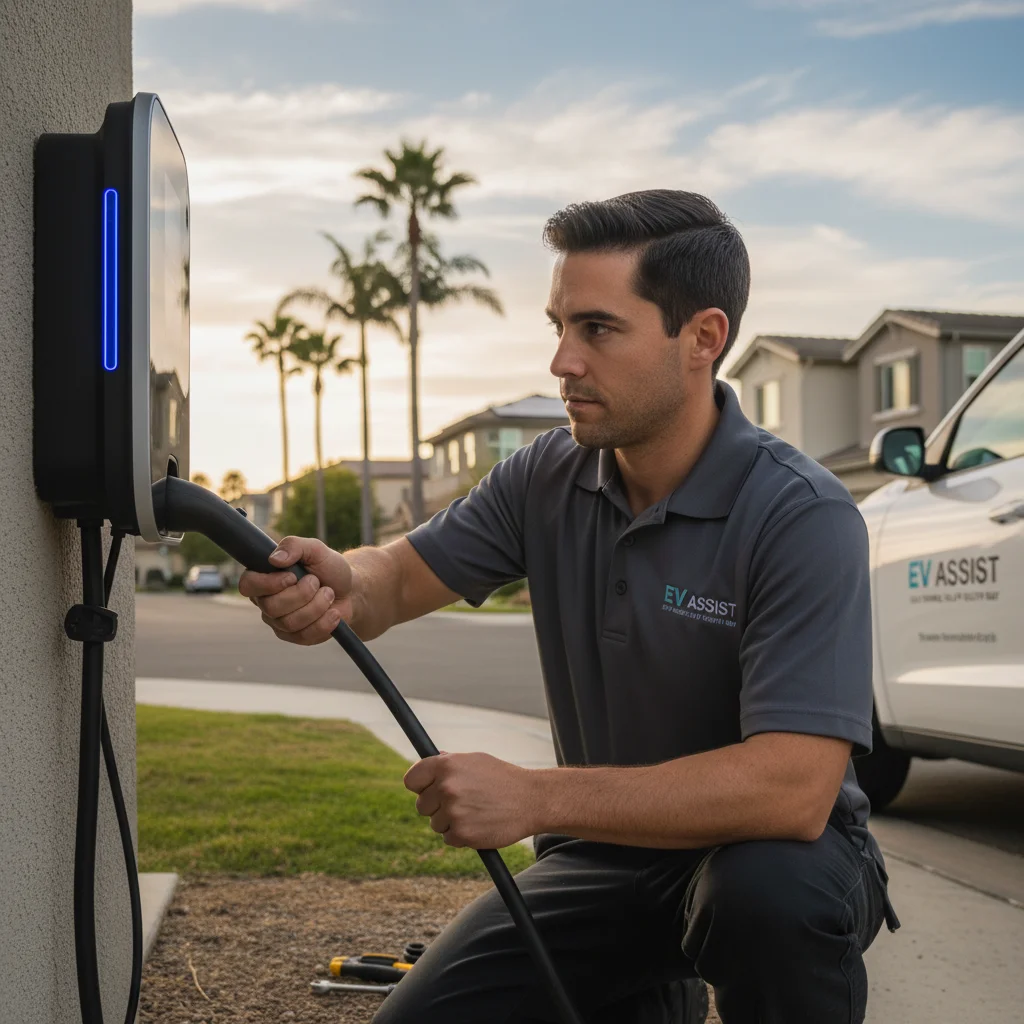
What we bring and how fast the operator arrives
Every dispatch to Tacoma rolls with a truck carrying a Level 2 source capable of delivering a meaningful top-up to CCS, NACS, and J1772-compatible vehicles. That is enough to put 10 to 20 miles of range into most EVs in under 30 minutes, enough to get you home or to a permanent charging station without a tow.
We also carry 12V jump start equipment for EVs, the process and connectors vary by manufacturer, plus Level 2 adapters for vehicles that do not accept DC fast charging in an on-road context, and basic diagnostics to distinguish a flat main battery from a 12V failure or a charge port lock issue.
Response time for Tacoma: the operator confirms a realistic window with you on the call. Freeway shoulder calls on I-5 and SR-16 tend to be faster because traffic flow works in our favor for operators nearby. SR-167 calls take slightly longer due to access logistics, but we have a route dialed in.
Mobile charge vs tow for Pierce County drivers
The default assumption when an EV dies on the road is “call a tow truck.” That assumption costs Tacoma drivers time and money they do not need to spend.
A flatbed tow from a Hilltop apartment to the nearest DC fast charger runs significantly more than a mobile charge call and takes 45 to 90 minutes to arrive. Then you are at a charging station without your car for another 30 to 45 minutes. Total disruption: 2 to 3 hours.
A mobile charge call gets an operator to you, delivers enough range to drive yourself to a charger or home, and has you moving again under your own power from the moment you call. The cases where a tow makes more sense: the vehicle has a hardware fault, the charge port is physically damaged, or diagnostic equipment indicates the pack will not accept a charge. In those situations, the operator will tell you straight, and can coordinate with a flatbed rather than waste your time.
For the broader decision tree, our guide on mobile EV charging vs a tow walks through the scenarios for the metro.
When to call us
If your EV is stranded in Tacoma, flat main battery, dead 12V, range emergency on the Narrows, or a charge port that will not open, that is a job for the operators we connect you with, not a wait for a tow truck. An operator comes out with the equipment to get you moving, knows the Pierce County roads, and the operator quotes you before starting.
Call (206) 202-7018 to reach a local operator.