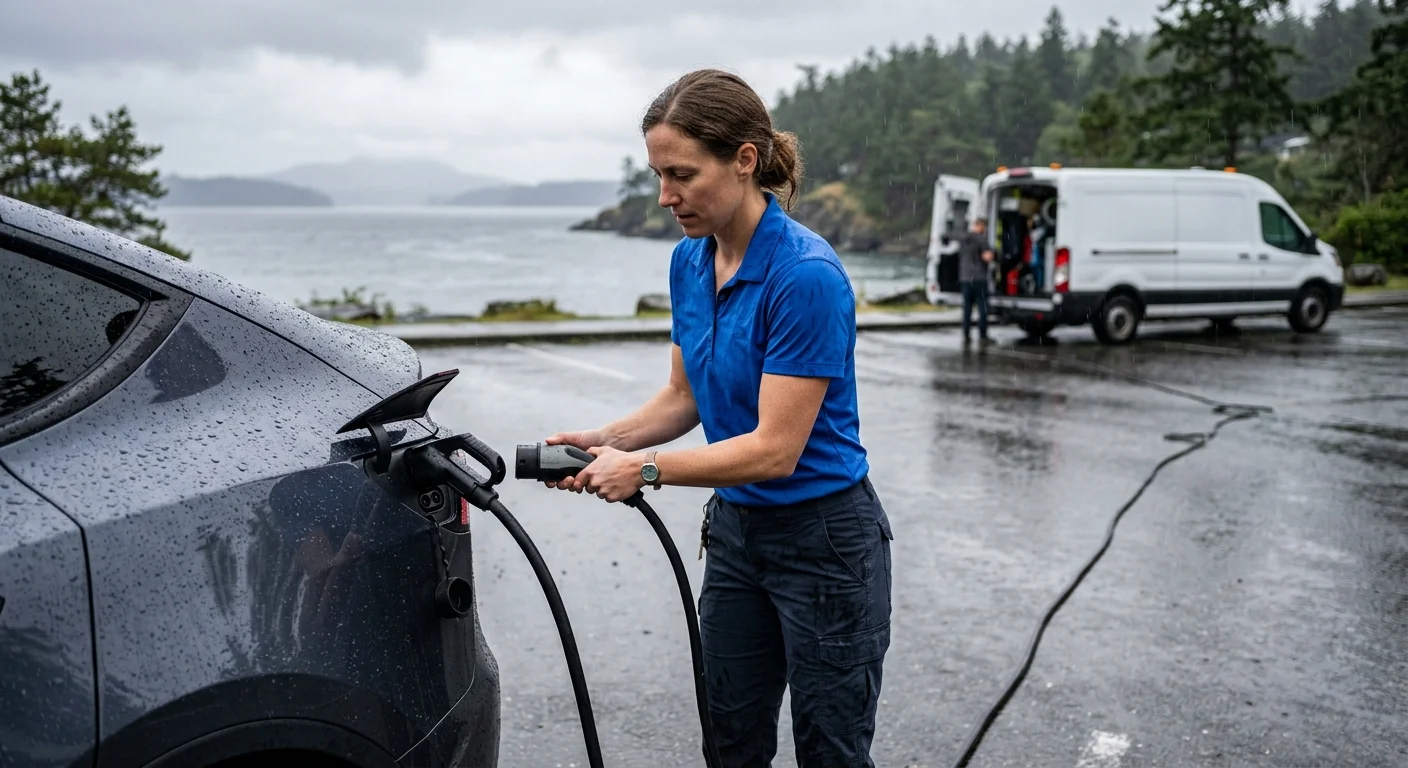
You’re stopped on the I-5 shoulder in Tukwila, or parked on Island Crest Way, and the pack is empty. A mobile charge only happens if the handle on the truck fits the inlet on your car. CCS and NACS are different shapes, and sending the wrong one wastes the call: the operator is on scene with a plug that will not seat.
What those two plugs mean when you are stranded
NACS is SAE J3400, the compact North American inlet Tesla vehicles use. One plug face handles AC Level 2 and DC fast charging on the car. CCS is the Combined Charging System. In the United States the CCS1 face is a J1772 AC inlet with two extra DC pins under it. People mix those names because the same door can take a skinny J1772 handle for Level 2 or the full CCS combo for DC.
They are different physical plugs. CCS uses the J1772 layout plus those DC pins. J1772 is the AC standard. A mobile EV charging rescue in this metro is Level 2 AC. It is 240V at 9.6 kW, inside the U.S. Department of Energy’s published 2.9-19.2 kW Level 2 band. The DOE’s electric vehicle pages are the federal overview. A J1772 or CCS adapter is the ordinary way a non-Tesla EV takes AC Level 2 power from a NACS source.
The published rescue kit for a matched operator is a Tesla Cybertruck with an integrated 240V / 9.6 kW bed outlet, a NACS plug, and a CCS adapter. That output matches a typical home wall connector. A 15 to 30 minute connection adds roughly 10 to 20 miles of range. Roughly 30 miles of range per hour is a derived figure from 9.6 kW against typical EV efficiency. Those numbers describe the size of a charge. They are not an arrival promise.
On a wet curb in Burien, the inlet on your car is the answer. NACS needs a NACS head or a documented adapter. CCS needs a CCS or J1772 path. Rain does not make them interchangeable. “Better” is the wrong word here. The handle that seats is the one that works.
Public DC stalls are a separate hunt. This page has not confirmed Supercharger stall connector types from a primary source we can publish, so check the stall in front of you. Tesla vehicles here take NACS. A roadside Level 2 rescue still has to match that inlet or bring the adapter.
CCS inlets are still on the road in this metro. King County’s registered mix after Tesla is Chevrolet, Nissan, BMW, Kia, and Hyundai. New NACS ports and older CCS combo ports share the same I-405 garages. Plan for both. A disappearing CCS network is not a fact we can publish. Both shapes still show up on Puget Sound cars in 2026.
2026 cars in this metro and adapter confusion
Washington’s DOL EV population file (updated 2026-09-15) lists 299,705 registered EVs statewide. Tesla accounts for 122,981, about 41 percent. King, Snohomish, and Pierce together hold over 207,000: King 144,257, Snohomish 37,818, Pierce 25,042. King County Teslas are 63,017 of 144,257, about 44 percent. Seattle has 45,469 registered EVs. Bellevue 14,383. Redmond 10,135. Tacoma 6,651. That is a two-plug fleet, not a Tesla-only one.
For 2026, read the inlet on the car you are standing next to. Hyundai publishes a native NACS port on the 2025 and later IONIQ 5. That is confirmed. The inlet on earlier IONIQ 5 years could not be confirmed from a primary source we can publish. Check the port and the owner’s manual. Ford, Rivian, Kia, and Chevrolet 2026 ports are the same rule. If the manufacturer spec is not confirmed here, treat the year as a question and look at the door.
Rivian drivers also hit a stuck-handle problem that is its own procedure. That is the Rivian roadside charger type writeup, with Rivian’s published hood-and-cable release. Name the inlet anyway. An R1T on US-2 in Gold Bar and an R1S on I-90 east of North Bend still need the right head before a Level 2 session can start.
Adapters are ordinary on a NACS source. Charge Pro SEA does not own trucks, adapters, or inventory. Independent operators quote their own kit. The published kit includes a NACS plug plus a CCS adapter. Confirm that the matched operator has the head your car needs before anyone rolls. If you already have an adapter in the frunk, say so on the call. Follow the automaker’s guidance for that adapter.
The 2026 mess is model-year drift. A 2024 car and a 2026 car from the same badge can look identical in the rain and take different plugs. “It’s a Hyundai” is not enough. “Chevy” is not enough. Year belongs in the first sentence. Take a photo of the inlet if you can: small oval NACS, or the larger CCS combo with two extra pins below.
Eastside garages in Bellevue and Redmond skew Tesla-heavy. South King and Pierce still mix Chevrolet, Kia, and Hyundai next to Tesla. Gold Bar and Sultan are a different geography: fewer public stalls, longer gaps, and a US-2 climb. The plug question is the same. The cost of getting it wrong is higher when the next charger is a long, wet drive.
What to tell the operator before anyone rolls
Charge Pro SEA is a referral service. We match you with a licensed, independent local operator. That operator quotes and bills you. We set no price and we promise no arrival window. The match is only as good as the details you give.
Say the make, model, and year. Then say the inlet: NACS, CCS, or J1772 if that is all you can see. If you have an adapter in the car, name it. If the 12V is dead and the port door will not open, say that too. A charge handle cannot help a locked port.
Pin the stop in real Puget Sound terms. “Near Seattle” is not a location. “Northbound I-5 shoulder south of the Boeing Access ramp” is. “Island Crest Way on Mercer Island” is. “SEA Cell Phone Lot” is. “Snoqualmie Pass on I-90, 3,022 feet” is. “US-2 in Gold Bar” is. “Jovita Boulevard in Edgewood” is. SR-520 across Lake Washington is tolled. The Tacoma Narrows Bridge on SR-16 is tolled. SR-167 has express toll lanes. Tolls do not change the plug. They do change how you describe the stop.
If you are on a state highway, dial 911 for WSDOT’s Incident Response Team. IRT teams are on call around the clock, patrol major corridors in peak hours, and cover roughly 1,300 centerline miles. Published IRT materials describe helping motorists who have run out of gas. They do not mention electric vehicles or a mobile charge. IRT can make the stop safer. They are not a NACS truck.
Outside incorporated cities, RCW 46.61.560 generally bars stopping on the roadway, with an exception when the vehicle is so disabled that stopping is unavoidable. RCW 46.61.590 then requires the driver to arrange prompt removal. Sitting on the I-5 shoulder in Federal Way while the wrong adapter is still in Fife is how a charge call turns into a tow call.
For a non-Tesla, ask for non-Tesla EV rescue in the same breath as the charge. How the truck feeds the car is in how a mobile EV charging truck works. Keep this call about the inlet, the year, and the milepost.
Winter range is why people strand here. Recurrent’s testing across 30-plus models found EVs retain on average 78 percent of range at 32F, about a 22 percent loss. AAA testing at 20F found temperature alone cut range 10 to 12 percent, and cabin climate pushed the loss toward 40 percent. That is a Puget Sound pattern: wet, thirties, heater on, then a dead pack on a grade.
When the wrong plug means a tow instead
If the handle will not mate, Level 2 never starts. No matching adapter, no 10 to 20 miles. Then the legal clock is the tow clock. RCW 46.61.590 requires prompt removal. Chapter 46.55 RCW governs towing and impound, including the registered tow truck operator system and the maximum impound rates the Washington State Patrol posts. Confirm the current rate with the tow operator before you authorize the hook. We will not invent a figure.
A charge on site is the smaller move when the inlet matches and the pack will take AC. A 15 to 30 minute Level 2 session is enough to limp to a public stall, a home charger, or a driveway in Shoreline. It will not refill a trip over Snoqualmie Pass. If you are already on the pass in traction conditions, chain and traction rules sit in RCW 46.37.420 and WAC 204-24. Closures are announced storm by storm. There is no fixed seasonal calendar. A mismatched plug on that shoulder is a tow. Stevens Pass is a long climb with the same plug problem. A summit elevation for Stevens could not be confirmed from a primary source we can publish, so check WSDOT’s pass page for the live condition.
Near SEA, the garage has 94 EV stalls with free Level 2 charging, and regular parking rates still apply. Sixty-four stalls sit in Rows E/F on Floor 7, thirty in Rows E/F on Floor 4. Two DC fast chargers sit in the Cell Phone Lot (public, about 80 percent in under 30 minutes, per the Port of Seattle). That helps if you can still roll into the garage. It does not help if you are already dead on SR-99 or in Allentown.
WSDOT IRT will not plug you in. A conventional jump pack will not fill a high-voltage pack. The 12V is a different job. If the car is a brick because the 12V died, say that before anyone brings only a charge handle.
The failure mode is simple. The driver says “electric car, needs a charge.” The match rolls with NACS and no CCS adapter, or the reverse. Ten minutes of rain later you are calling a tow under Chapter 46.55 RCW. Name the make, model, year, and inlet first. That is the CCS vs NACS mobile EV charging decision on this metro’s roads.
When to call us
If the pack is empty and you cannot reach a public stall, you need a mobile EV rescue operator who can match CCS or NACS on site. Call us at (206) 202-7018 and we’ll connect you with a local EV rescue operator. Have the make, model, year, and inlet ready so the match is not wasted.