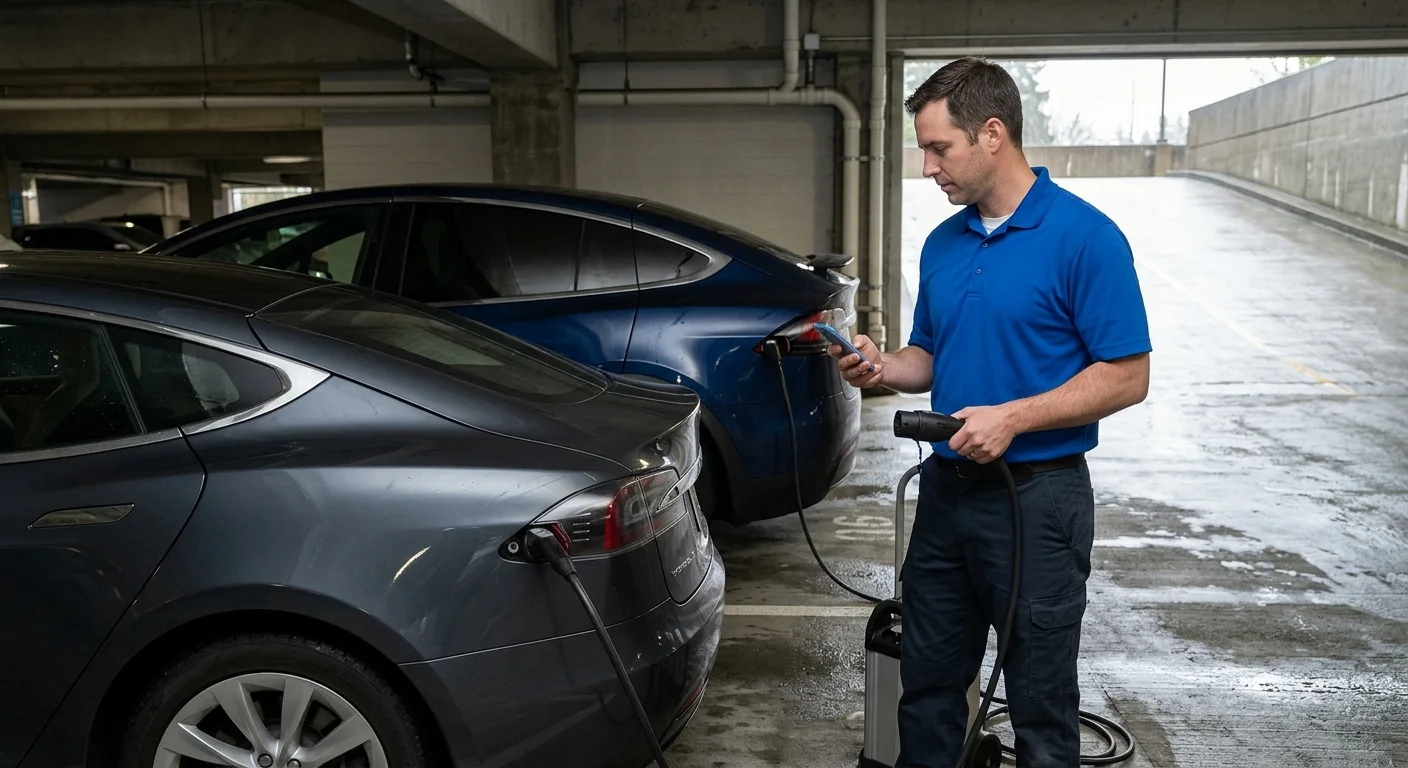
Two Model Ys sit nose to tail in a Kirkland office garage with both charge ports open. Can a Tesla charge another Tesla in that stall: Tesla-to-Tesla pack charging could not be confirmed from Tesla’s current public pages. Check that VIN’s owner’s manual and the Tesla app for Power Share, then plan a local mobile charge if you need miles.
What Tesla publishes about sharing charge
King County has 63,017 Teslas among 144,257 registered EVs, about 44 percent of the county’s electric fleet, per Washington DOL EV population data. Statewide, Tesla accounts for 122,981 vehicles, about 41 percent of 299,705 registered EVs. Kirkland has 8,487 registered EVs. Bellevue has 14,383. Two Tesla drivers in the same Eastside garage, or in the same Bellevue Supercharger queue, hit this question when one pack is empty.
The Tesla documents logged for this site cover jump-starting. Tesla’s own wording, verbatim, is: “Model 3 cannot be used to jump start another vehicle. Doing so can result in damage.” The same sentence appears for Model S, Model X, Model Y, and Cybertruck, with the model name swapped. That is a low-voltage warning. It is the Tesla rule we can cite. It is silent on pouring traction-pack energy from one Tesla into another.
Power Share (sometimes written Powershare) and vehicle-to-vehicle charging are the names searchers use for Tesla-to-Tesla energy share. A Tesla-published Power Share rule, model list, cable part, kilowatt rating, or price could not be confirmed from Tesla’s current public pages for this article. Tesla’s surfaces change by model year and software. Treat the owner’s manual PDF for that VIN as the authority. Search it for Power Share, energy export, or vehicle-to-load. Then open the Tesla app for the same car and look under charging and energy controls. If the book and the screens are silent, that car has no published Tesla-to-Tesla pack-share path you can follow on a Kirkland garage floor.
A Tesla Power Share price could not be confirmed here either. Tesla’s app is where session fees, hardware options, and software flags actually live for a given account. Skip forum dollar figures. Open the app on the donor car and on the empty car before anyone unrolls a cable.
Which Tesla has Power Share also could not be confirmed as a complete, current list. Build year, software, and hardware options all matter. A neighbor’s Cybertruck, Model Y, or Model 3 may look identical to yours and still miss an export feature. The VIN’s manual and the Tesla app are the check. A feature name on a marketing page from another year is a weak plan in a wet Eastside stall.
CCS is the Combined Charging System connector family. Tesla vehicles in North America use NACS, also called J3400, as the charge inlet. Level 2 AC charging runs 240V residential (208V commercial) in a published 2.9-19.2 kW band, with SAE J1772 plus J3400 (NACS) for Tesla vehicles. A J1772 or CCS adapter is the ordinary way a non-Tesla EV takes AC Level 2 power from a NACS source, per the U.S. DOE Alternative Fuels Data Center. Two Teslas already using NACS still need a charger between them. The inlet on a Model Y is built to take power. Tesla has not given this site a confirmed inlet-to-inlet procedure.
A Supercharger stall in Bellevue is a station feeding the car. That is a different system from one Tesla feeding the car in the next stall. If the queue is long, two owners still need a charger, a wall connector, or a mobile Level 2 session. For general EV charging background, the U.S. Department of Energy keeps a public explainer.
Why a jump pack is not a pack refill
A Tesla has two electrical systems. The low-voltage battery wakes doors, screens, and contactors. The high-voltage traction pack holds the miles. Mixing those jobs is how a Kirkland coworker ends up with jumper cables on a car that needed a charge port.
Tesla’s chemistry split on the small battery is published. Vehicles built in Gigafactory Shanghai before about October 2021, and in Fremont before about December 2021, have a lead-acid low voltage battery. Vehicles built after those dates have a lithium-ion low voltage battery. Tesla tells owners to check Controls, Software, Additional Vehicle Information for that split. A jump procedure follows that chemistry. A pack refill does not.
A jump pack, or an external low-voltage supply, is for the small battery. Tesla’s public DIY pages describe using an external supply to wake a Tesla whose own low-voltage battery has gone quiet. Tesla’s same pages bar using the Tesla as the donor for another vehicle. Jumper cables between two Model Ys in that Kirkland garage aim at the wrong tank, and they use the Tesla as a donor, which Tesla warns can result in damage.
Miles live in the traction pack. Filling miles takes energy at the charge port. That is Level 2 AC, or a DC fast charger such as a Supercharger. A 12V wake can make the car unlock, show a screen, and manage the pack. It leaves the range number where it was. An empty Model 3 on I-405 that still shows a percent on the display already has a living 12V path. That car needs a charge, not cables.
Think of two tanks. The 12V tank runs computers. The pack tank turns the motors. A jump pack is a cup for the small tank. A wall connector, a Supercharger, or a mobile Level 2 session fills the big tank. If the screen is dark and the car will not wake, start with Tesla’s low-voltage steps for that model year. If the car is awake and the range reads near zero, go to the charge port.
Eastside mornings make this mix-up more common. Across 30-plus EV models, Recurrent Auto found that EVs retain on average 78% of range at 32F, about a 22% loss. AAA testing at 20F found temperature alone cut range 10-12%, and cabin climate control pushed the loss toward 40%. A Model Y that looked fine leaving a Kirkland office can arrive at a Bellevue Supercharger queue with less pack than the driver budgeted. The coworker with a full car and jumper cables still cannot move those miles across.
When another EV or a rescue truck can help
Some electric vehicles can export power. Whether one EV can charge another depends on the donor’s hardware, the cable, and the empty car’s inlet. Tesla-to-Tesla pack share remains unconfirmed on this page. A different truck is a different story. The Ford F-150 Lightning and Pro Power Onboard path is documented on that post. Read the Lightning steps there. This page stays on two Teslas.
When a Tesla needs miles on site, a matched local operator can bring Level 2 charging to the car. Charge Pro SEA is a referral service. It connects drivers with licensed, independent local EV charging professionals. The operator quotes and bills the driver. The brand sets no price, owns no truck, and performs no charging.
Rescue equipment in this network is a Tesla Cybertruck with an integrated 240V / 9.6 kW bed outlet, a NACS plug, and a CCS adapter. That 9.6 kW is the same power level as a typical home wall connector, inside the U.S. DOE Level 2 band of 2.9-19.2 kW. “Roughly 30 miles of range per hour” is a derived figure from 9.6 kW against a typical 3.0-3.5 mi/kWh EV. A 15 to 30 minute connection adds roughly 10 to 20 miles. Those numbers describe the size of a charge. They are not an arrival window.
On I-405, an empty Model 3 on the shoulder is a highway incident. WSDOT’s Incident Response Team responds to incidents on state highways, from flat tires and running out of gas to major collisions. Teams are on call 24/7 and patrol major corridors during peak hours. Published IRT materials mention motorists who have run out of gas. They do not mention electric vehicles, out-of-charge situations, or EV charging. To reach help on the roadway, dial 911. RCW 46.61.590 requires the driver to arrange prompt removal. Once you are out of the travel lane and safe, a mobile Level 2 session can add enough miles to reach a Supercharger in Bellevue or a workplace charger back in Kirkland.
A neighbor’s Tesla is a weak plan B until that VIN’s manual shows an export path. A Lightning with a published export system is a different vehicle. A matched operator with a bed outlet and a NACS plug is the on-site charge this network is built to connect. SR 520 across Lake Washington is tolled, and I-405 backs up through the Eastside on wet afternoons. Sitting in a travel lane to wait on a coworker’s unconfirmed Power Share setup is a poor use of that time.
How to request a local mobile charge instead
If the Tesla app still shows range and a charger is a short, legal drive away, go there. If the car will not make the next stall, stay out of the travel lane and request help.
Charge Pro SEA matches you with a local operator for mobile EV charging and for Tesla roadside rescue. Tell the coordinator the model, the approximate range or percent, and whether the car is awake. An awake car with a low pack is a charge job. A dark car may be a 12V job. The operator prices and quotes both paths before starting, and bills you directly.
Tesla also offers roadside through the Tesla app. Confirm coverage on Tesla’s own support pages for that account. Tesla’s program and a local mobile charge can both be in play. This brand does not dispatch Tesla’s contractors and does not set Tesla’s policy.
Share a pin. Name the Kirkland garage, the I-405 shoulder, or the Bellevue Supercharger lot. Puget Sound Energy serves most of the Eastside. Seattle City Light serves Seattle. Those utilities run the wires. They do not roll a charger to a stalled Tesla. A public stall, a workplace wall connector, or a mobile Level 2 session is what fills the pack.
Check the owner’s manual and the Tesla app one more time before anyone opens a frunk with jumper cables. If Power Share appears for that VIN, follow Tesla’s steps for that car exactly. If it does not appear, skip the experiment. Request the charge. Two Teslas with open ports and no charger between them will still be empty in the morning.
Washington’s registered EV file is public at data.wa.gov. Tesla’s share of this metro is large enough that Kirkland office ramps and Eastside shoulders see this question often. The published answer stays the same: confirm export in Tesla’s book for that VIN, then bring a charger to the NACS inlet.
When to call us
A Tesla that is awake and out of pack energy needs a charge on the charge port. That is a mobile Level 2 job for a matched local operator, especially in a Kirkland garage, on the I-405 shoulder, or in a full Bellevue Supercharger queue. Call us at (206) 202-7018 and we’ll connect you with a local EV rescue operator.