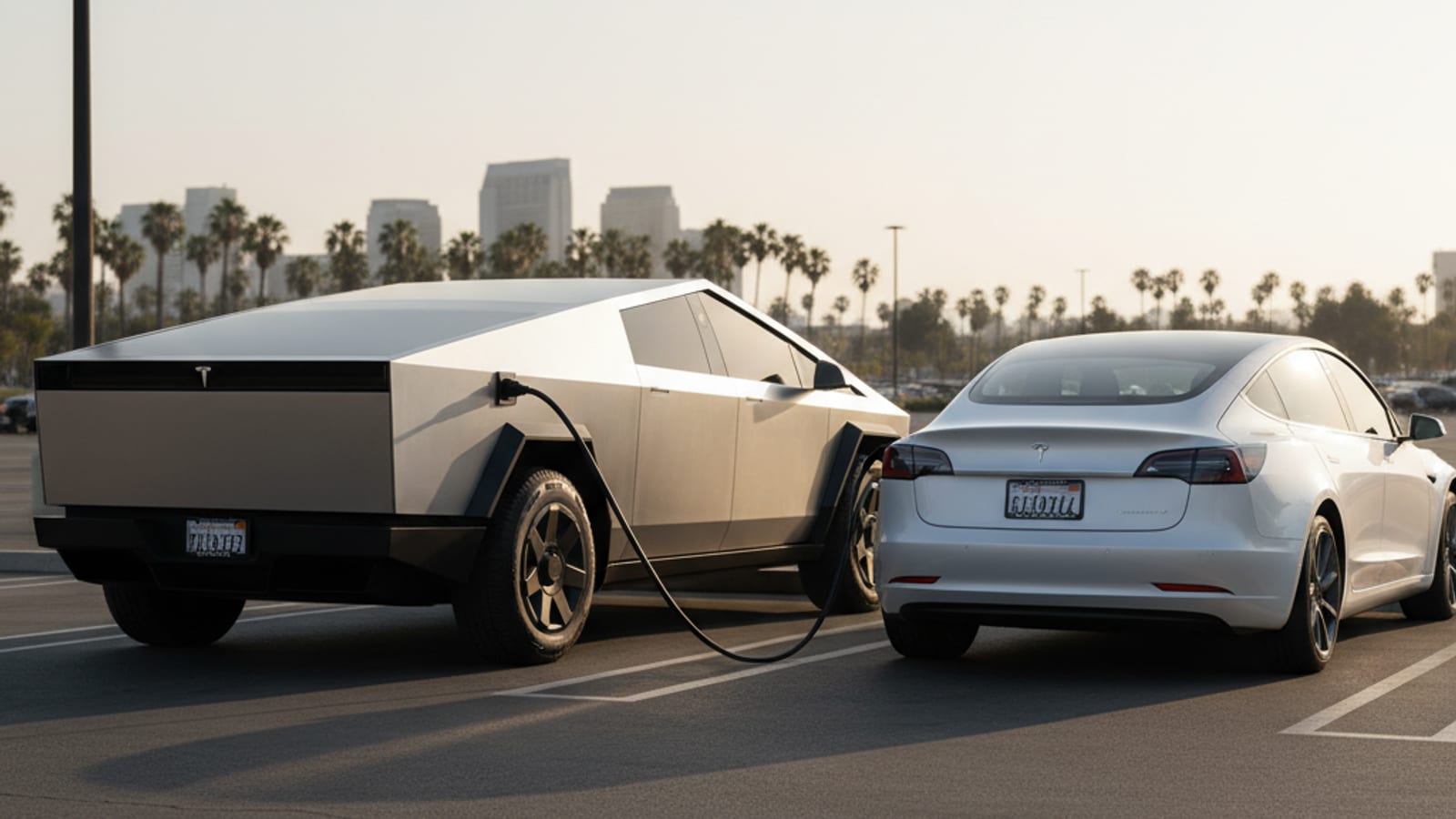
A question we hear once a week from drivers on the Eastside and in Seattle: “Can I just park my Tesla next to the dead one and transfer some charge?” The short answer: no, not between two regular Teslas. The longer answer is more interesting. Some EVs can charge other EVs. It’s a real feature, and it’s how modern mobile rescue work actually happens on the ground.
This guide covers what is possible today in the Puget Sound region, and when a truck is the better answer.
The physics of EV-to-EV charging
Every EV has a large battery pack full of stored energy. On paper, transferring some of it to another EV is a battery-to-battery problem, not fundamentally different from jumping a 12V.
In practice, the problem is the interface. To get energy out of the traction pack and into a form another EV can accept, you need three things:
- An inverter that converts DC pack voltage to AC (or to a different DC level).
- A physical outlet or port that exposes the AC or DC.
- A cable that plugs into the other car’s charge port (J3400/NACS or CCS).
Most EVs have the first one internally (for running HVAC, the 12V, and similar loads) but don’t route it to an external outlet. Without the outlet, the energy stays inside.
A growing number of EVs do have the outlet. Those are the ones that can charge other EVs, and other things.
Which EVs can export power today
| Vehicle | Export capability | Max output | Standard outlet |
|---|---|---|---|
| Tesla Cybertruck | Pro Power bed and frunk outlets | 9.6 kW at 240V | NEMA 14-50 and 120V |
| Ford F-150 Lightning | Pro Power Onboard | 2.4 kW standard, 9.6 kW extended | Bed and cab outlets |
| Hyundai Ioniq 5 | V2L adapter | 3.6 kW | Adapter converts charge port |
| Kia EV6 and EV9 | V2L adapter | 3.6 kW | Adapter converts charge port |
| Rivian R1T / R1S (with Camp Package) | 120V bed outlets | 1.4 kW | 120V only |
| Tesla Model 3 / Y / S / X | None | - | Cannot export |
| Chevrolet Silverado EV | Power Takeoff | 10.2 kW | Multiple outlets |
| Lucid Air | None currently | - | - |
A pattern emerges: EVs marketed at truck buyers and adventure buyers export power. EVs marketed at commuters (most Teslas, Mach-E, Polestar) don’t.
Why regular Teslas cannot charge another Tesla
This is the question we get most. It comes down to hardware choices Tesla made early.
Model 3, Y, S, and X have onboard chargers, electronics that convert AC from a charger into DC for the pack. They do not have an inverter designed to run in reverse at meaningful power. The 12V pigtail at the tow-eye puts out 12V, not 240V, and only at current levels appropriate for waking another car’s 12V, not charging a traction pack.
Tesla has demonstrated bidirectional capability in lab videos and mentioned it in investor calls. For the current fleet on the road around Bellevue, Kirkland, and Seattle, it is not a feature.
Why the Cybertruck is different
The Cybertruck has Pro Power Onboard, a set of real outlets in the bed and frunk. The bed-wall outlet on the driver’s side rear corner is a 240V NEMA 14-50, the same as a dryer outlet, rated for up to 9.6 kW continuous.
That’s enough to run:
- A standard Level 2 EV charger (J1772 or J3400/NACS) at near-full speed.
- Portable tools, job-site equipment, or a small building.
- Medical equipment in a power outage.
For EV rescue, a Cybertruck bed outlet can plug a 50-foot cable into a stranded Tesla’s charge port. The Cybertruck’s pack delivers 9.6 kW of AC through the stranded car’s onboard charger. That works out to roughly 30 miles of range per hour.
How fast EV-to-EV charging really is
Roughly:
- Cybertruck (9.6 kW) to a Tesla: about 30 miles per hour of charging. About 10 to 20 miles added in 15 to 30 minutes.
- Ford Lightning Extended (9.6 kW) to another EV: same, about 30 miles per hour.
- Ioniq 5 or EV6 V2L (3.6 kW): about 10 miles per hour. Useful in a pinch, slow for real rescue.
- Rivian 120V (1.4 kW): about 4 miles per hour. Not useful for range rescue, more for running a coffee maker at camp.
For comparison, a Supercharger delivers 150 to 250 kW, roughly 20x faster than any current bidirectional EV. That’s why mobile charging is a bridge tool (get you 20 miles to a Supercharger), not a destination tool.
Why 240V AC is the sweet spot for rescue
You might wonder why operators don’t roll a DC fast charger on a truck. A few reasons:
- Size. DC fast chargers need kilowatt-scale power electronics. The lightest commercial mobile DCFC units weigh 2,000+ pounds and cost significantly.
- Safety. High-voltage DC transfer on an open shoulder is genuinely risky. 240V AC through the car’s own onboard charger uses the vehicle’s native safety systems.
- Cable handling. A 50-foot J3400 cable at 9.6 kW is two-person-liftable. A DC cable at 150 kW is thick, stiff, and heavy.
- Enough speed to matter. Adding 20 miles in 20 minutes gets you to real infrastructure. That’s what rescue needs to do.
240V AC via the Cybertruck bed outlet hits the practical sweet spot.
When a truck makes more sense
For drivers who don’t own a Cybertruck or Lightning, the practical question becomes: how do I get a charge in 15 to 30 minutes on the side of I-5, or on a residential street in Ballard, or in a Bellevue parking garage?
That’s where a mobile EV rescue service fits. The operator runs the Cybertruck or similar high-output vehicle. The driver doesn’t need to own one or know how to wire a V2L session safely. For our service area, mobile EV charging covers King, Pierce, and Snohomish counties, with operators who carry the right adapter for J3400 and CCS ports.
The future: V2V and V2G standards
Tesla and most other automakers have signaled that bidirectional charging is coming to passenger EVs. Ford already offers V2H (vehicle-to-home) backup on Lightning with the Sunrun kit. Tesla demonstrated V2H at a 2023 investor day. Kia, Hyundai, and GM have all shipped V2L or V2G hardware.
Practical takeaway: in 5 years, most EVs sold new will be able to share power. Today, it’s a feature of select trucks and a handful of Korean sedans and SUVs. Plan your rescue strategy around what’s actually on the road now.
Bottom line
Regular Teslas cannot charge other Teslas. Cybertrucks can, and so can F-150 Lightnings, and so can any EV with a real 240V export outlet. For stranded EVs in the Puget Sound region, the practical path is a mobile rescue operator running a Cybertruck or similar setup with a 50-foot J3400 cable and a practiced process.
If your EV is stranded and you’d rather not wait for a Cybertruck-owning friend to show up, call (206) 202-7018 and we’ll connect you with a local mobile rescue operator across King, Pierce, and Snohomish counties.