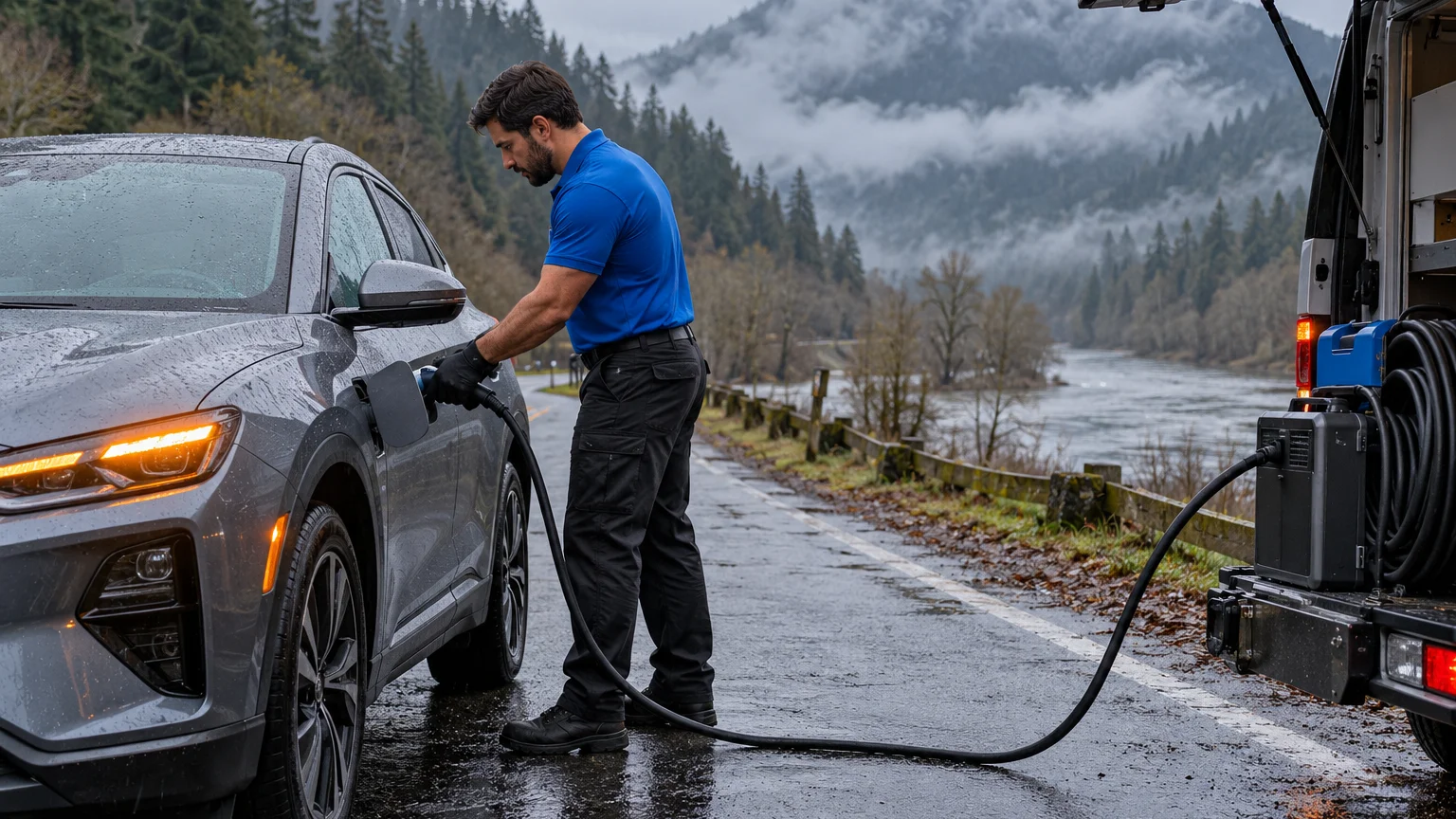
An empty EV battery near Carnation needs a clear next step. First secure the car, share your exact location, then decide whether a short mobile charge or a tow fits the situation.
Why the Snoqualmie Valley can leave few options
Carnation sits within the Snoqualmie Valley, between Duvall and Fall City. SR-203 and the rural stretches around it require more planning than an urban street grid. A driver may need to describe a river crossing, travel direction, or nearby intersection before an operator can identify the stop.
We couldn’t confirm a current, authoritative list of public charging stations in Carnation from the supplied research. Don’t assume a charger shown in an old search result remains available. Check your vehicle’s navigation system and the charger’s official network app before trying to reach it. Confirm the connector, operating status, and access rules there.
Washington DOL data listed 500 registered EVs in Carnation when the state file was read in September 2026. That figure shows EVs are present locally, but it doesn’t prove that roadside charging is available at a given place. The Washington DOL data portal is the authority for updated registration figures.
If the car still moves, don’t spend its remaining energy searching side roads. Stop somewhere lawful and safer before the vehicle loses propulsion. Turn on the hazard lights and follow the instructions in the owner’s manual. If the car has already stopped in a travel lane or another dangerous position, call 911.
Outside incorporated cities and towns, RCW 46.61.560 generally prohibits stopping on the roadway. It makes an exception when a disabled vehicle can’t avoid stopping. RCW 46.61.590 requires the driver to arrange prompt removal. Those rules matter on rural approaches outside Carnation.
Charge Pro SEA can connect you with a licensed, independent local operator. The operator confirms availability, quotes the work, and bills you directly. For nearby context, the Duvall EV roadside guide covers the valley north of Carnation.
Carnation roads, river crossings, and wet range
When requesting help, say that you’re near Carnation, Washington. Then add the road, travel direction, nearest cross street, and your last river crossing. Share a dropped map pin if your phone has service. A photograph of the stopped car and its surroundings may also help the operator identify a safe approach.
For an electric car stranded on SR-203, don’t report only “Snoqualmie Valley.” That description covers too much ground. State whether you were traveling toward Duvall or Fall City. If you’re off SR-203, give the full road name shown by your map. Don’t guess at an address.
Rain can make road markings, pullouts, and vehicle locations harder to describe. Keep the car’s hazard lights on if the owner’s manual supports that step. Stay away from moving traffic. Don’t stand beside the charge port when that would place you near a live lane.
Wet weather doesn’t supply enough information to calculate your remaining range. Temperature, cabin heating, vehicle efficiency, speed, and battery condition can all affect the displayed estimate. Recurrent’s published study across more than 30 EV models found average range retention of 78 percent at 32°F. That’s a broad average, not a forecast for your car or trip.
Use the vehicle’s displayed energy information as guidance, not a promise. If the remaining range is falling faster than expected, reduce optional energy use only when doing so is safe. Pick a reachable, confirmed destination before moving.
Current flooding, closures, and road restrictions can change. None were confirmed for this article’s publication time. Check an official city, county, or state transportation source before traveling. Don’t rely on an older social post or cached map notice.
Drivers continuing south can also review the Snoqualmie EV roadside guide. It addresses a different area and shouldn’t replace current route information for Carnation.
How to tell pack depletion from a 12V failure
An EV has a high-voltage traction pack and a separate low-voltage system. Either can leave the vehicle unable to move. The right service depends on which system failed, so don’t request a high-voltage charge based only on a dark screen.
Start with what happened before the stop. Note the last displayed range or battery percentage. Record every warning message you can still see. Tell the operator whether the vehicle slowed after showing a low charge, shut down without a low-charge warning, or became unresponsive while parked.
A responsive display showing an empty traction battery points toward pack depletion. It still isn’t a remote diagnosis. A blank display, failed locks, or an unresponsive car also doesn’t prove that the traction pack is empty. Those details can help a qualified operator check whether the 12V system needs attention.
Don’t connect cables or open service panels unless the owner’s manual gives a procedure for your exact model and model year. EV low-voltage systems differ. Tesla also states that its vehicles can’t be used to jump-start another vehicle because doing so can cause damage.
A matched operator can jump a dead 12V on site and load-test it. The operator may also offer an on-site replacement suited to the vehicle’s model year. Stock and timing depend on that operator, so confirm both before authorizing work. The operator quotes and bills the driver directly.
Give the operator these details:
- Vehicle make, model, and model year
- Last displayed battery percentage or range
- Exact warning text, if visible
- Whether doors, screens, and exterior lights respond
- Charging connector type, if known
- Current road and travel direction
- Whether the car blocks moving traffic
Don’t repeatedly attempt to restart the vehicle while waiting. Follow the owner’s manual and preserve the information on any visible warning screen. If the situation appears unsafe, call 911 instead of continuing remote troubleshooting.
When to request charging or a tow
Mobile charging fits a narrow goal. It provides enough energy to reach a confirmed charging location or another safe destination. It isn’t intended to refill the complete traction battery beside the road.
The rescue equipment described by Charge Pro SEA provides Level 2 AC power at 240 volts and 9.6 kW. A typical rescue connection lasts 15 to 30 minutes and adds roughly 10 to 20 miles of range. That’s the size of the charge, not an arrival estimate or a guaranteed driving distance.
The equipment uses a NACS plug with a CCS adapter. Level 2 AC connectors include SAE J1772 and J3400, also called NACS. Adapter and vehicle compatibility must be confirmed before work begins. Tell the operator your exact model, model year, and charge-port type.
Request mobile EV charging when the traction pack is depleted, the vehicle can accept AC charging, and a small charge can reach a verified destination. Before authorizing service, identify that destination and leave a reasonable margin. Don’t plan around the exact edge of the estimated range.
The broader out-of-charge recovery service may help when you aren’t sure whether charging will solve the stop. Charge Pro SEA refers the request to an independent operator. That operator evaluates the situation, gives the quote, and performs any accepted work.
A tow is usually the clearer request when the vehicle has collision damage, a mechanical fault, a charging fault, or no compatible charging connection. It may also be necessary when the car can’t remain safely where it stopped. Tell the towing provider that the vehicle is electric and currently has no usable power.
Don’t assume an insurance plan or automaker program includes high-voltage charging. Confirm the covered services, towing limit, destination rules, and customer charges with the provider. Tesla states that it can assist when the battery is depleted, but out-of-range help isn’t financially covered under its published roadside terms.
WSDOT’s Incident Response Team assists with incidents on state highways. Its published materials don’t mention EV charging or out-of-charge service. WSDOT directs drivers to call 911 for roadway help.
When to call us
Call when your EV is out of charge near Carnation and needs a mobile rescue operator. We can also connect you when pack depletion and a 12V failure are hard to distinguish.
Call us at (206) 202-7018 and we’ll connect you with a local EV rescue operator.