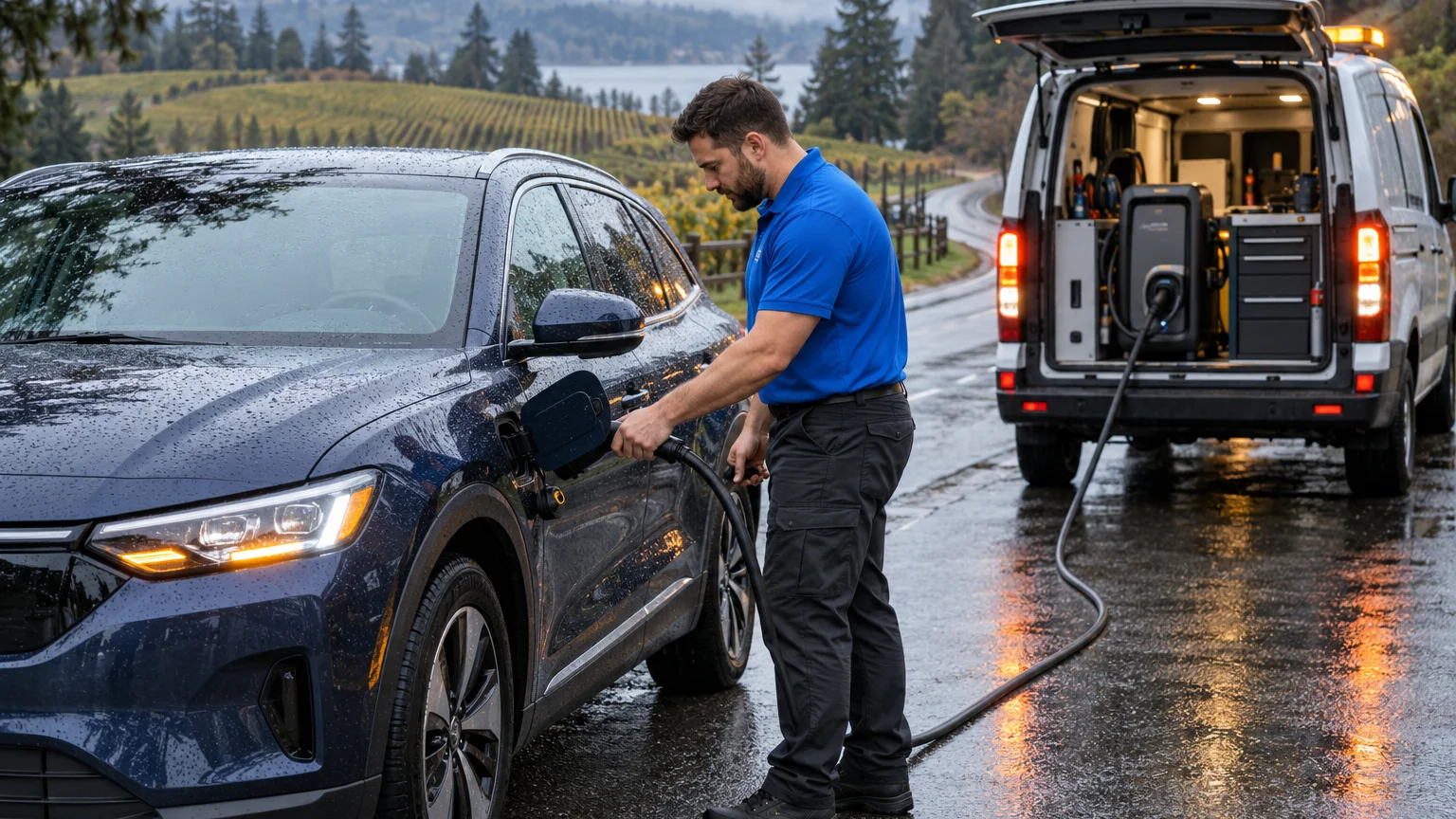
A non-Tesla EV stall in Woodinville creates one immediate decision. Can a mobile operator provide a compatible charge, or does the vehicle need towing? The answer depends on the connector, vehicle condition, and stopping location.
Charge Pro SEA connects drivers with licensed, independent local operators. The operator confirms compatibility, quotes the work, and bills you directly. Charge Pro SEA doesn’t perform charging or towing.
Why a non-Tesla rescue needs the right connector
A mobile charging source isn’t automatically compatible with every electric vehicle. The operator needs to match the source, adapter, and vehicle inlet before leaving for your location.
Level 2 AC charging uses SAE J1772 or J3400, also called NACS. A J1772 or CCS adapter is the ordinary way a compatible non-Tesla EV accepts AC Level 2 power from a NACS source. That doesn’t mean every adapter fits every model or charging situation.
Model year can change the answer. For example, Hyundai documents a native NACS port on the 2025 and later IONIQ 5. Earlier model years shouldn’t be treated as identical. If you’re unsure about your inlet, send the operator a clear photo instead of guessing.
The published mobile rescue setup uses a 240-volt, 9.6-kilowatt source. A typical 15 to 30 minute connection adds roughly 10 to 20 miles of range. That figure describes the size of the charge. It isn’t an arrival estimate or a promise that every vehicle will accept the same amount.
That limited charge is meant to help reach a suitable charging location. It isn’t intended to refill the entire battery beside the road. Vehicle settings, the charging fault, and connector compatibility still need review.
Our Non-Tesla EV Rescue service connects Woodinville drivers with operators who assess those details. You can also read how CCS and NACS mobile rescue differ before choosing an option.
Don’t assume an operator carries your required adapter. Confirm the connector and adapter during the initial conversation. A photo of the open charge port can prevent a mismatch.
Woodinville roads, hills, and rural-edge stalls
A stall on SR-202 presents a different location problem than one along NE 175th Street. The same applies near the Sammamish River valley, winery-area roads, or the rural edge toward Duvall. Give the operator a precise position, travel direction, and nearby landmark.
A street name alone may not identify your actual stopping point. Share a map pin when possible. Note whether you’re in a public parking area, driveway, roadside shoulder, or travel lane. Don’t assume a nearby private lot allows service work or vehicle access. The operator needs to assess the location before accepting the job.
For a stall on SR-202, include your direction of travel. Describe the nearest intersection or visible business without claiming you’re inside its property. Along winery-area roads, distinguish the public road from a driveway or private parking area. Toward Duvall, send the map pin before your phone battery becomes another problem.
The Washington Department of Licensing dataset recorded 3,604 registered EVs in Woodinville. That figure includes multiple makes and vehicle configurations. It doesn’t tell an operator which connector your specific car needs. Make, model, year, and a port photo remain more useful during a rescue request. The underlying records are available through Washington’s open-data portal.
If you’re exposed on a state highway, WSDOT says to dial 911 for roadway help. Its Incident Response Team handles incidents on state highways. WSDOT’s published material doesn’t mention mobile EV charging for out-of-charge vehicles.
For broader local planning, our Woodinville EV roadside guide covers other roadside problems. This page stays focused on non-Tesla charging compatibility and the charge-or-tow decision.
What to tell the operator before dispatch
Start with the vehicle, not just the battery percentage. Give the operator the make, exact model, and model year. Then describe what happened before the car stopped.
Share these details during the matching call:
- Your exact location and travel direction
- The make, model, and model year
- The displayed battery percentage, if visible
- Any warning message shown by the vehicle
- A clear photo of the charging inlet
- Whether the inlet door opens
- Whether the vehicle powers on
- Whether the car can shift or move
- Any visible damage around the vehicle or charge port
- Whether you’re on a roadway, shoulder, driveway, or parking area
Don’t identify the port from memory if you’re uncertain. Send a photo with the inlet open. The operator can compare the visible inlet with the available connector and adapter. That matters for CCS EV rescue in Woodinville, especially when model years use different equipment.
Tell the operator if the car stopped after a failed charging attempt. Include what the display showed and whether the charging plug released normally. Report how many connection attempts were made and what the vehicle displayed each time. The operator needs the original symptoms, not a cleaned-up version of the story.
A completely dark vehicle may require a different assessment. EVs have a low-voltage system as well as a high-voltage traction battery. If the matched operator diagnoses a dead 12-volt battery, the published service scope includes an on-site jump and load test. An operator can also quote replacement of a failed AGM lead-acid or lithium 12-volt battery, based on the model year.
Charge Pro SEA doesn’t set the price. The matched operator quotes the available options before starting and bills you directly. Ask what equipment is planned, whether your connector is confirmed, and what happens if the vehicle won’t accept a charge.
Our mobile EV charging service explains the referral process. If you’re comparing nearby Eastside situations, the Redmond non-Tesla rescue guide covers that city’s separate location and connector decisions.
When a mobile charge won’t replace a tow
Mobile charging fits a specific problem: a compatible vehicle has an accessible inlet, can accept Level 2 AC power, and needs a limited charge. It won’t solve every EV stall.
A tow may be the better path when the vehicle has collision damage, visible electrical damage, or an inaccessible charge port. The same applies when the car won’t accept a charging session after the connector and adapter are confirmed. The operator should make that decision from the vehicle’s condition and manufacturer guidance.
A mobile charge also doesn’t repair a charging system fault. If the vehicle stopped charging at a public or home unit, the remaining battery percentage doesn’t prove the main battery is empty. Warning messages, an inlet problem, or another vehicle fault can point toward transport or repair instead.
The stopping place matters too. An operator may determine that the location doesn’t provide a workable place for a charging connection. A travel lane, exposed highway position, restricted property, or inaccessible parking area can change the available option. If you’re on a roadway and need immediate help, follow WSDOT’s direction to call 911.
Tell the operator whether anyone has already tried to push or tow the car. Also report whether the car can enter its transport mode. If it can’t power on, say that before towing equipment is selected.
Washington law requires a driver to arrange prompt removal of a disabled vehicle. The exact towing method depends on the vehicle, condition, and location. Ask the operator or tow provider to follow the manufacturer’s transport instructions for your model.
A limited roadside charge makes sense when it can provide enough range for the next appropriate charging stop. The published typical rescue charge adds roughly 10 to 20 miles during 15 to 30 minutes of connection time. It doesn’t promise a destination, because actual range depends on the vehicle and conditions.
If the operator can’t confirm compatibility, ask what towing option is available. That keeps the decision centered on confirmed connector and vehicle details.
When to call us
Call when your non-Tesla EV stalls in Woodinville and you need an operator to assess mobile charging, connector compatibility, or towing. Have your location, make, model, year, warning message, and charge-port photo ready.
Call us at (206) 202-7018 and we’ll connect you with a local EV rescue operator.