Your EV just went dark on Pacific Avenue South, and the lot in front of you has no public DC stall. Spanaway’s commute runs SR-7, 176th Street E, and I-5 south of Tacoma, toward Joint Base Lewis-McChord. Charge Pro SEA connects you with a licensed local operator who can add range on the curb or jump a dead 12V. That operator quotes and bills you directly.
I-5, SR-7, and the stretch toward JBLM
Spanaway sits in unincorporated Pierce County, south of Parkland on Pacific Avenue. That road is SR-7. It is the north-south spine for this community. About 34,322 people live here. Washington DOL EV records show 820 registered electric vehicles in Spanaway. Pierce County as a whole has 25,042. Those cars still have to get through the same wet arterials as everyone else.
176th Street E is the east-west cut. It feeds the big-box lots, school traffic, and the run toward the base. I-5 sits west of town. Drivers use it to drop into Tacoma or keep south toward DuPont. Joint Base Lewis-McChord sits on the west and southwest side of this commute. A stall on a public Spanaway street is a county-road problem. A stall on I-5 or SR-7 is a state-highway problem. Treat them as different scenes.
WSDOT’s Incident Response Team patrols major corridors and answers stalled vehicles on state highways. Teams are on call around the clock and cover about 1,300 centerline miles, roughly 18% of state-owned centerline miles. Their published materials cover flat tires, collisions, and running out of gas. They do not mention electric vehicles, empty packs, or mobile charging. To reach help on the roadway, dial 911. That is the published path. It is not a brand dispatch.
Outside incorporated cities, RCW 46.61.560 generally bars stopping on the roadway. The same statute carves out a vehicle so disabled that stopping is unavoidable. Spanaway is unincorporated, so that rule is the one that applies on these shoulders. RCW 46.61.590 then requires the driver to arrange prompt removal. Put the hazards on. Stay out of the travel lane if you can roll the car. Do not stand in SR-7 traffic to flag a charger.
JBLM has its own gates, posted access rules, and security process. We could not confirm a public, written EV-rescue access rule for the installation from WSDOT or Washington State Patrol pages. If you are on base, follow the signs at the gate and the instructions of military police. Charge Pro SEA refers operators for the public roads around Spanaway. We do not control base entry. A matched operator cannot invent a pass for you.
Parkland is the next community north on the same SR-7 line. Tacoma sits farther up Pacific. Those streets have their own posts. This page is for the Spanaway stretch: 176th, Pacific Avenue South, the I-5 ramps south of Tacoma, and the public roads that feed the base commute.
Empty pack vs a dead 12V on a Spanaway curb
Two failures look the same from the sidewalk. The car is quiet. The screens are dark, or Drive will not engage. They are not the same job.
An empty traction pack means the big battery that moves the car is out of usable range. A dead 12V, the low-voltage battery, means the car cannot close contactors, run computers, or release the parking brake even if the pack still has energy. Tesla’s own manuals are blunt. Model 3 cannot be used to jump start another vehicle. Doing so can result in damage. The same sentence appears for Model S, Model X, Model Y, and Cybertruck. Do not try to jump a gas car from your EV. Do not assume a neighbor’s cables will wake a lithium 12V the way they wake a mower.
A matched operator jumps a dead 12V on site, load-tests it, and can replace a failed 12V on site, AGM lead-acid or lithium, per model year. The operator prices and quotes both options before starting, and bills you directly. That is the published service definition. It is not a promise that every truck carries every battery.
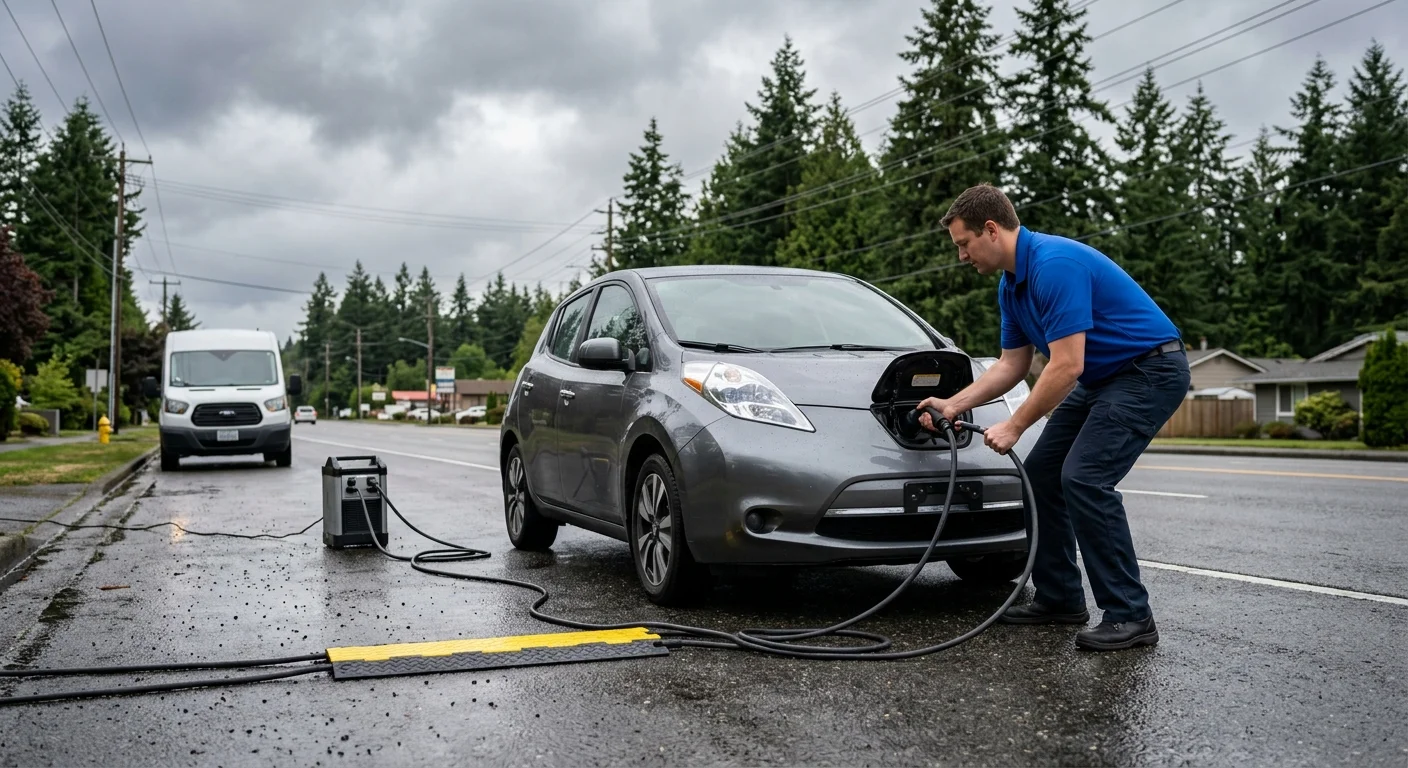
If the pack is empty, the job is a mobile Level 2 charge. The ordinary rescue setup is 240V AC at 9.6 kW, the same power level as a typical home wall connector. Level 2 AC connectors are SAE J1772, plus J3400 (NACS) for Tesla vehicles. A J1772 or CCS adapter is the ordinary way a non-Tesla takes AC Level 2 from a NACS source. A 15 to 30 minute connection adds roughly 10 to 20 miles. That figure is the size of a charge. It is not how fast anyone arrives. Roughly 30 miles of range per hour is the derived rate at 9.6 kW. Treat it as a ballpark, never a guarantee. The U.S. Department of Energy publishes the charging-level basics if you want the connector names straight before you call.
Spanaway’s suburban lots, church lots, and 176th frontage often have no public DC stall. You can sit in a grocery lot with a silent car and no fast charger in sight. That is why on-site recovery exists. Emergency EV roadside assistance is the service path for a stall on a curb, a shoulder, or a lot. Out-of-charge EV recovery is the path when the pack is empty and you need range to reach a charger or a driveway.
Cold rain cuts range here. Recurrent’s testing across 30-plus models found EVs keep about 78% of range at 32F, about a 22% loss. AAA testing at 20F found temperature alone cut range 10-12%, and cabin heat pushed the loss toward 40%. Spanaway winter mornings sit in that band. Leave extra buffer before you commit to I-5 with a thin pack.
Mobile charge vs a tow toward Tacoma
The default instinct is a tow north into Tacoma. Sometimes that is the right call. Sometimes it is the slower, messier one.
A mobile Level 2 session is meant to add enough miles to roll to a charger, a driveway, or a shop. It is not a full overnight charge on the shoulder. If the car will accept AC, and you can wait through a 15 to 30 minute connection, staying put usually beats a wrecker on SR-7. The operator who takes the job brings the 240V gear. Charge Pro SEA does not own that truck and does not perform the charge.
A tow is the better path when the car will not take a charge, the 12V keeps dying, a wheel is locked, or the vehicle is in a travel lane WSDOT or State Patrol wants cleared. Chapter 46.55 RCW governs towing and impound in Washington, including the registered tow truck operator system and the maximum impound rates the Washington State Patrol posts. Confirm the current rate with the tow company before you authorize a hook. We do not set tow prices. We do not publish a brand fee.
If you are on I-5, incident response may already be in the mix after a 911 call. They clear the lane. They do not plug in an EV. Once the car is in a safe spot, you still need a charging operator or a flatbed that can move an EV the way the manufacturer allows. Ask the tow company how they plan to load it before the winch comes out.
Towing toward Tacoma also means you are leaving Spanaway’s curb for a city with more public DC. That can be rational after a charge that only buys 10 to 20 miles. It is a second decision, not the first one. Nearby writeups for Parkland EV roadside help and Tacoma EV roadside assistance cover those streets. They do not cover 176th or the SR-7 lots south of Parkland.
Puget Sound Energy serves much of Pierce County outside Tacoma, including this community. Tacoma Power’s residential Level 2 rebate, a $400 bill credit up to $600 total per installation, is a Tacoma Public Utilities program. It does not apply to a Spanaway house on PSE. Do not mix the two when you plan home charging later. For the stall in front of you, the utility name does not change the roadside job.
How to request a local operator from the shoulder
Stay in the car if traffic is close. If you can roll a few feet into a lot off Pacific or 176th, do that first. Then call.
Dial 911 first if you are in a live lane on I-5 or SR-7, or if anyone is hurt. Ask for WSDOT incident response on a state highway. That is the published instruction.
Then call Charge Pro SEA. We match you with a licensed, independent local operator. We do not send a brand-owned truck. We do not quote a price for the work. The operator who takes the job quotes you, does the work, and bills you.
Have this ready when you call:
- Exact location: Pacific Avenue South near which cross street, 176th Street E and the lot name, or the I-5 direction and the nearest ramp
- Make, model, and year
- Whether the screens light, whether the charge port opens, whether you hear contactors
- Connector: NACS or J1772
- Whether you think it is an empty pack or a dead 12V
If the car is a Tesla and the 12V is suspect, say so. Vehicles built in Gigafactory Shanghai before about October 2021, and in Fremont before about December 2021, have a lead-acid low-voltage battery. Vehicles built after those dates have a lithium-ion low-voltage battery. The operator needs that split before they pick a jump method. If it is a non-Tesla that needs a CCS adapter for AC from a NACS source, say that too.
Washington is an all-party consent state for recording private communications. RCW 9.73.030 makes a violation a gross misdemeanor. Do not record the operator without consent.
You pay the operator, not a brand invoice from us. Ask for the quote before any cable goes in. If they recommend a 12V replacement, get that price before they pull the old battery. Stay visible to the operator. Stay out of the SR-7 travel lane.
When to call us
Call when the car will not move on a Spanaway curb, a 176th lot, or a shoulder on SR-7 or I-5, and you need a mobile charge or a 12V jump instead of a blind tow to Tacoma. Call us at (206) 202-7018 and we’ll connect you with a local EV rescue operator.