Your R1T or R1S just dropped to a low battery on US 2 east of Snohomish, or maybe it’s sitting dead in a parking lot in Everett. You open the Rivian app to request help, and now the waiting starts. Here’s an honest look at what Rivian’s factory roadside program actually covers in the Puget Sound region, where the gaps are, and when a local mobile charging referral will get you moving faster.
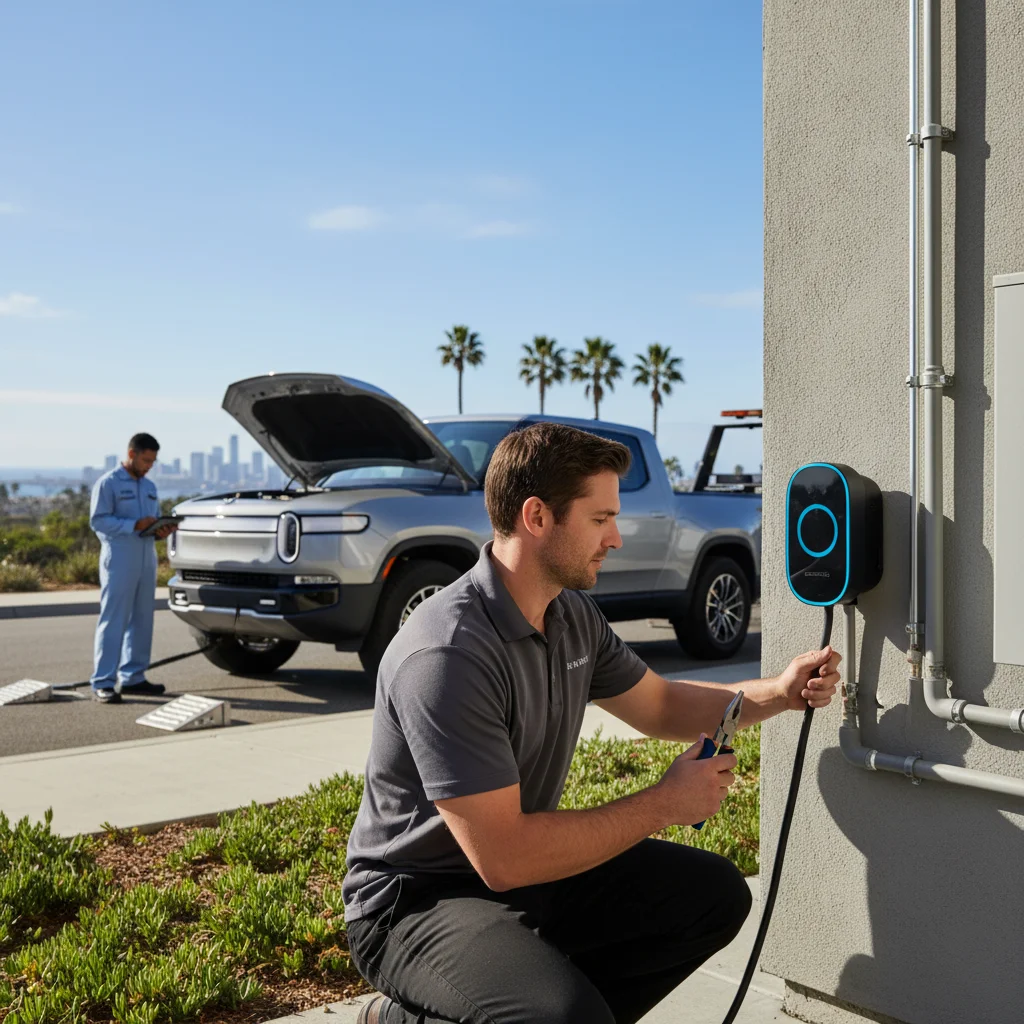
What Rivian’s factory roadside includes in 2026
Rivian bundles roadside assistance into every new vehicle sale for a defined coverage period, currently four years or 50,000 miles from the original purchase date, whichever comes first. That coverage travels with the vehicle, so a used R1S you bought privately still carries the remaining term.
What the program covers:
- Towing to the nearest Rivian Service Center
- Emergency charging assistance, Rivian dispatches a service partner to deliver enough charge to reach a charging station
- Flat tire service, spare installation or towing if no spare is available
- Lockout assistance
- Winching if the vehicle is stuck off-road (a genuinely useful perk for R1T owners who use their trucks)
What it doesn’t cover is equally important. Rivian roadside doesn’t reimburse third-party charging sessions you arrange independently, and it doesn’t send a Rivian-branded truck. The service contracts out to third-party roadside networks. That handoff is where Snohomish County owners consistently run into friction.
Coverage beyond four years or 50,000 miles lapses unless Rivian has rolled out an extended service plan by the time you’re reading this. Check your Rivian app under Account, then Vehicle, then Coverage for your exact expiration date.
Why Rivian dispatch times in Snohomish County run long
Snohomish County has a growing Rivian population. Snohomish, Monroe, and the Woodinville area have some of the highest R1 concentrations in Washington state, but the service infrastructure hasn’t kept pace. A few reasons dispatch times stretch out here specifically.
No local Rivian Service Center. The nearest Rivian-authorized facility is far enough that when Rivian’s roadside network dispatches a third-party tow, the driver often has to factor in a long haul rather than a local drop, which affects how quickly they prioritize the call.
Third-party contractor variability. Rivian uses national roadside networks to fulfill calls in markets without dense local coverage. That means the truck rolling to you in Snohomish County might be a general tow operator who handles ICE vehicles most of the day and isn’t set up for EV-specific charging delivery.
Snohomish geography. A breakdown on US 2 near Monroe hits differently than one on I-5 near Marysville during evening traffic. ETA estimates from Rivian’s app frequently undercount actual drive times through the county’s congestion corridors.
Forum threads are full of Washington-area owners reporting waits of 90 minutes to over three hours for a charge delivery. That’s not a knock on Rivian’s intent, it’s a coverage-density problem. Our non-Tesla EV rescue referral exists partly because that gap is real and consistent.
Charging connector reality: CCS today, NACS adapter coming
This one matters when you’re stranded and trying to figure out your options.
As of 2026, Rivian vehicles in the US use the CCS1 (Combined Charging System) connector as their primary DC fast-charge port. That’s the same standard used by most non-Tesla EVs sold before 2025. Rivian has announced a transition to the NACS (North American Charging Standard) port on future production vehicles, and a NACS DC Fast Charging Adapter for existing owners, but adapter availability has rolled out gradually and not every owner has one yet.
Why this matters roadside:
- Tesla Superchargers (the largest fast-charge network in the Puget Sound region) require either a NACS port or a compatible adapter. Without the adapter, those stations aren’t accessible to your R1.
- CCS-compatible DC fast chargers are available across the region, but coverage is uneven outside the Seattle and Bellevue cores.
- A mobile charging operator who carries CCS-compatible equipment can deliver a charge directly to your vehicle at the roadside, no adapter needed.
If you haven’t confirmed whether your Rivian adapter has shipped, check the Rivian app or your order account page. Until it arrives, plan your routes around CCS availability.
When to skip Rivian roadside and call a local mobile charger
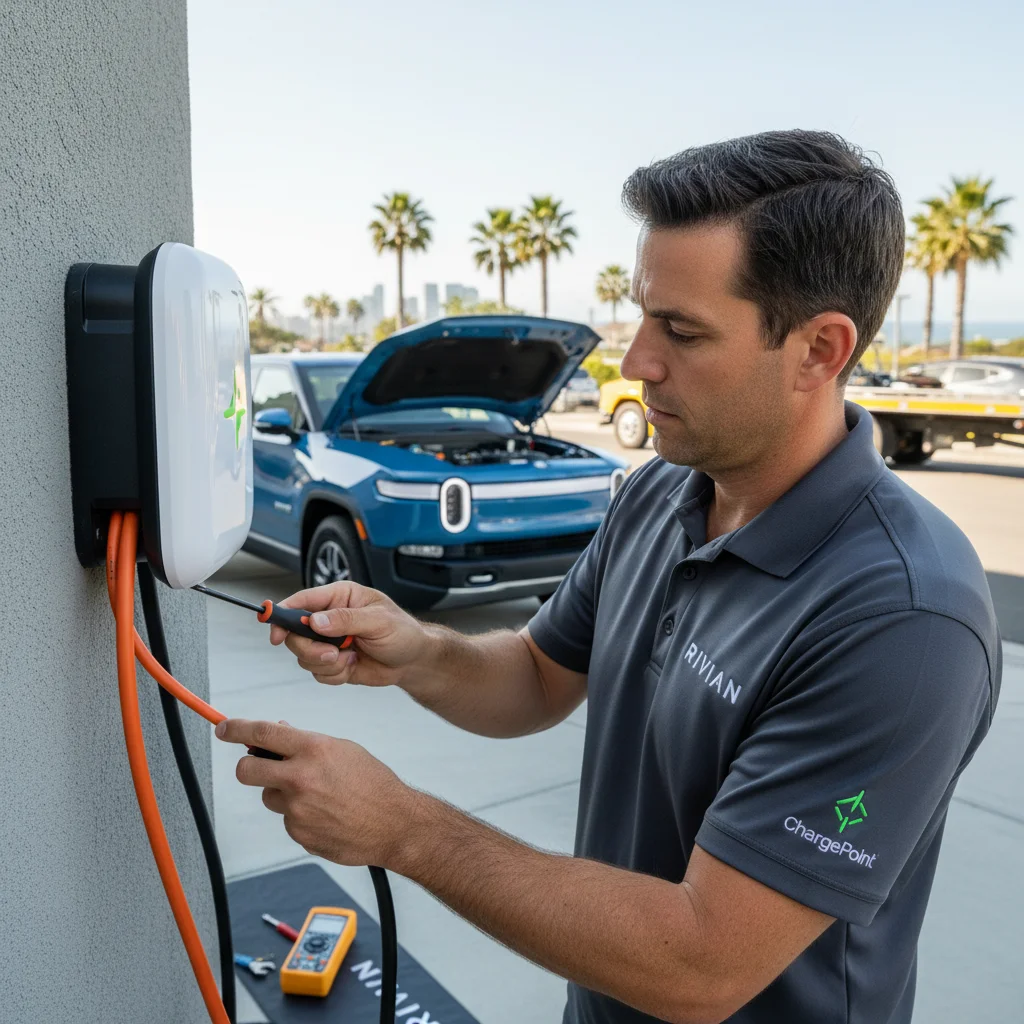
Rivian roadside is worth calling first when you need a tow or a lockout, those are hard to replicate locally. But for a low-battery or out-of-charge situation in Snohomish County, a local mobile EV charging referral will almost always reach you faster than a dispatched third-party contractor.
Here are the specific situations where skipping Rivian’s queue makes sense:
You’re under 15% and still moving. Don’t wait until you’re fully stopped. Call a mobile service now and keep driving toward a meetup point. It’s faster than staging a full roadside stop.
You’re already at 0% and stopped. Rivian’s ETA from their network in the Puget Sound region can easily run 90+ minutes. A local referral to a mobile operator with CCS-compatible equipment can often arrive in under an hour depending on your location in the county.
You’re in a parking structure or private lot. Tow trucks have limited access. A mobile charger can drive in, plug in, and get you enough range to exit and reach a proper station.
Your four-year coverage has expired. At that point Rivian roadside isn’t free anyway. Calling a local service directly is faster and often similarly priced to whatever Rivian’s out-of-warranty fee structure looks like.
For broader context on how local mobile rescue compares to traditional options, the non-Tesla EV rescue referral covers the full picture, including what to expect with other brands like Ioniq 5 and Ford Lightning. And if you want a side-by-side breakdown of mobile charging versus waiting for a tow, this comparison lays it out clearly.
The US Department of Energy’s AFDC also maintains a real-time station map that can help you identify nearby CCS chargers if you have enough range to reach one while you wait.
How to document a roadside event for warranty
This section is short because most Rivian owners skip it entirely, and then regret it when a battery or drivetrain issue shows up later.
Any time you run a Rivian battery pack to a low state under non-routine conditions (extreme cold, software glitch, unexpected drop), document the event. The Snohomish Valley and the US 2 climb toward Stevens Pass put extra stress on a pack in ways that compound over time. The Washington utilities and the Washington State Department of Commerce have noted that high-elevation cold-soak and deep discharge cycles are among the leading contributors to early degradation in EV battery packs.
What to capture:
- Screenshot of the Rivian app at time of incident showing battery percentage and any error codes
- Timestamp and GPS location (your phone’s native maps app works fine)
- Photos of any warning lights or app alerts
- The dispatch confirmation number from Rivian roadside, if you called them
- Receipt or service summary from any third-party mobile charging crew
Store these in a folder labeled with your VIN. If a warranty claim comes up later, whether it’s a battery capacity issue or a drivetrain fault Rivian attributes to “operator misuse”, timestamped documentation from the roadside event gives you a clear counter-record.
If the event involved a third-party service call, ask the matched operator for a written summary of what was delivered. It takes 30 seconds for them to send it, and it completes your paper trail.
When to call us
If your Rivian R1T or R1S is stranded in Snohomish County, whether you’re out of charge on US 2, stuck in a parking structure in Everett, or dealing with a dead 12V auxiliary battery, our referral network connects you with operators who carry CCS-compatible equipment and cover the full Puget Sound region. Call (206) 202-7018 to reach a local EV rescue operator.