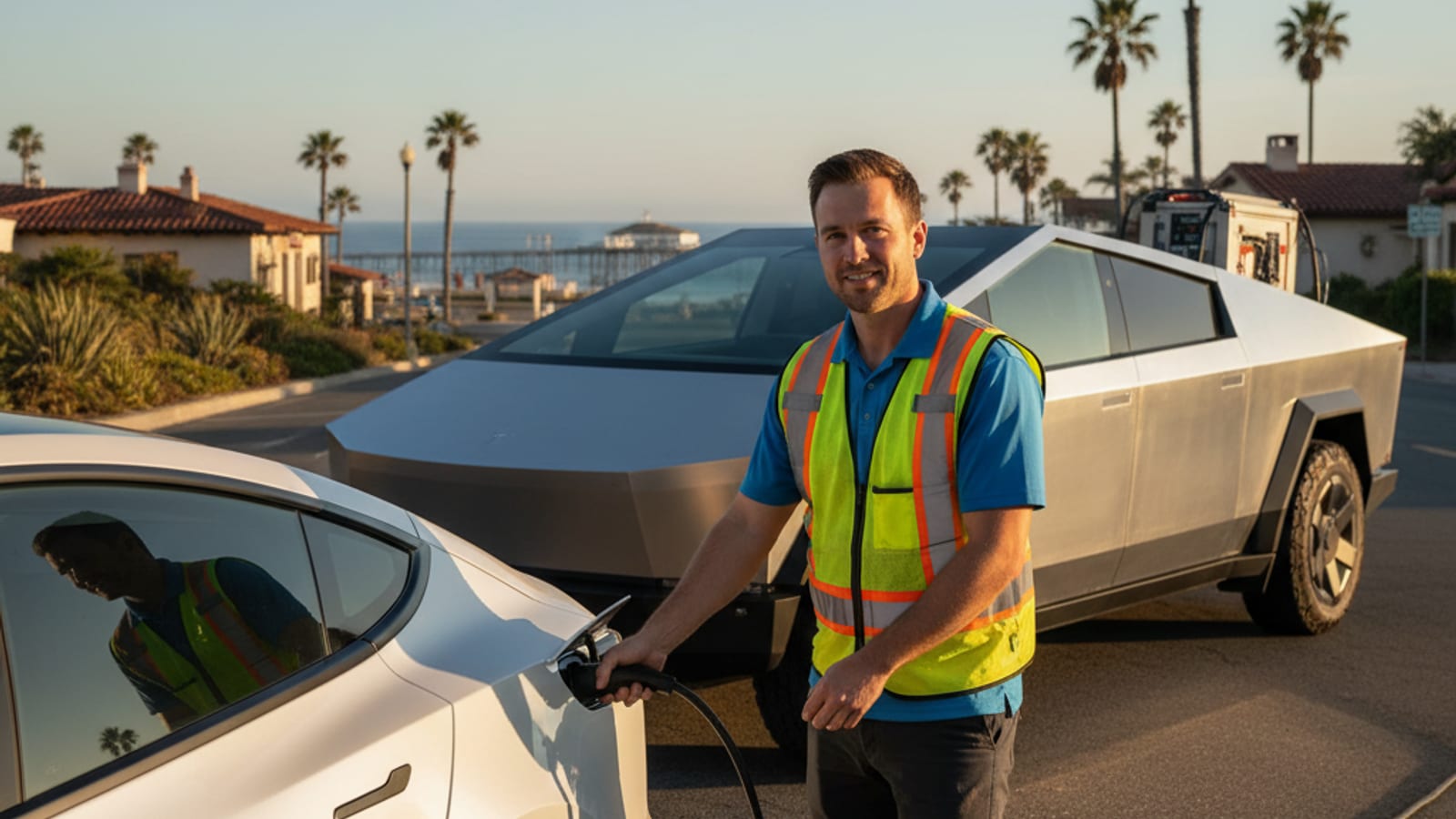
Mobile EV charging in Mukilteo may help after an EV stalls. The right option depends on your location, vehicle, battery state, and available access. Our referral service connects drivers with licensed, independent local operators who review those details before recommending charging or transport.
Start with a safe location near the ferry terminal
Your stopping position comes before any charging decision. If the EV still moves, get away from active traffic when you can do so safely. A freeway travel lane isn’t an appropriate place to arrange roadside charging. Contact emergency services if the vehicle creates an immediate road hazard.
The Mukilteo ferry terminal sits along SR 525 just south of the Whidbey Island connection point. The roads feeding the terminal, including Mukilteo Speedway and SR 525 itself, see heavy holding-lane traffic during commute hours.
Once stopped, turn on the hazard lights. Note whether the car sits on a shoulder, ramp, frontage road, or nearby parking lot. Don’t describe the location as simply “near the ferry.” The operator needs enough detail to understand the approach and working space.
Share your direction of travel first. Northbound and southbound Mukilteo Speedway require different approaches. Then explain whether you came from Everett via SR 99 or from Lynnwood via I-5. A screenshot from your navigation app can support the written description.
Don’t move around the vehicle near passing traffic just to inspect it. Tell the operator what you can observe from your current position. Mention traffic exposure, shoulder width, barriers, and nearby driveways.
A mobile operator must decide whether the stopping place supports on-site work. That decision belongs to the independent professional reviewing the call. If the location isn’t suitable, moving or transporting the EV may be the better route.
Our mobile EV charging referral service connects you with local operators. It doesn’t guarantee availability, specific equipment, charging output, or an arrival window.
Share the nearest exit and access details
A precise location helps the operator assess the request before accepting it. Start with the nearest named exit, your direction, and the side of the roadway. Include a dropped map pin when possible.
If you left Mukilteo Speedway, say which road you used. “Near the ferry terminal” still covers several possible access points. Add the nearest business, parking entrance, cross street, or visible sign. Describe whether the vehicle is before or after a turn.
Access details matter beyond the street name. Tell the operator if the EV is inside a garage, gated community, hotel lot, workplace lot, or restricted parking area. Share the garage level, entrance name, gate instructions, and clearance signs you can see. Don’t assume a service vehicle can enter every space.
In the Mukilteo waterfront area, a business name may be more helpful than a broad neighborhood label. Add your parking location and the direction the car faces. If you’re along a curb, explain whether the operator could approach the charge port without blocking traffic.
Also identify the vehicle before the operator arrives. Share the make, model, model year, and charge-port location if known. Tell them whether you have a charging adapter, but don’t assume it matches their equipment. The operator must confirm vehicle and connector compatibility.
For a wider look at service across the region, see our mobile EV charging in North County service. Mukilteo calls still require location-specific review.
Tell empty charge from low-voltage failure
“Dead battery” can describe two different problems. The traction battery may be depleted, or the vehicle may have a low-voltage electrical failure. Those situations can look similar from the driver’s seat, but the recovery path may differ.
Tell the operator what happened before the vehicle stopped. Share the last battery percentage or estimated range you saw. Mention any low-charge messages, power reduction, charging errors, or low-voltage warnings. Exact dashboard wording is more helpful than your diagnosis.
Next, describe what still works. Does the main screen turn on? Do the doors unlock normally? Can the car shift into drive or neutral? Does the charge port respond? Report what you observe without taking panels apart or touching electrical components.
A blank screen doesn’t prove that the traction battery is empty. Likewise, a visible battery percentage doesn’t explain every no-start condition. The matched operator reviews the symptoms, vehicle, and location before deciding what service fits. Some problems may need transport instead of an on-site charge.
The out-of-charge EV recovery service covers requests where the main battery appears depleted. The operator still confirms whether mobile charging is suitable for that particular vehicle and location.
The US Department of Energy provides general information about electric vehicles and charging. It doesn’t diagnose a stalled car. Follow the vehicle manufacturer’s instructions for warnings, towing, and roadside procedures.
Avoid repeatedly trying controls when the vehicle displays a warning you don’t understand. Record the message or take a photo if it’s safe. That gives the operator better information without guessing about the cause.
Account for the ferry holding lane
A stall near the Mukilteo ferry holding lane needs more detail than a freeway location alone. Tell the operator whether you’re still on SR 525, in the holding lane, or off the road at one of the terminal-area parking lots. Add the closest entrance, business, or cross street that appears on your map.
The ferry holding lane is its own special case. Drivers waiting for the next sailing often sit with the cabin heater running for 30 to 90 minutes, especially on a cold winter morning. That dwell time burns through the last percent of range with the car essentially idling. A driver who arrives with comfortable margin can find themselves at 3% when the boat finally boards.
Parking access can change the available recovery choices. A surface lot, curb space, and enclosed garage create different working conditions. Report any posted clearance, gate, loading, or access restrictions. The independent operator can then decide whether their vehicle and equipment fit the site.
Drivers elsewhere in Mukilteo may face different access conditions. A residential driveway, workplace lot, shopping area, and freeway shoulder aren’t interchangeable. Describe the actual site instead of choosing the nearest neighborhood label.
Our broader guide to EV roadside assistance in Edmonds explains other recovery situations. This page focuses on the narrower decision after a suspected out-of-charge stall in Mukilteo.
Choose mobile charging or transport
Mobile charging isn’t automatically the right answer for every stalled EV. The operator reviews the battery state, warning messages, vehicle compatibility, charge port, and stopping location. Access and traffic exposure also affect the decision.
An on-site charge may fit when the traction battery appears depleted and the location supports the work. The operator must also confirm that compatible charging is available. Our referral service doesn’t promise a connector, power output, delivered energy amount, or resulting driving range.
Transport may fit when charging can’t be completed at the location. It may also be considered when the symptoms point beyond an empty traction battery. The operator can review the vehicle’s condition and your preferred destination before explaining the available choices.
Think about the next safe destination before making that choice. A small roadside charge, if offered, shouldn’t be treated as proof that every vehicle issue is resolved. Ask the operator what the delivered charge is intended to accomplish. Check the vehicle display before continuing.
Ask the operator for the current amount and service terms before approving work. Your insurer, automaker, or roadside plan may also explain whether your policy applies.
The useful question isn’t whether charging always beats transport. It’s which option fits this EV, this battery condition, and this Mukilteo location. Clear details let the independent operator make that assessment without relying on assumptions.
When to call us
Call when your EV has stalled in Mukilteo and you need an operator to assess mobile charging or transport. Have your location, vehicle details, battery reading, and dashboard messages ready. Call (206) 202-7018 to reach a local EV rescue operator.