Use a fixed rapid charger if your EV can safely reach a confirmed, compatible station. If it cannot, stop somewhere safe and consider mobile charging or vehicle transport instead. The right choice depends on your remaining range, location, connector, and vehicle condition.
Verify current station details before driving
An “EV rapid charger near me” result is only a starting point. Station addresses, access rules, pricing, and operating status can change. Confirm those details before spending your remaining range on the drive.
Start with the station operator’s official app or website. Compare that information with your vehicle’s navigation system. An aggregated map may help you find options, but do not treat an old listing as proof that a charger works today.
Check these details before selecting a station:
- The connector matches your vehicle.
- The operator reports the station as available.
- You can enter the property when you arrive.
- The charger is not restricted to customers, residents, or employees.
- Your vehicle predicts enough energy for the full route.
- You understand the current price before starting a session.
The US Department of Energy’s charging guide identifies CCS, CHAdeMO, and J3400 (NACS) as DC fast-charging connector types. Your vehicle may not accept every connector. An adapter also does not automatically make every charger compatible, so follow your vehicle manufacturer’s guidance.
Live status should still be treated as a signal, not a promise. Another driver might occupy the stall before you arrive. A charger can also appear online while the screen, cable, payment reader, or connection fails at the site.
If you are planning ahead, save more than one compatible station along your route. That gives you another verified option without forcing a rushed search at low charge.
Compare downtown Seattle, Bellevue, and freeway access
A station’s straight-line distance does not tell you whether it is reachable. Puget Sound drivers need to examine the actual route, property entrance, and return path.
Downtown Seattle searches deserve extra care. Check whether the charger sits along the street or inside a parking structure. Confirm the correct garage entrance, access rules, and current parking charges. A nearby map pin will not help if the entrance requires more driving than your battery can support. The SEA airport garage holds 94 free Level 2 EV stalls across Floor 7 Rows E and F (General) and Floor 4 Rows E and F (Reserved), but those are not rapid chargers, and the rest of the garage’s 12,000+ stalls on the dark long-term floors do not help a low-charge driver.
In Bellevue, identify which side of I-405 the station occupies. Look closely at access from NE 8th, NE 10th, or the road shown in the operator’s listing. Do not assume a charger visible across the freeway has a short driving route. Use turn-by-turn directions to review the complete approach.
Freeway searches have a different problem. Compare the actual exit path from I-5, I-90, I-405, or SR 167. Then check whether you can reach the charger without circling through unfamiliar streets. Include the distance from your current lane position, not merely the distance shown on a general map.
Your planned direction after charging matters too. A station may be easy to enter but awkward to leave toward your destination. Review both directions before committing your remaining energy.
If your battery is already very low, choose based on verified access and vehicle compatibility. Do not choose solely because a listing says “fast” or appears first. A working, reachable charger is more useful than a higher-powered station with uncertain access.
Check whether a reachable charger remains
Treat your dashboard range as an estimate and compare it with the complete route. Include freeway exits, local turns, garage ramps, and the station entrance. If the route leaves no reasonable buffer, continuing may turn a manageable low-charge warning into a stopped vehicle.
First, check whether the EV is still operating normally. Warning messages, reduced-power alerts, charging-system faults, or a locked charge port may point to a problem that a public charger will not solve. Read the exact dashboard message and consult the vehicle manual.
Next, verify at least one compatible station through its official network source. Review reported status, connector type, access, and directions. If possible, identify a second option that your EV can also reach. Do not plan on driving from one uncertain charger to another with almost no energy remaining.
When you arrive and the station does not work, record what happens. Note any screen message and the point where charging stops. Try another compatible stall only when you can do so safely and the operator’s instructions allow it.
If no reachable charger remains, stop looking for a map result that requires more range than the car has. Move to a safe legal location if the vehicle can still do so. When it cannot, avoid pushing or moving it without guidance. At that point, roadside help or transport is the more practical path.
Know when mobile charging may fit
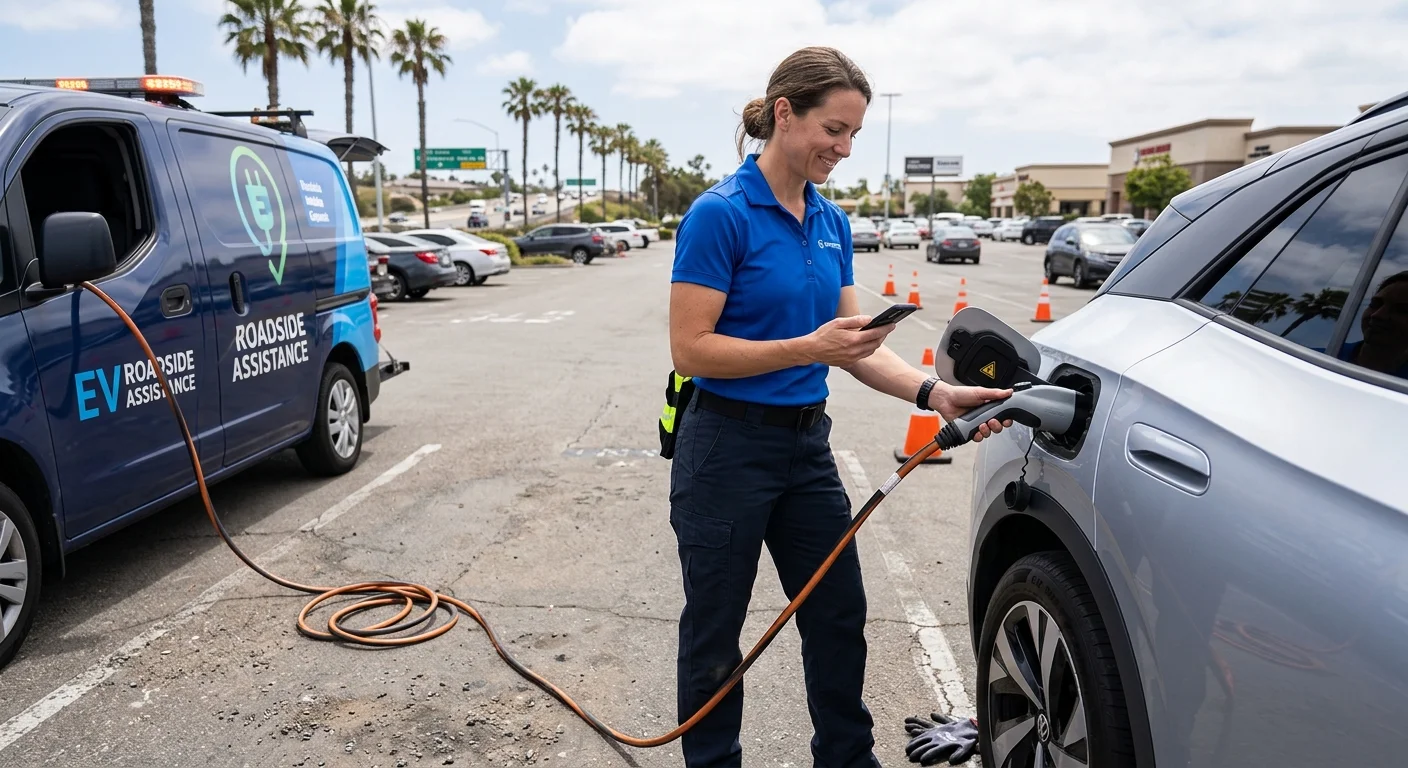
Mobile charging may fit when your EV is safely parked, its main battery is depleted, and a compatible operator can provide energy at that location. The goal is usually enough usable charge to reach a fixed station, not to replace a normal charging session.
Equipment varies between independent operators. Availability, connector support, output, vehicle compatibility, access, and service terms must be confirmed directly. Charge Pro SEA makes the connection, but it does not perform the charging or promise that a specific operator carries particular equipment.
Before requesting mobile EV charging, collect the details an operator needs:
- Your EV’s year, make, and model.
- The exact dashboard message.
- Your current battery percentage, if displayed.
- Your visible connector or charge-port type.
- Your precise location and parking position.
- Any height, gate, garage, or property-access limits.
- Whether the vehicle can shift, steer, and unlock.
Location details matter across the metro. “Bellevue” is not precise enough inside a tower. “Auburn” does not identify the correct side of SR-167. On a freeway, provide the route, direction, nearest exit, and a location pin when it is safe to do so.
Mobile charging may not fit when the car will not accept power, the charge port is damaged, the low-voltage system prevents access, or the vehicle sits in an unsafe position. Describe the symptoms without guessing at the cause. The matched operator can confirm whether the requested service matches the situation.
Know when transport may fit instead
Vehicle transport may fit when charging will not address the immediate problem. That includes situations where the EV cannot accept a charge, the charge port will not open, the vehicle shows a serious fault, or collision damage is visible. It may also be the safer choice when the car has stopped in a dangerous location.
A depleted main battery and a low-voltage failure can look similar from the driver’s seat. A dark screen, locked doors, or an EV that will not shift does not prove the traction battery needs charging. Share the exact symptoms with the operator rather than requesting equipment based on a guess.
Transport may also make more sense when every verified compatible charger lies beyond the vehicle’s remaining range. Do not continue toward a station because its map pin looks close. Use the actual route and the vehicle’s displayed estimate.
Our out-of-charge EV recovery service can connect you with a matched local operator. Charge Pro SEA does not tow vehicles, set operator pricing, or provide a service warranty. Confirm the operator’s proposed service, current price, timing, equipment, and destination before agreeing to the job.
If transport is recommended, follow your vehicle manufacturer’s towing instructions. EV towing requirements differ by vehicle, so do not assume one loading method works for every model. Tell the operator whether the vehicle can enter transport mode, shift into neutral, release its parking brake, and unlock its charge port.
When to call us
Call when your EV cannot safely reach a confirmed rapid charger and mobile help may fit. We will connect you with a matched local operator who can assess the situation and explain the available option.
Call (206) 202-7018 and we will connect you with a local EV rescue operator.