An EV stall in Frederickson can leave you far from a usable charger. Your next move depends on whether the main pack is empty, the 12V battery has failed, or the vehicle needs a tow.
Charge Pro SEA connects drivers with licensed, independent local operators. The matched operator handles the roadside work, provides the quote, and bills you directly.
Frederickson roads and industrial-area stalls
Frederickson isn’t simply an extension of Spanaway or Puyallup. Its industrial and warehouse areas create a different roadside setting. A driver may stop near a large commercial property, a loading entrance, or a busy route with limited space nearby.
Canyon Road East and 176th Street East are key location details. Tell the operator which road you’re on and your direction of travel. Include the nearest cross street, driveway, or visible business sign. A map pin helps when the street address covers a large property.
Don’t assume a warehouse lot is open for roadside work. Private access rules and approved service areas vary by property. No single Frederickson access rule could be confirmed from a current public authority. Follow posted signs and directions from the property owner, tenant, or on-site staff.
If your vehicle is blocking traffic or you’re in immediate danger, call 911. The WSDOT Incident Response Team responds to incidents on state highways. WSDOT tells drivers to dial 911 for roadway help. Its published materials don’t specifically promise EV charging.
Washington Department of Licensing data lists 700 registered EVs in Frederickson. That figure comes from the state’s September 2026 EV population file. The underlying data is available through the Washington open-data portal.
This page doesn’t rely on an unverified public charger location in Frederickson. Before moving toward any station, confirm its location and current status with the charging-network operator. A listing alone doesn’t tell you whether your car can reach it or use its connector.
Drivers closer to the south side can also review the Spanaway EV roadside guide. For travel northwest toward Tacoma, the Parkland roadside guide covers that separate area.
Empty pack versus a dead 12V
“Dead EV” can describe two different problems. One involves the high-voltage traction pack. The other involves the smaller 12V battery that supports the vehicle’s low-voltage systems.
Start with what happened before the car stopped. Note the last displayed charge level and any warning message. Tell the operator whether the vehicle lost driving power gradually or simply became unresponsive. Don’t guess if the display went dark before you could read it.
An empty traction pack is more likely when the vehicle showed a very low charge level and then stopped driving. A dark screen, inactive locks, or an unresponsive charge door may point toward a 12V issue. Those symptoms don’t confirm the cause by themselves. Model-specific behavior varies, so share the symptoms instead of requesting the wrong service.
Try the manufacturer’s normal wake-up steps if you can do so safely. Check the key, phone app, and dashboard once. Repeated attempts usually give the operator less useful information than a clear account of the first failure.
A matched operator can load-test a dead 12V battery. Depending on the model year and battery type, the operator may also quote an on-site replacement. The operator prices the options before starting and bills you directly.
Don’t use a Tesla to jump-start another vehicle. Tesla’s manuals state that its vehicles can’t be used to jump-start another vehicle because damage can result.
If the traction pack is empty, ask for out-of-charge EV recovery. If the cause remains uncertain, describe the dashboard, locks, charge door, and last charge reading. That gives the operator a better starting point without turning a roadside request into a diagnosis.
Mobile charging versus towing toward Tacoma
Mobile charging can make sense when the EV is accessible, compatible, and otherwise able to drive. Towing may be the better path when the car is damaged, won’t accept power, has a separate fault, or can’t be serviced safely where it stopped.
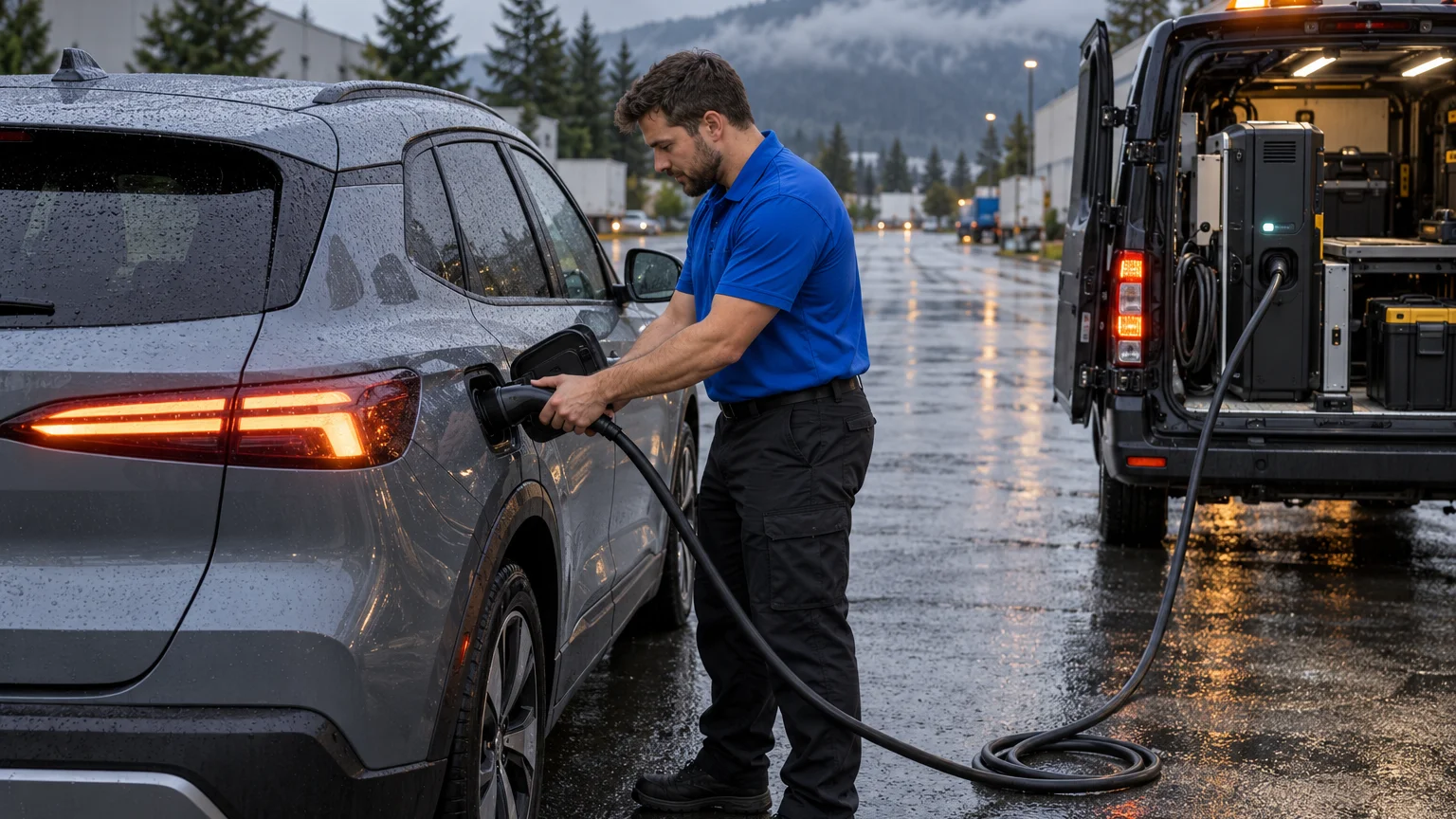
The operators available through Charge Pro SEA may use a Tesla Cybertruck with an integrated 240V, 9.6 kW bed outlet. The mobile Level 2 setup uses NACS, with an adapter for compatible CCS-equipped vehicles. J1772 and J3400, also called NACS, are the standard connector names used for Level 2 AC charging.
A typical mobile connection lasts 15 to 30 minutes of charging time. That connection can add roughly 10 to 20 miles of range. This describes the size of the charge, not an operator’s arrival time. Actual added range varies with the vehicle and conditions.
That small charge isn’t intended to refill the pack. It’s meant to provide enough usable energy for a practical next move. Before driving, confirm that the destination is within the range shown by the vehicle. Also confirm that the destination charger is operating and compatible.
Use extra care when the route requires more energy than the display suggests. Cabin climate use and temperature can affect available range. Research covering more than 30 EV models found average range retention of 78 percent at 32°F. Your vehicle’s display and owner’s guidance remain the better tools for the immediate trip.
A tow avoids relying on a short charge when the next destination isn’t safely reachable. The matched operator can discuss whether your vehicle should go toward Tacoma, Spanaway, Puyallup, or another destination you select. Charge Pro SEA doesn’t choose the repair facility, set the tow price, or promise an arrival window.
Ask where the tow will end before authorizing it. Confirm whether that destination can receive the vehicle. If you want on-site power first, request emergency EV roadside assistance and describe the connector on your car.
What to share when requesting local help
A clear request helps the matched operator understand your Frederickson stop. Start with your exact location. Share a dropped map pin, road name, direction of travel, and nearest cross street. On Canyon Road East or 176th Street East, direction matters more than a vague Frederickson address.
Next, identify the vehicle. Give the year, make, model, and connector type if you know it. Drivers with a 2025 or later Hyundai IONIQ 5 can report its native NACS port. If you don’t know the connector, send a clear photo of the open charge port without forcing any cover or latch.
Describe what the vehicle is doing now. Useful details include:
- The last charge percentage you saw
- The exact warning text, if it remains visible
- Whether the screen, locks, and charge door respond
- Whether the vehicle can shift into neutral
- Whether there’s collision, tire, or wheel damage
- Whether the EV is in a traffic lane or parking area
- Whether a property representative has given access directions
Mention barriers or access controls. A warehouse address may lead to several gates or entrances. Share the entrance you’re using and follow posted property directions. Don’t move through a restricted gate just because a map points there.
Tell the operator what outcome you need. You may want enough mobile charge to reach a confirmed station. You may need a 12V load test. You may prefer towing because the car shows another fault. If you’re unsure, say so.
Ask for the operator’s quote before work starts. Charge Pro SEA doesn’t set the price or collect payment for the roadside service. The driver contracts with and pays the independent operator directly.
Don’t promise yourself that a short charge will cover an uncertain route. Confirm the destination, connector, and displayed range first. If conditions change, tell the operator before service begins.
When to call us
Call when an EV in Frederickson can’t continue because its pack is empty, its 12V system may have failed, or you need help choosing between mobile charging and towing. Charge Pro SEA will match you with a licensed, independent local operator who can assess the roadside request.
Call us at (206) 202-7018 and we’ll connect you with a local EV rescue operator.