An EV battery in the Puget Sound region does not face one set of conditions. A car that lives in Bellevue and one that lives in Gold Bar see different weather, different grades, and different charging access, even though both sit in the same metro. This is a decision guide for sorting through that, not another mileage chart.
Start with the vehicle maker’s guidance
Every EV maker publishes its own guidance for the traction battery, and that guidance is the correct starting point, not a general region-wide rule. Tesla’s owner support pages, Rivian’s current documentation, and the manuals for Ford, Hyundai, Chevrolet, and Kia EVs each set their own recommended charge limits, software update cadence, and service intervals. Those figures differ by model and by battery chemistry, and they change as manufacturers update their guidance.
We cannot confirm a single degradation rate, charge-limit percentage, or “ideal” charging window that applies across every EV in the Puget Sound region, and no reputable source publishes one that covers every make and model. Any post that hands you a specific percentage for what cold, grade, or charging habits cost your pack is guessing. The honest answer is that your owner’s manual or the manufacturer’s app is the only source built for your specific vehicle, and it should be the first thing you check, not the last.
Account for lowland and foothill driving conditions
The Puget Sound region is not one climate, and it is not one set of roads. The lowland cities along I-5 from Everett through Seattle and Tacoma sit in a 35 to 45F rain band for months at a time. Drive east toward North Bend or Gold Bar and the temperature drops, the snow shows up sooner, and the cabin heater works harder. Those foothill runs routinely see colder mornings than the lakes around Bellevue and the waterfronts of Tacoma.
Recurrent Auto publishes data on cold-weather range, and the figure most cited is around 78 percent of rated range at 32F for typical EVs. AAA has published that cabin heat can push the loss higher, to roughly 40 percent at 20F. The drain comes from the heater and the defrost, not a hard freeze on the pack itself. The pack has thermal management that warms it in cold weather; the energy goes to keeping you warm.
The central city and the Eastside sit between the rain band and the foothills. Bellevue, Redmond, and Kirkland hold a few degrees warmer than the Snoqualmie Valley because of urban density, and a few degrees cooler than the Tacoma waterfront because of the lake-effect cold air. East of the mountains, Gold Bar and Stevens Pass live in a different climate entirely. The grade from Monroe up to Stevens Pass through US-2 is the climb that catches winter drivers most often, and a loaded EV working against that grade behaves differently than one cruising flat I-5 miles.
Separate traction-battery care from 12V warning signs
One of the most common mix-ups we hear about is treating every “battery” symptom as the same problem. An EV has two separate battery systems, and they fail differently.
The traction battery is the large pack that powers the drive motors and shows up as your range estimate on the dashboard. When it runs low, the car keeps functioning right up until it does not. You will see the range countdown, you may get low-charge warnings, and the vehicle will eventually stop moving under its own power once the pack is too depleted to continue.
The 12V auxiliary battery is a different, much smaller battery that runs the low-voltage systems. Door locks, the infotainment screen, and the computer that wakes up the high-voltage system all run on it. When the 12V battery fails, the car can seem completely dead even if the traction battery shows a full charge. Locks will not respond, the screen will not wake, and the car will not “start” in any sense, because the low-voltage system that turns everything else on has nothing to run on.
Knowing which one you are dealing with changes what happens next. A depleted traction battery on the shoulder of I-5 or I-90 is a charging or recovery situation. A dead 12V battery in a Bellevue driveway or a SeaTac parking structure is a jump-start situation, and it can often be resolved without touching the main pack at all. If your car will not respond at all and the range display was fine last time you looked, the 12V system is the more likely cause, and it is worth ruling out before assuming the worst about the traction pack.
Plan charging before longer regional routes
Route planning matters more in the Puget Sound region than the mileage suggests, because charging infrastructure is not distributed evenly. A trip from Bellevue to North Bend covers real elevation change with fewer charging options along the way than a lowland errand run. A trip from Seattle over Snoqualmie Pass needs more planning than the same distance along I-5.
The US Department of Energy’s Alternative Fuels Data Center publishes the verified specifications for each charging level, and they are useful for planning before you leave rather than guessing on the road. Level 2 charging runs on 240V residential or 208V commercial power and adds roughly 25 miles of range per hour of charging. DC fast charging, found along heavier-traffic corridors, can deliver significantly more in a shorter session. Actual charging speed still depends on your vehicle’s acceptance rate, its state of charge, and the ambient temperature, so treat the numbers as planning inputs, not promises.
For longer drives east of North Bend or north of Arlington, check your route against a current charging map rather than assuming a station will be available or working when you arrive. The Seattle EV charging guide is a useful starting point for the central metro before you commit to a route with fewer options.
Choose roadside help, transport, or a service center
Once you know which battery is involved and what the route looks like, the decision usually sorts itself into one of three lanes.
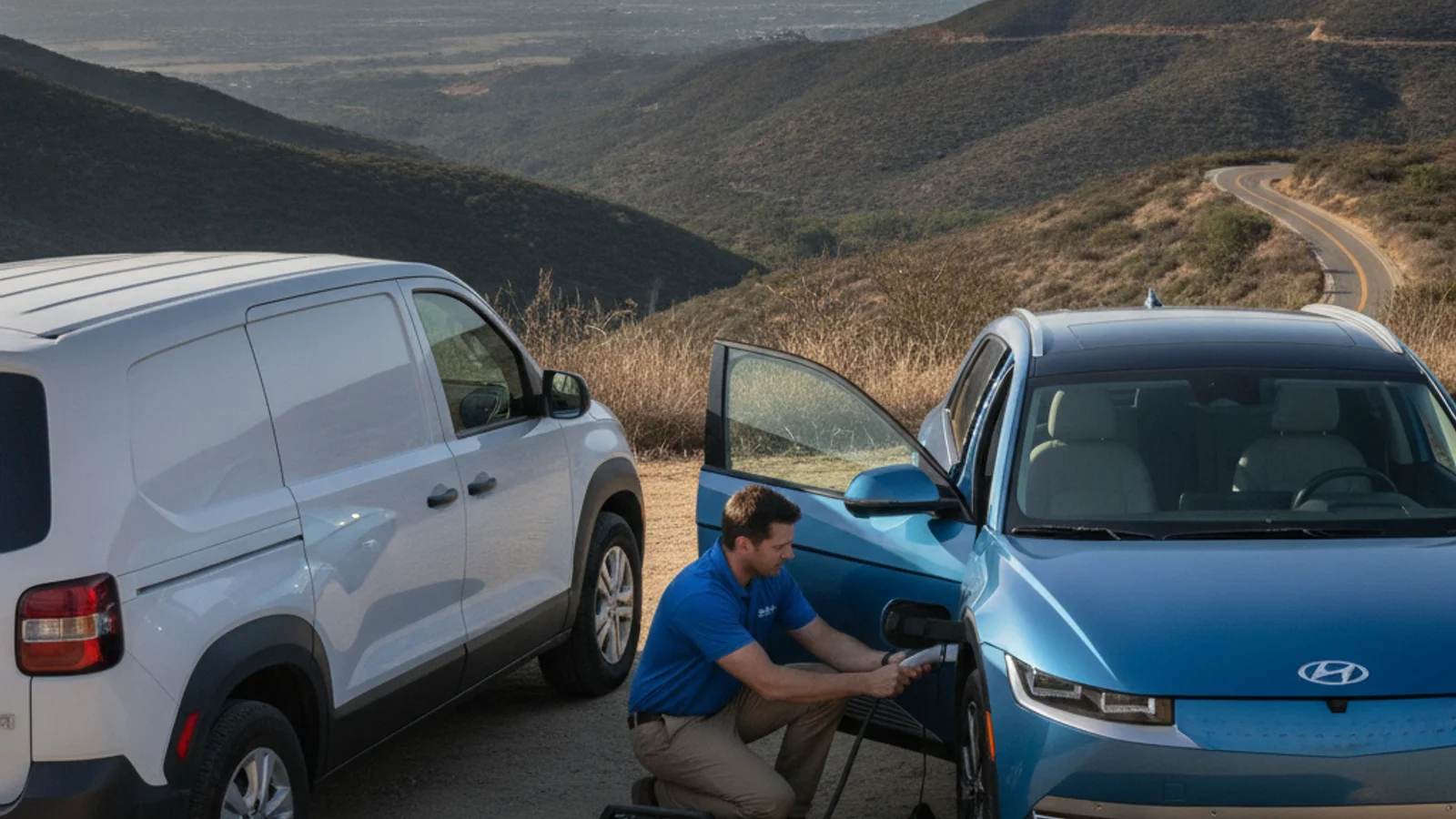
If the traction battery is depleted and you are stopped somewhere accessible, mobile charging or out-of-charge recovery is the roadside option. The independent operator can evaluate whether enough charge can be added on-site to reach a compatible charging location, or whether the vehicle needs to be transported instead. That decision depends on the vehicle, the location, and the equipment available, and it is the operator’s call once they are on scene, not a guess made over the phone.
If the symptoms point to the 12V system instead, a jump start is usually the faster fix, and it does not require moving the vehicle at all. Our general EV roadside assistance covers that kind of call along with other on-the-spot issues that come up away from home.
If neither applies, meaning the car charges normally, drives normally, and nothing about the traction pack or the 12V system looks wrong, but you have a real question about long-term battery health, that is a service center question, not a roadside one. Diagnostics for battery state of health, warranty questions, and any recommended service beyond what your manual describes belong with the manufacturer or an authorized service center, not with a roadside operator whose job is getting you moving again.
When to call us
If your EV’s traction battery is depleted somewhere in King, Pierce, or Snohomish County, or the vehicle will not respond and you suspect a dead 12V battery, that is a roadside situation, not a wait-and-see one.
Call (206) 202-7018 and we will connect you with a local EV rescue operator.