Most national roadside plans jump a dead EV 12-volt battery, or they send a tow. Roadside assistance does not replace an EV 12V battery as a standard curb job. A black screen after a Ballard alley overnight sit is still a jump-or-tow call unless you booked a real replacement.
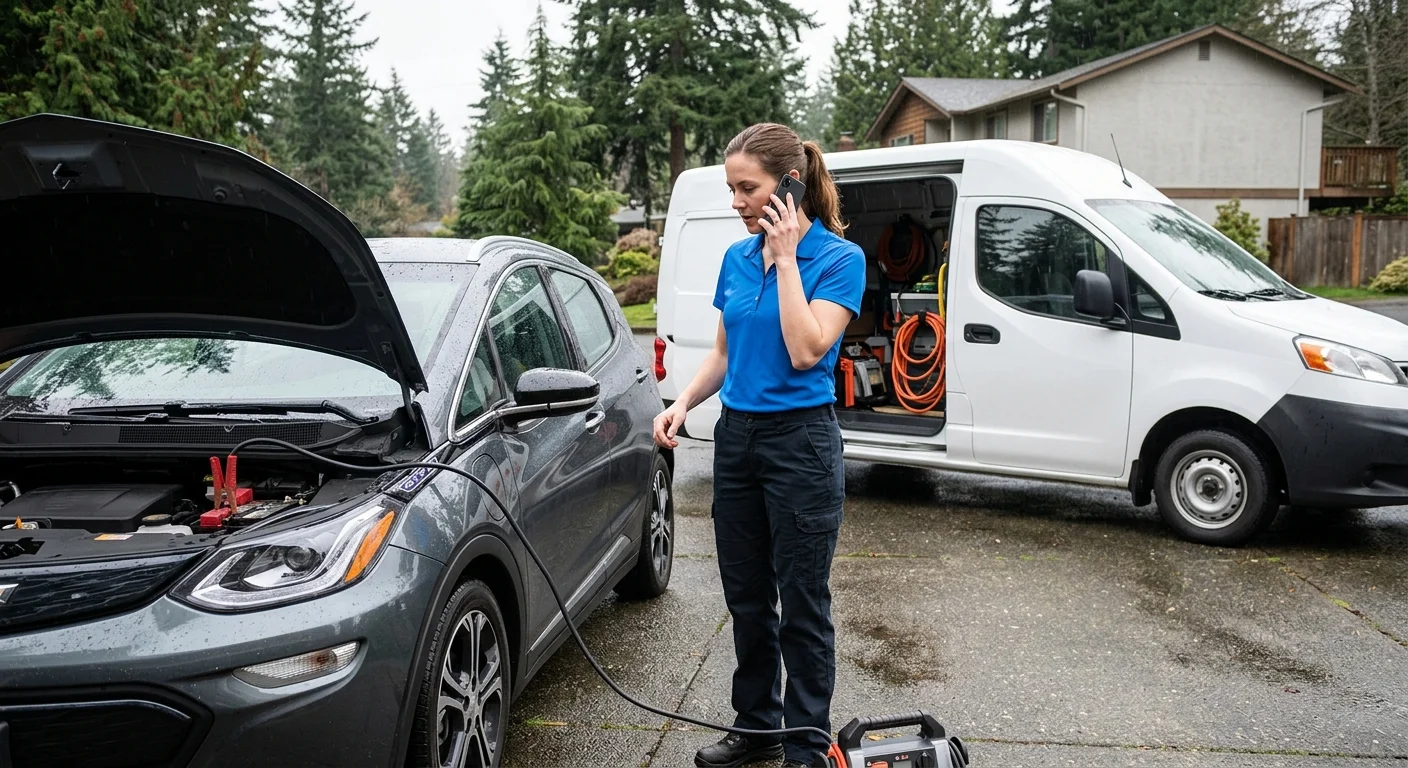
Jump, tow, and a replacement are different jobs
Your EV has two battery systems. The high-voltage pack moves the car. The small 12-volt battery wakes the computers, the locks, and the switches that connect the drive pack. When the 12V is flat, the traction pack can still hold a full charge. The car still looks dead. A neighbor who offers a jump from a Tesla is not a workaround. Tesla’s own manual says a Model 3 cannot be used to jump start another vehicle. The same sentence appears for Model S, Model X, Model Y, and Cybertruck.
A jump puts 12-volt current into that small battery, or across its jump points, so the car can boot. Whether roadside assistance can jump-start an EV is a different question from a swap. If the 12V is only discharged, a jump can be enough to get you moving. If it will not hold a charge, a jump is a delay.
A tow moves the vehicle. On a state highway, Washington still expects you to arrange prompt removal. RCW 46.61.560 lets a disabled vehicle stop when stopping is unavoidable. RCW 46.61.590 requires the driver to arrange that prompt removal. The WSDOT Incident Response Team patrols major corridors. You reach it by dialing 911. Its published materials describe helping motorists who have run out of gas. They do not mention electric vehicles, out-of-charge sits, or 12V work.
A replacement is the third job. A failed 12V comes out and a matching unit goes in. Chemistry matters. Tesla service docs split the fleet. Vehicles built in Gigafactory Shanghai before about October 2021, and in Fremont before about December 2021, use a lead-acid low-voltage battery. Later cars use a lithium-ion 12V. Mercedes-Benz is stricter on the EQS. The MY23 EQS Sedan Operator’s Manual is blunt. Starting assistance, 12V charging, and 12V replacement should happen only at a qualified specialist workshop. Mercedes names an authorized Mercedes-Benz Center as the example.
Do not treat those three jobs as one phone call. Ask which one the person on the other end actually does. For the swap itself, follow the EV 12V battery replacement guide rather than guessing at DIY steps on a wet street.
What national clubs usually send for a 12V
National clubs are built around a jump box and a tow truck. That model fits a gas car with a flooded lead-acid battery under the hood. An EV 12V may sit in a frunk, under a seat, or behind trim. Some cars need a lithium-safe procedure. Some, like the EQS, tell you not to take starting assistance from a random truck at all.
Club replacement rules that could not be confirmed
It could not be confirmed from public policy pages that AAA, Tesla roadside, State Farm, or Progressive will install a new EV 12V on site as a standard roadside benefit. Do not wait on the shoulder for a battery a dispatcher never promised. Open the app. Read the policy. Ask the person they send, out loud, whether they are coming with a jump, a flatbed, or a matching 12V.
If the club cannot confirm a replacement, the next move is usually a jump. If the jump fails, or the car is a lithium 12V they will not touch, the next move is usually a tow to a shop. That is a long night on I-5 in Tacoma rain. It is also how a simple 12V failure turns into a shop visit you did not need, if a local operator had the right battery in the van.
Washington has a lot of these cars. The Washington DOL EV file, updated 2026-09-15, counts 299,705 registered EVs statewide. King County has 144,257. Snohomish has 37,818. Pierce has 25,042. Combined, that is over 207,000 EVs in the three counties. Seattle alone has 45,469. Tesla is about 41 percent of the statewide fleet, and about 44 percent of King County EVs. Those counts live on Washington’s public data portal. They explain why a club van that only stocks a generic flooded battery may not match what is in your car.
The U.S. Department of Energy’s electric vehicle overview is the right primer on the high-voltage pack. It is not a 12V service manual. Keep those two systems separate when you talk to dispatch. Most roadside plans do not replace EV 12V batteries on the shoulder. They jump, they tow, or they send you to a shop.
Warranty coverage for a 12V
If a manufacturer roadside line is part of your new-car coverage, check that document the same way. An extended warranty may cover a 12V, or it may not. That rule could not be confirmed as a single nationwide answer. The policy in your glovebox, or in the app, is the source. A blog post is not. Ask the warranty line whether they cover the auxiliary 12V, the traction pack, or neither, and whether the work has to happen at a dealer.
When a Puget Sound driver still needs a new battery
A jump is the right first move when the 12V went flat from sitting. A Ballard alley overnight sit, cabin cameras, and sentry use can drain a weak 12V even when the traction pack is fine. So can a wet Issaquah driveway after a short Eastside hop that never let the DC/DC converter rest. That converter is the system that tops up the 12V while you drive. Short trips in the rain do not give it much time.
Cold makes the whole electrical system work harder. Recurrent Auto’s winter testing across 30-plus EV models found cars retain on average 78 percent of range at 32°F. AAA testing at 20°F found temperature alone cut range 10 to 12 percent, and cabin climate control pushed the loss toward 40 percent. Range loss is not a 12V diagnosis. It is the climate those 12V batteries live in around Puget Sound.
You likely still need a new 12V when the car dies again after a jump. When the screens flicker, then go black, then come back with a jump, then fail in the grocery lot. When a load test says the battery cannot hold. You do not have to replace the high-voltage pack because the 12V died. Those are different parts.
Charge Pro SEA’s published service definition is that a matched operator jumps a dead 12V on site, load-tests it, and can replace a failed 12V on site, AGM lead-acid or lithium, per model year. The operator prices and quotes both options before starting, and bills you directly. That is the service definition, not a promise about any one van’s stock or schedule.
A house call versus a shop
Yes, someone can come to a house, an alley, or a driveway for this. The operator you are matched with can jump, test, and, when the car and chemistry allow, install a replacement on site. You also need a shop, not a curb swap, when the maker says so. Mercedes-Benz is explicit on the EQS. When that 12V is disconnected or discharged, Mercedes lists that the drive system cannot start, the electric parking brake cannot release or apply, and the selector lever cannot be put into position. Other brands may require coding after a 12V change. That coding rule could not be confirmed as a single list across every model sold in King, Pierce, and Snohomish counties. Ask the operator what your model year needs before they open the tray.
Do not confuse a dead 12V with an empty traction pack. You do not need a mobile Level 2 charge because the screens are dark. A 15 to 30 minute Level 2 connection adds roughly 10 to 20 miles of range, and that is a different rescue. If the high-voltage pack is the problem, ask for charging or a tow. If the 12V is the problem, ask for a jump and a test.
For the actual swap sequence, chemistry, and what to tell a tech, use the EV 12V battery replacement guide. Skip the curb DIY if you do not know the jump points or the lithium rules.
How to request a local operator for a 12V jump
Charge Pro SEA is a referral service. It matches you with a licensed, independent local operator. It does not jump batteries, install 12Vs, or own a truck. The operator you are connected with does the work, quotes it, and bills you. The pros in that network are licensed and insured. The brand is not the one holding the cables.
Call with four facts. Make and model year. Where the car sits: a Ballard alley, an Issaquah driveway, or the I-5 shoulder in Tacoma. Whether the screens are dark, the doors are locked, or the car already took a jump today. Whether you already called a club and they offered a jump, a tow, or nothing you can confirm in the app.
Ask for a Tesla 12V battery jump if that is your car, or for emergency EV roadside assistance if you are in a non-Tesla or you are not sure which system failed. Say you want a jump and a load test, and a quote for an EV 12V battery roadside replacement if the test fails. Do not ask the brand for a price. The operator sets that.
If you are on a state highway, stay out of the lane. Dial 911 for WSDOT Incident Response. Then call for the 12V work once you are in a safe spot. Incident Response is there for the roadway. It is not a 12V shop.
If the car is an EQS, say that before anyone connects cables. Mercedes wants starting assistance and 12V replacement at a qualified specialist workshop. A matched operator can still help you decide jump, transport, or a dealer path. Tesla owners should also say the build window if they know it, so the operator brings lead-acid or lithium, not a guess.
The operator quotes both options before starting. You accept one. They bill you. That is the whole loop.
When to call us
Call when the 12V has already been jumped and the car died again, or when a club can only offer a tow and you still need a test or a matching battery on site. Call us at (206) 202-7018 and we’ll connect you with a local EV rescue operator.