Your EV relies on its big, high-voltage pack to go places, but there is another, smaller battery that is just as critical: the 12V auxiliary battery. When this often-overlooked component starts to fail, it can leave your sophisticated EV completely unresponsive and stranded. Understanding the signs of a dying 12V and knowing your replacement options can save you a significant headache and an unexpected tow across the Puget Sound.
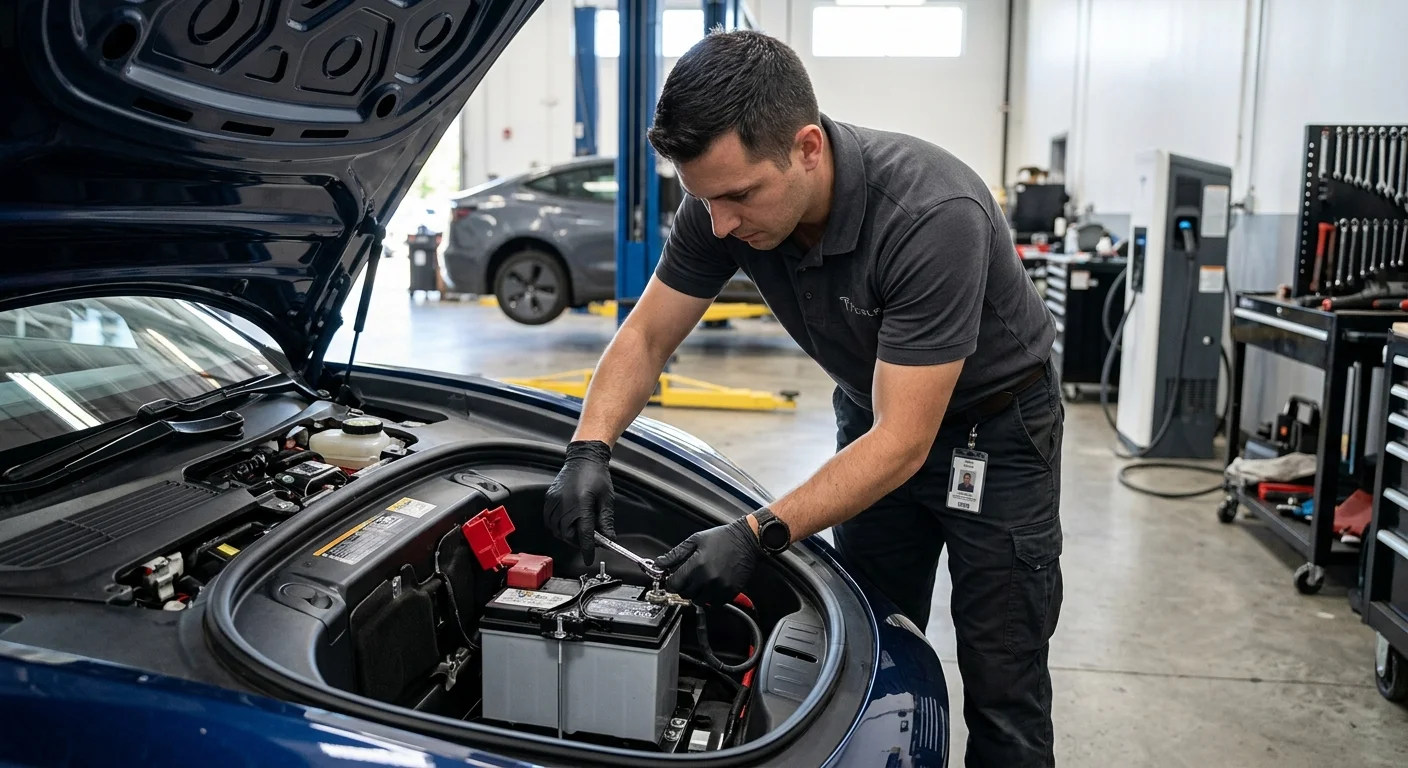
Why a failing 12V can strand your EV completely
It sounds counterintuitive: how can a small 12-volt battery bring a powerful electric vehicle to a halt? The answer lies in how modern EVs are designed. While the large traction battery powers the motors and drives the car, the 12V battery runs all the low-voltage systems: the vehicle’s computer, unlocking the doors, operating the windows, turning on the lights, and crucially, initiating the contactors that connect the high-voltage battery to the rest of the car.
Think of it as your EV’s “starter” battery, even though it does not crank an engine. Without sufficient power from the 12V, the car’s computers cannot boot up, the systems that prepare the high-voltage battery for operation stay inactive, and your EV becomes a very heavy brick. You will not be able to put it in drive, open the charge port, or sometimes even open the doors or frunk manually. This often leads to confusing errors on the dash or a completely blank screen, making it look like the main battery is dead when in fact the little 12V is preventing anything from happening.
This is exactly what strands Bellevue and Seattle drivers who parked at SEA long-term, in a downtown garage, or in a Marysville apartment lot for a week. The traction pack is full, but the car will not wake.
7 warning signs your 12V is about to die
Catching a failing 12V before it completely gives up can save you a roadside emergency. Modern EVs are often good at alerting you, but the signs can be subtle.
- “12V battery replacement due” or similar dashboard alerts. Many EVs, particularly Teslas, display a direct warning message when internal diagnostics detect a weakening 12V. Do not ignore these.
- Sluggish or non-responsive infotainment screen. If the central display takes longer to boot up, freezes, or occasionally goes black, it could be insufficient 12V power.
- Unreliable door locks or key fob response. If the key fob is not consistently unlocking or locking the car, or if the door handles do not present reliably, the 12V system might be struggling.
- Erratic lights or accessories. Flickering interior lights, dim headlights, or accessories that do not operate properly can point to a weak 12V.
- Vehicle will not “wake up.” You press the brake, but nothing happens. The car does not go into drive mode. This is a critical sign the 12V cannot initiate the startup sequence.
- “Service required” or general error messages. A failing 12V can trigger a cascade of seemingly unrelated error codes as various ECUs struggle for stable power.
- Slightly older battery (3 to 5 years). EV 12V batteries typically last 3 to 5 years. If yours is in that range and you notice other symptoms, get it checked.
Paying attention to these signs helps you schedule a replacement proactively. For more on the symptoms specific to one common model, our Tesla 12V battery failure symptoms post covers what Tesla owners actually see in the days before the failure.
How long an EV 12V lasts in the Pacific Northwest
Coastal humidity, mild winters with extended rainy stretches, and the wet-dry cycles inland all put measurable stress on the small battery under the hood. An EV 12V in a Seattle or Bellevue garage that sits more than two weeks at a time will usually die earlier than the same battery in a Phoenix garage that runs every day.
For Tesla Model 3 and Model Y, the replacement interval commonly lands between 3 and 4 years. For Rivian R1T and R1S, slightly longer, around 4 to 5 years, because the trucks sit plugged in more often. For Ford Mach-E and Hyundai Ioniq 5, the AGM battery that ships from the factory usually lasts 3 to 5 years. Volvo Recharge and Audi Q4 e-tron cars, with MEB platform electronics that stay awake in parking lots, often see the 12V fail closer to year 3.
If your EV is past year three and showing any of the seven signs above, treat the battery as suspect and book a load test before it strands you.
Can you replace it yourself? A step-by-step overview
For experienced DIYers, replacing an EV’s 12V battery can be manageable but requires careful attention to safety and specific vehicle procedures. EVs have complex electrical systems, and incorrect handling can damage components or injure you.
Locate the 12V battery. This is often the first challenge. In many Teslas (Model 3, Model Y), the 12V battery is under the frunk cowl, requiring removal of plastic trim pieces. For a Ford Mach-E, it might be in the frunk or under the rear seat. Hyundai Ioniq 5s sometimes place it under the hood near the windshield. It varies a lot by brand.
Gather your tools and safety gear. Basic hand tools like 10mm or 13mm wrenches, a plastic pry tool for trim, and potentially a multimeter. Wear insulated gloves and safety glasses.
Disconnect the battery. Always disconnect the negative terminal first, then the positive. Make sure the terminals are securely isolated from any metal parts. Many EVs also require placing the car in service mode before disconnecting the 12V to prevent errors.
Remove the old battery. There is often a hold-down clamp or strap. Carefully remove it and lift out the old battery.
Install the new battery. Place the new battery in the tray, secure the hold-down clamp, and connect the positive terminal first, then the negative. Ensure all connections are tight.
Reassemble and test. Replace any removed trim pieces. Then try to wake up your EV. If the car will not power on, double-check all connections.
If you are uncomfortable with electrical work or unsure about any step, professional help is the safer choice. Incorrect installation can damage your EV’s sensitive electronics.
What to do when it dies on the road
Even with all the preventative measures, a 12V battery can sometimes fail unexpectedly. If your EV suddenly will not start, displays error messages, or goes completely dark, a dead 12V is a likely culprit.
Do not panic, assess the situation. Confirm the symptoms align with a dead 12V. Are the doors unresponsive? Is the infotainment screen blank? If so, you need external power.
How to safely get the car powered back. Many EVs have designated jump points, often behind a removable panel in the front bumper or frunk. Connect a 12V jump pack or another vehicle’s 12V battery to these terminals. Never attempt to jump-start an EV using its high-voltage battery system. Follow your owner’s manual precisely.
A jump start is a temporary fix. It only provides enough power to get your EV’s main systems online and let the DC-DC converter begin recharging the 12V from the high-voltage pack. It does not fix a dying 12V. Drive to a service center for testing and replacement as soon as possible.
If you are unsure how to jump-start your specific EV, do not have the right equipment, or find yourself stranded in an unsafe location, call for professional roadside assistance. Services like our Tesla 12V battery jump are designed for exactly these situations, providing the correct tools and expertise to safely get your EV moving again.
When to call us
If your EV’s 12V battery dies and you need a quick, safe jump to get to a service center for replacement, our mobile rescue team connects you with operators across the Puget Sound. The operator carries the proper equipment for the specific EV jump procedure and confirms pricing before starting.
Call (206) 202-7018 to reach a local operator.