Roadside assistance can absolutely jump-start an EV, with one caveat. The jump that works on an EV is the 12V auxiliary battery, not the main traction pack. Confusing the two is the most common reason drivers end up waiting longer than they should or paying for a tow they did not need.
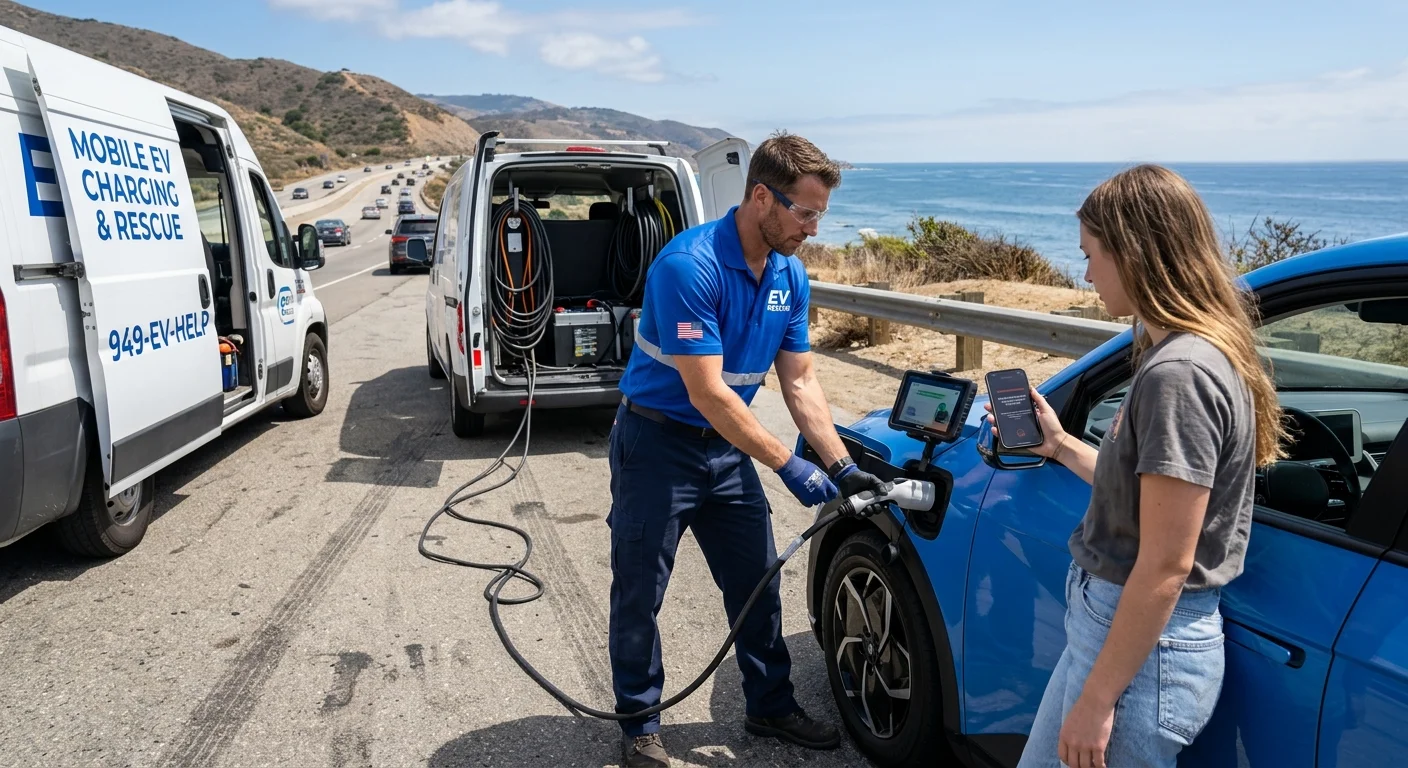
The Puget Sound region makes that mix-up more likely because the state freeways have a free program for gas vehicles that does not formally cover EVs. WSDOT’s Incident Response Team patrols I-5, I-90, I-405, SR 167, and other state highways, and its published materials mention running out of gas but say nothing about electric traction packs. Drivers here assume the IRT will help any stranded vehicle, then sit on the shoulder longer than they expected.
What a 12V jump actually does on an EV
Every modern EV uses a 12V auxiliary battery to run the computers, the infotainment system, the contactors that connect the high-voltage pack, and the parking-latch mechanisms. When that battery dies, the car looks completely off: no screen, no door handles that present, no gear selection, no ready light. The high-voltage pack can be at 90 percent and the vehicle is still a brick.
Jump-starting the 12V wakes the computers. Once awake, the contactors close, the high-voltage pack connects, and the car is drivable again. The procedure uses the same portable lithium jump pack that fits a gas car’s battery, connected to the EV’s under-hood jump posts, which every manufacturer exposes for exactly this purpose.
The 12V jump does not add range. It does not charge the traction pack. It does not solve a depleted pack situation. A driver who jumped the 12V on a Tesla Model Y at 3 percent traction pack still has 3 percent traction pack. The car will now drive, but the next stop is still the nearest charger.
Why the main pack cannot be jump-started
The traction pack is a sealed high-voltage lithium system with its own battery management. Connecting another 12V battery, a 240V outlet, or a portable generator directly to the pack’s high-voltage terminals is dangerous, ineffective, and outside what roadside assistance is licensed or equipped to do. Even mobile EV charging trucks do not “jump” a traction pack in the way a 12V gets jumped. They connect to the vehicle’s charging port and add energy through the same path the car uses at a public charger.
If the traction pack is empty, the answer is mobile EV charging or out-of-charge recovery, not a jump.
WSDOT IRT: what it covers and what it does not
WSDOT’s Incident Response Program provides free help on state highways. The team clears debris, manages traffic around collisions, and pushes or tows vehicles off the roadway to keep traffic moving. Their published materials describe helping with flat tires, running out of gas, and minor mechanical problems.
The published copy mentions gas. It does not mention EVs. That is an observed absence, not a confirmed policy: WSDOT materials do not say IRT will not help an EV, and they do not say IRT will help only the 12V. Before assuming free state-highway help on a non-traffic stop, call 911 from the road and ask, or check the WSDOT page for the current wording.
For the most common EV no-start in this region, a dead 12V, an IRT operator with a portable jump pack can usually revive the car the same way a private roadside operator would. The car drives away and the driver reaches a service center for a real 12V replacement. That part is genuinely useful.
What to tell the operator
The wrong report puts the response at the wrong place. The right report gets the right truck.
Describe the symptoms exactly. “Dashboard is dark, no ready light, but the car was fine yesterday” is a 12V report. “Traction pack is at 3 percent and I cannot make it to the next charger” is an out-of-charge report. “The car threw a high-voltage isolation fault” is a tow report.
Share the vehicle make, model, and model year. The connector type matters for an out-of-charge job. The location, including which side of the freeway you are on, matters for any shoulder stop.
State whether the vehicle can shift, steer, and accept charging. A car that will not roll needs a flatbed, not a portable charger. A car that rolls but will not accept charging also needs transport.
For the operator working out of the Puget Sound service area, conditions matter. Bellevue in a thunderstorm is different from Bellevue at noon. Mercer Island with the I-90 floating bridge shut down is different from a quiet street in Issaquah. A clear description saves time on both ends.
How the service actually works in the region
Charge Pro SEA is a referral line. We match stranded drivers with licensed, independent local EV rescue operators who run mobile charging trucks, portable jump units, and flatbed tow capability for the cases that need it.
For a 12V jump, the matched operator arrives with a portable lithium jump pack, connects to the under-hood jump posts the same way a roadside tech would on a gas car, and waits for the cars systems to wake. The whole job often takes less than ten minutes once the operator is on scene.
For a traction-pack out-of-charge case, the operator brings a portable Level 2 or DC charger, connects to the car’s charging port through the standard inlet, and adds enough range to reach a fixed charger or home. The owner pays the operator directly; Charge Pro SEA does not set prices, perform the work, or guarantee a delivery window.
If the matched operator finds the situation is not a 12V or out-of-charge case, the next move is a flatbed tow to a service center. Our non-Tesla EV rescue and Tesla roadside rescue pages describe what each service does.
Limits worth knowing
A 12V that has just been jumped may fail again on the next cold morning. A 12V that threw a warning before the no-start event is already past its useful life. Replacing it is the right next step, but the replacement is a service-center or driveway job, not a roadside job.
A traction pack that has been driven to 0 percent is not damaged by the deep discharge, but the 12V that died alongside it usually needs replacement too. Mobile charging adds usable range; it does not fix the underlying 12V weakness.
A collision or a high-voltage isolation fault is a different problem entirely. The right move is a flatbed to a collision center or an EV-certified service shop, not a roadside charge.
When to call us
If the dashboard is dark and the high-voltage pack is fine, an operator can jump the 12V. If the pack is empty, an operator can add range at the scene. Either way, Charge Pro SEA matches you with a licensed independent local operator across the Puget Sound region. Call (206) 202-7018 to reach a local EV rescue operator.