A Chevy Blazer EV that won’t start almost always comes down to one of three causes: a dead 12V auxiliary battery, a GM Ultium BMS software fault blocking high-voltage initialization, or a charge-port latch error that keeps the car from entering “Ready” mode. The large center touchscreen going completely dark is the clearest sign the 12V system has lost power. The Blazer EV shares its Ultium platform with the Cadillac Lyriq and Chevy Equinox EV, so the failure modes, and the fixes, are nearly identical across the family.
Chevy is a top make in King County
King County’s registered EV fleet includes a meaningful share of GM vehicles, and the Blazer EV shows up regularly across the Eastside, South King, and the Seattle metro. A wet garage through the fall is exactly the environment where a 12V battery that sits below full charge degrades fastest. We see Blazer EV no-starts cluster after weeks of damp cold commutes with the cabin heater and defrost cycling.
The Blazer EV runs two separate electrical systems. The Ultium traction pack drives the motors. A conventional 12V auxiliary battery powers everything else. Door locks, infotainment, body control modules, and the computers that authorize the high-voltage system to come online all pull from the 12V. When the 12V dies, the car won’t boot, no matter how much charge is in the main pack.
On the Blazer EV, the 12V battery sits in the front trunk area under a plastic panel. There is no conventional engine bay, so owners familiar with ICE vehicles often don’t know where to look. If the 12V still holds a residual charge, the frunk opens from the interior release or the key fob. If the 12V is completely dead, the latch is electrically controlled, so you’ll need to use the manual emergency release described in the owner’s manual.
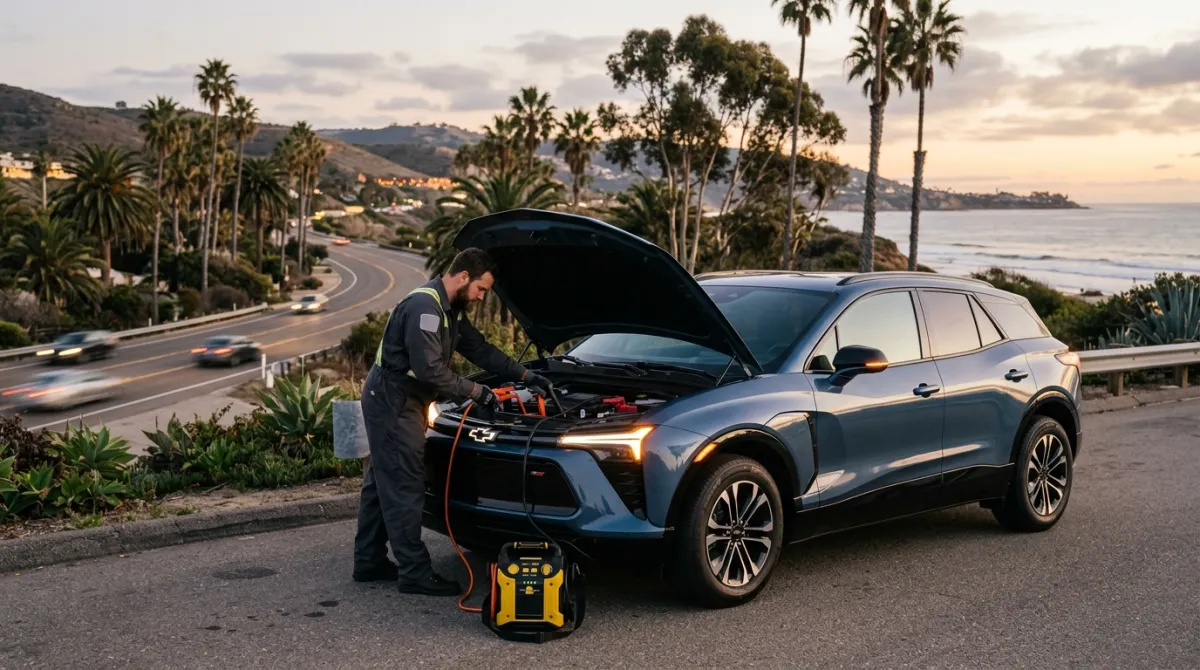
The jump-start terminals are on a dedicated buss bar in the front compartment, separate from the battery terminals themselves. The positive post has a red cap. The negative ground point is a chassis bolt nearby. Connect your jump pack to the buss bar terminals, not directly to the battery posts, and let the 12V system recover for 60 to 90 seconds before pressing the start button.
Ultium BMS and software faults
The Blazer EV had a well-documented rough launch. In late 2023 and into 2024, GM issued a stop-sale on new Blazer EV inventory due to software issues that could cause no-start events, unexpected power losses, and charge session failures. Owners with early-build units reported cars that refused to initialize even with a healthy traction pack. GM pushed over-the-air software updates and later required dealer software flashing for affected builds.
A BMS-related no-start looks different from a simple dead 12V:
- The large center display powers on briefly, then cuts out, or shows a boot animation that never completes
- The car briefly enters “Ready” mode and then drops out before you can move
- Dashboard shows a “Service High Voltage Charging System” or “Service EV System” message
- The charge level reads normally in the myChevrolet app, but the car still refuses to drive
The standard field reset for a BMS software hang is a full 12V power cycle. Open the front compartment, locate the auxiliary battery, and disconnect the negative terminal for two full minutes. Reconnect, wait for the modules to sequence back up, then attempt a normal start. This clears volatile memory in the body control modules and lets the BMS reinitialize from scratch. It resolves the majority of software-hang no-starts without any tools.
If the car still won’t start after the power cycle, or if high-voltage warnings persist, that’s a dealer diagnostic job. Don’t try to force a charge session on a Blazer EV that’s showing active Ultium faults.
Reading the screen before you call
The Blazer EV’s large center touchscreen going dark is one of the most alarming no-start symptoms, and it’s also one of the most diagnostic. Here’s how to read it:
| Screen state | What it likely means |
|---|---|
| Completely dark, no dome light, fob won’t unlock | 12V battery fully dead |
| Dark screen but doors unlock normally | 12V low but not dead; try jump pack |
| Screen flashes on then off repeatedly | BMS module boot loop; try 12V power cycle |
| Screen loads normally, “Service” warning, won’t enter Ready | Ultium fault; power cycle, then dealer |
| Screen shows charge port locked icon | Latch fault; see charge port troubleshooting |
The first scenario, total darkness with no response to the fob, is the most common situation we encounter on Blazer EVs across the Puget Sound region. It’s a 12V problem, and a portable jump pack plus a few minutes of patience puts the car back online.
What happens if you’re stranded across the region
The Blazer EV has a steady footprint from the Eastside suburbs through South King and Pierce County. Stranded calls tend to cluster around a few patterns:
I-5 and I-405 corridors. Drivers on long daily commutes will sometimes park overnight with a marginal 12V, come back to a car that won’t start, and face a frunk latch that won’t open. Knowing where the manual release is before you need it is worth a few minutes with the owner’s manual.
Apartment parking and underground garages. Many Blazer EV owners in Federal Way, Kent, and Renton rely on shared parking structures where 12V-friendly outlets are scarce. A car that sits in an unheated garage for two weeks through November can drain below the contactor threshold without warning.
SEA airport long-term parking. A Blazer EV left in the SEA garage stalls for a week of business travel loses 12V charge to monitoring systems. The owner returns, sees a full Ultium pack on the app, and the car still won’t wake up.
For any of these situations, our non-Tesla EV rescue referral covers GM vehicles including the Blazer EV, Equinox EV, and Lyriq across the Puget Sound region. If the car is out of charge rather than stuck in a software fault, the matched operator delivers a meaningful range boost on-site via a 240V Level 2 source with CCS adapter.
If your Chevy Blazer EV won’t start anywhere in the Puget Sound region, call (206) 202-7018 to reach a local operator.