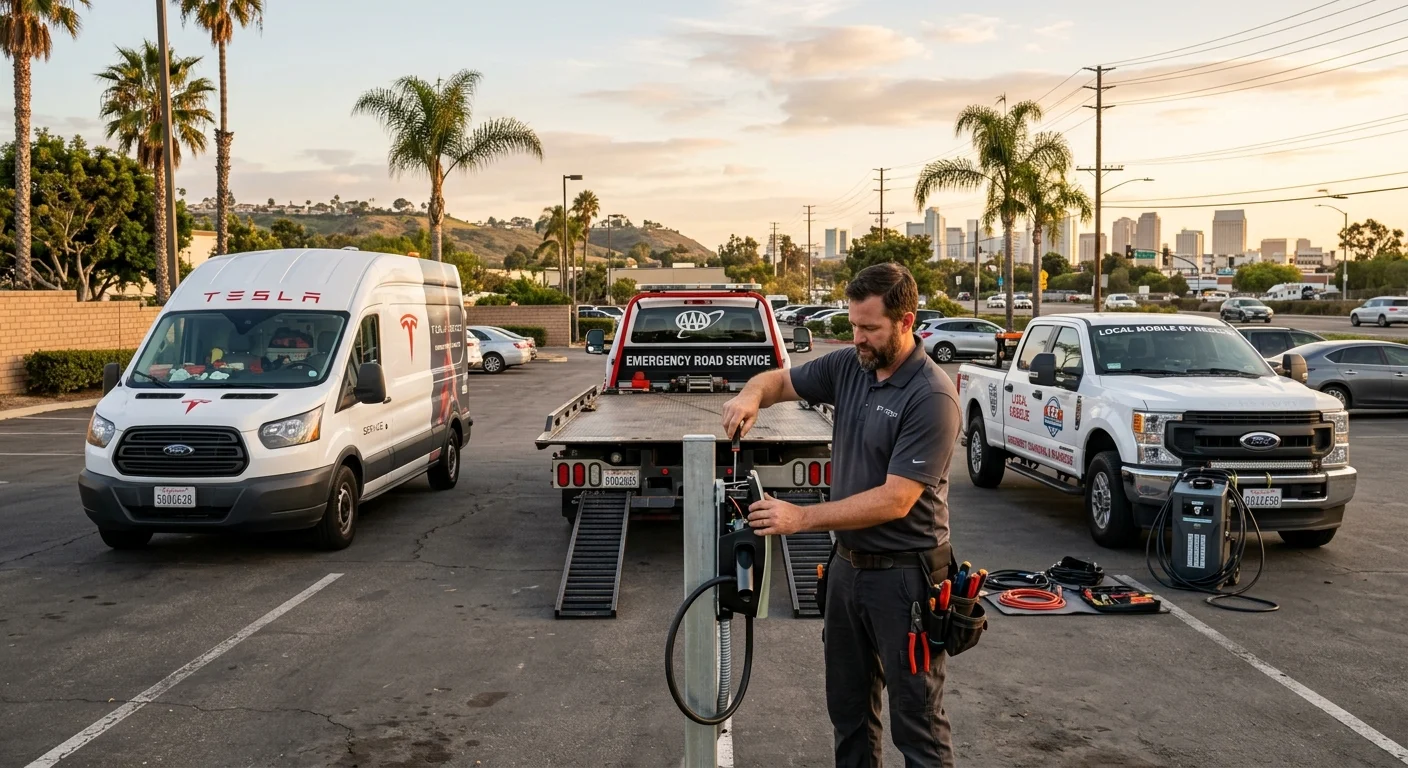
Running out of charge on I-405 near Bellevue, or facing a 12V warning in a Sea-Tac garage with your Tesla, can sour a day fast. As a Tesla owner in the Puget Sound, knowing who to call matters, especially since the metro now has two in five EVs registered as Teslas statewide. In 2026, the “best” option is not always a single service.
This guide compares Tesla factory roadside assistance, AAA Premier, and local mobile EV rescue services, so you can match the right coverage to the way you actually drive.
What ‘best’ means for a Tesla owner today
The definition of “best” goes beyond a simple tow. Tesla owners in King and Snohomish counties have needs that traditional services sometimes miss. Top priorities include help during the bridge commute home, mobile charging when the nearest station is a real drive away, and operators who understand the Model 3 frunk jump point versus the Model S frunk cover.
Specialized EV knowledge matters. Not all tow operators understand how to flatbed a Tesla or how to wake a dead 12V without damaging the gateway module. The best service offers technicians trained on Tesla quirks, from charge port release to Sentry Mode drain. Coverage for these issues, combined with clear communication and transparent terms, defines the best roadside assistance for Tesla owners in the metro.
Tesla factory roadside: where it works and where it lags
Tesla factory roadside comes standard on new vehicles and runs through the warranty period, giving you a baseline. The team knows your car’s diagnostics and can dispatch Tesla-trained help or approved contractors. They cover flat tires, lockouts, minor repairs, and towing to the nearest service center if a repair is not possible on-site. For many owners, knowing Tesla itself is handling the call is reassuring.
The limits show up in response time and the way out-of-charge calls typically resolve. Tesla’s free coverage is time and mileage limited, so older vehicles may need a paid extension or another provider. Most factory responses to a depleted traction pack are a tow to a Supercharger, not a direct mobile charge. During rush hour on I-405 or across the I-90 floating bridge, that tow can stretch, and you arrive at a busy Supercharger with a low pack to wait in a line.
AAA Premier: what it actually adds for a Tesla
AAA has long been the default roadside answer, and Premier membership extends towing distance, which matters when the nearest working charger is far from where you stranded. Premier covers the basics for any vehicle, including jump starts, flat changes, lockouts, and tows. For an EV, the practical question is whether they can dispatch a contractor with mobile charging capability rather than just a flatbed.
In the Puget Sound, the answer varies by call volume and contractor availability. AAA’s reach into more remote parts of the network, say along SR 7 toward Eatonville or out US-2 past Gold Bar, can be longer than a local operator who stages closer to those corridors. For a Tesla driver, AAA is most useful as the broad safety net for the situations a Tesla-specific plan does not cover.
Local mobile EV rescue: speed, scope, and limits
Local mobile EV rescue services, like the operators we connect drivers with, are a specialized and often faster alternative for Tesla owners in the metro. The primary advantage is speed and direct EV expertise. When your Tesla runs out of charge or has a 12V issue, an operator rolls a mobile charging truck directly to your location. This is not a tow to a charger. It is an immediate, on-site power delivery that gets you enough range to reach your destination or the nearest station. Operators carry NACS and CCS adapters, so they cover every Tesla plus the wider EV fleet.
The scope is focused on EV-specific problems, which makes local mobile rescue particularly effective for common Tesla roadside emergencies. Local operators understand bridge commute dwell time, the cold drain on the I-90 floating bridge span, and the way the I-405 corridor piles up at peak. The limits are geographic reach outside the metro and towing capacity for major mechanical failures. For very long-distance tows, AAA or Tesla’s own network may be a better fit, but for getting a Tesla moving quickly from an out-of-charge or 12V event, local mobile rescue is hard to beat.
How to stack coverage as a Tesla owner
For Tesla drivers in the metro, the most reliable approach is not picking one service but combining them so each covers a different gap.
Start with Tesla factory roadside, which is included for newer vehicles. It provides a baseline and ensures Tesla-specific expertise if a more complex diagnostic is needed. Treat it as your first line for warranty-covered issues or general advice.
Add AAA Premier as your broad safety net. It extends towing coverage, which is useful if your Tesla needs to be transported a long distance to a service center, and it covers the non-EV-specific emergencies like a flat tire in a place where Tesla’s network is thin.
Integrate a local mobile EV rescue service for the most common situations in the Puget Sound: running out of charge or a dead 12V. Local service is built around on-site power delivery and fixes made where the car sits. It covers the gaps where Tesla is slow or AAA cannot dispatch mobile charging quickly. Stacking all three gives you dedicated Tesla expertise, broad towing capability, and rapid on-site mobile charging.
How a 12V failure plays out differently here
Months in the 35 to 45F rain band, plus week-long garage sits for travel, push Tesla 12V batteries harder than the climate averages suggest. A Model 3 that worked fine last winter can throw a low voltage warning after a week at Sea-Tac parking. Knowing the jump point for your specific model matters. Model 3 and Y keep the 12V under the frunk cover, Model S and X put it inside the frunk on the passenger side, and the jump procedure is not identical across the lineup. Our Tesla 12V battery jump service connects you with an operator who confirms the right access point before doing anything to the car.
When to call us
If your Tesla needs an urgent charge, a 12V battery jump, or rapid EV-specific roadside assistance anywhere in the metro, the operators we work with can help. Call (206) 202-7018 to reach a local operator who quotes you before starting any work.