When the displayed charge reaches zero and the Tesla stops, the immediate problem is a depleted traction pack. The car needs compatible charging or transport, not an ordinary jump meant for its low-voltage battery. Don’t count on unlisted reserve miles after the display reaches zero.
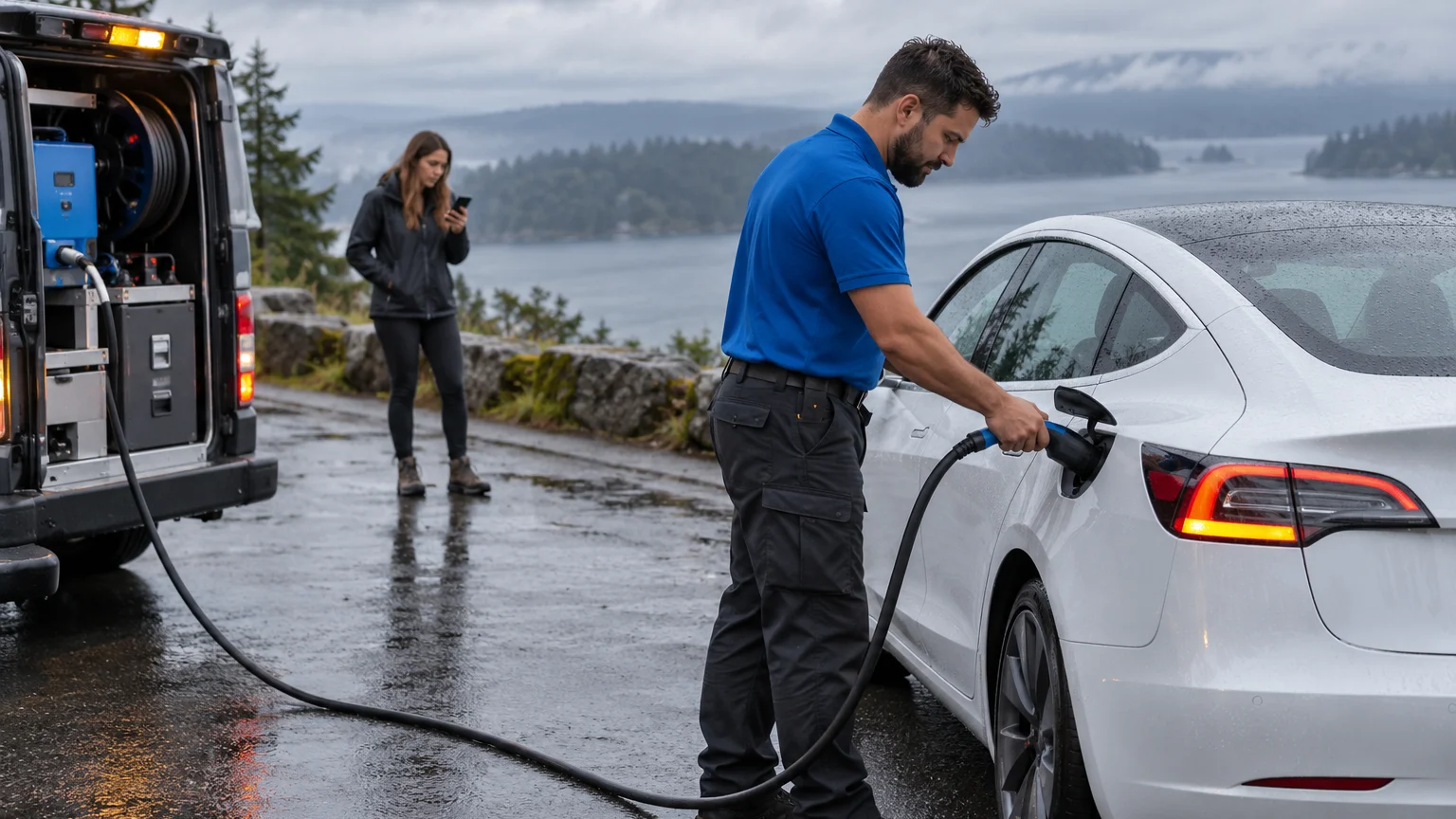
Zero charge is different from a dead 12V
A Tesla has a traction battery and a separate low-voltage battery. They serve different purposes, so “the battery died” isn’t a complete diagnosis.
Zero displayed driving charge concerns the traction pack. That’s the battery associated with moving the vehicle. A low-voltage failure is a separate problem. Depending on the model and production period, Tesla has used lead-acid or lithium-ion low-voltage batteries.
Don’t assume a 12V jump will solve a depleted traction pack. It doesn’t add driving charge to that pack. Likewise, connecting a traction-pack charger isn’t the same service as testing a failed low-voltage battery.
Start with what happened immediately before the stop:
- Did the displayed driving charge fall to zero?
- Did the car stop after repeated low-charge warnings?
- Was the car parked when it became unresponsive?
- Did you see a low-voltage warning instead?
- Is any part of the display still available?
Those observations help a rescue operator identify the service needed. They don’t replace an inspection, and they shouldn’t be treated as a final diagnosis.
Our guide to a dead 12V or depleted main pack explains the distinction further. If the low-voltage battery is the problem, a matched operator can jump it, load-test it, and quote replacement options before starting. The operator handles the work and bills the driver directly.
If the traction charge reached zero, ask for out-of-charge EV recovery. Tell the operator the Tesla model, location, display status, and what appeared before it stopped. That information matters in a wet Eastside parking lot, where “dead Tesla” could otherwise describe several different situations.
What Tesla documents about a depleted pack
Tesla’s current public support page says it can assist when battery charge is depleted. It also states that out-of-range assistance isn’t a financially covered service. That distinction matters. Roadside availability doesn’t mean a zero-charge recovery will be free.
Tesla’s North American roadside policy lists a coverage period of four years or 50,000 miles, whichever occurs first. The Basic Vehicle Limited Warranty uses the same time and mileage limit. Tesla also says the owner’s warranty document is authoritative, so check the documents attached to your vehicle.
A warranty term doesn’t answer every zero-charge question. It also shouldn’t be treated as a promise that depletion, charging, or towing costs are covered. Confirm the current terms with Tesla before authorizing service.
Several popular claims about zero charge couldn’t be confirmed in the approved source record for this page. That includes:
- A guaranteed number of miles available after zero
- A universal shutdown sequence across every Tesla
- A fixed number of restart attempts
- A reserve amount that applies to every model
- One towing procedure for every Tesla and model year
Don’t use forum reports or another driver’s video as your operating limit. Vehicle configuration and current instructions can differ. Consult Tesla’s current owner documentation for the exact model before attempting a restart or arranging transport.
The approved record also doesn’t support the claim that reaching zero automatically means the traction battery has permanently failed. “Depleted” and “failed” describe different problems. Charging response and vehicle diagnostics determine what happens next.
For Tesla-specific help in the Puget Sound region, our Tesla roadside rescue service connects drivers with licensed, independent local operators. Charge Pro SEA doesn’t perform charging, towing, testing, or repair work.
What to do before the car stops moving
A low-charge warning gives you a decision window. Use that window before the vehicle loses the ability to continue. Don’t build your plan around rumored reserve mileage after zero.
If the Tesla is still moving, focus on leaving active traffic when that can be done safely. I-5 congestion can narrow your options quickly. An I-90 climb can also leave fewer convenient places to stop. Avoid committing to a charger you can’t confidently reach.
Our Tesla low-battery warning guide covers the planning stage in more detail. The basic priorities are straightforward:
- Review the displayed charge and available navigation information.
- Choose a reachable stopping point, not an optimistic one.
- Avoid unnecessary detours while the remaining charge is uncertain.
- Share your exact location after you’re safely stopped.
- Report whether the display remains available.
Location details should be specific. Give the road, direction of travel, nearby exit, parking level, or recognizable entrance. In an Eastside parking structure, include clearance limits if they’re posted. On I-5 or I-90, identify whether you’re in a travel lane, on a shoulder, or fully outside traffic.
If you’re disabled on a state highway, WSDOT says to dial 911 for roadway help. Its Incident Response Team responds to incidents on state highways. WSDOT’s published materials don’t confirm mobile EV charging for depleted vehicles, so don’t assume that service will include traction-pack charging.
Washington law generally allows an unavoidable stop for a disabled vehicle outside incorporated cities and towns. It also requires the driver to arrange prompt removal. Your immediate location may therefore change the recovery decision.
Once stopped, avoid repeated guesses about hidden range. Contact Tesla, your coverage provider, or an EV rescue operator. Explain that the traction charge reached zero. Clear wording helps prevent a low-voltage jump from being sent for a traction-pack problem.
Mobile charging versus a flatbed tow
The right recovery method depends on the vehicle, location, charging access, and current Tesla instructions. Mobile charging can make sense when a compatible operator can safely connect at the stopped vehicle. A flatbed tow may make more sense when charging there isn’t practical or the vehicle needs inspection.
Operators in the Charge Pro SEA referral network may use a Tesla Cybertruck with an integrated 240V, 9.6 kW outlet. The published equipment includes a NACS plug and CCS adapter. At that power level, a typical 15 to 30 minute connection adds roughly 10 to 20 miles of range. That describes the size of the charge, not an arrival promise or guaranteed driving distance.
A small recovery charge is meant to provide limited mobility. It isn’t a full recharge. The destination must fit the charge actually added, the vehicle’s condition, and the route ahead. Heavy I-5 traffic or a return toward an I-90 grade should be considered before moving.
Mobile charging may be considered when:
- The traction pack is depleted rather than failed
- The stopped location allows a safe connection
- The vehicle can accept compatible AC charging
- A reachable charging destination fits the added range
- No separate fault requires transport or repair
A flatbed tow may be the better option when the car can’t accept a charge, the stopping place isn’t workable, or the display shows another fault. It may also be appropriate when the current owner documentation calls for transport.
The approved source record doesn’t contain one towing procedure covering every Tesla. Before loading the vehicle, the operator should check Tesla’s instructions for that exact model. Don’t rely on generic EV towing advice or assume every Tesla behaves the same.
Ask the operator to explain the proposed service and quote it before work starts. Charge Pro SEA doesn’t set the price, collect payment, or provide a warranty. The customer contracts with and pays the independent operator directly.
When to call us
Call when your Tesla has reached zero charge and you need help deciding between compatible mobile charging and transport. We’ll connect you with a licensed, independent local operator who can assess the location and quote the available recovery option.
Call us at (206) 202-7018 and we’ll connect you with a local EV rescue operator.